Receptors First, Antigen Chooses
Read the transcript of “Receptors First, Antigen Chooses”
Film transcript: Receptors First, Antigen Chooses
Your body already holds cells that can bind viruses you have never met. How could it prepare for something it has never seen? There are two possible answers. A soft, general receptor might fold itself around each new antigen, like clay. Or receptors could be made first, and the antigen picks one that fits. Adaptive immunity is carried by lymphocytes, a kind of white blood cell. The molecule a lymphocyte's receptor binds is called an antigen. Macfarlane Burnet proposed the second answer, called clonal selection. Nearly every lymphocyte makes receptors of one shape. It makes them before it meets the antigen they fit. But the human genome holds far fewer protein-coding genes than there are receptor shapes. So how can it make millions of them?
For a worked example, follow one developing B cell as it builds the heavy chain of its antibody. The tip of that chain is not encoded as one piece. It is built from short stretches of DNA, called gene segments. Here they sit in three rows: V segments, D segments and J segments. The cell picks one V, one D and one J. Enzymes cut the DNA, and the cell joins the three chosen pieces. That joined piece encodes the tip of one heavy chain. The screen shows illustrative human counts for each row. The cell takes one segment from each row. Do the choices add up, or multiply?
They multiply. Every V can go with every D, and every such pair with every J. So 69 segments give 5,520 V-D-J combinations for the heavy chain's variable region. And that is only one chain. Light chains use just V and J segments. T cells build their own receptor chains from segments of their own. Imprecise joins and chain pairing multiply the variety further. So the body holds a vast crowd of lymphocytes, each with its own receptor. It is like a shoe shop with millions of pairs already on the shelves, waiting for the right customer.
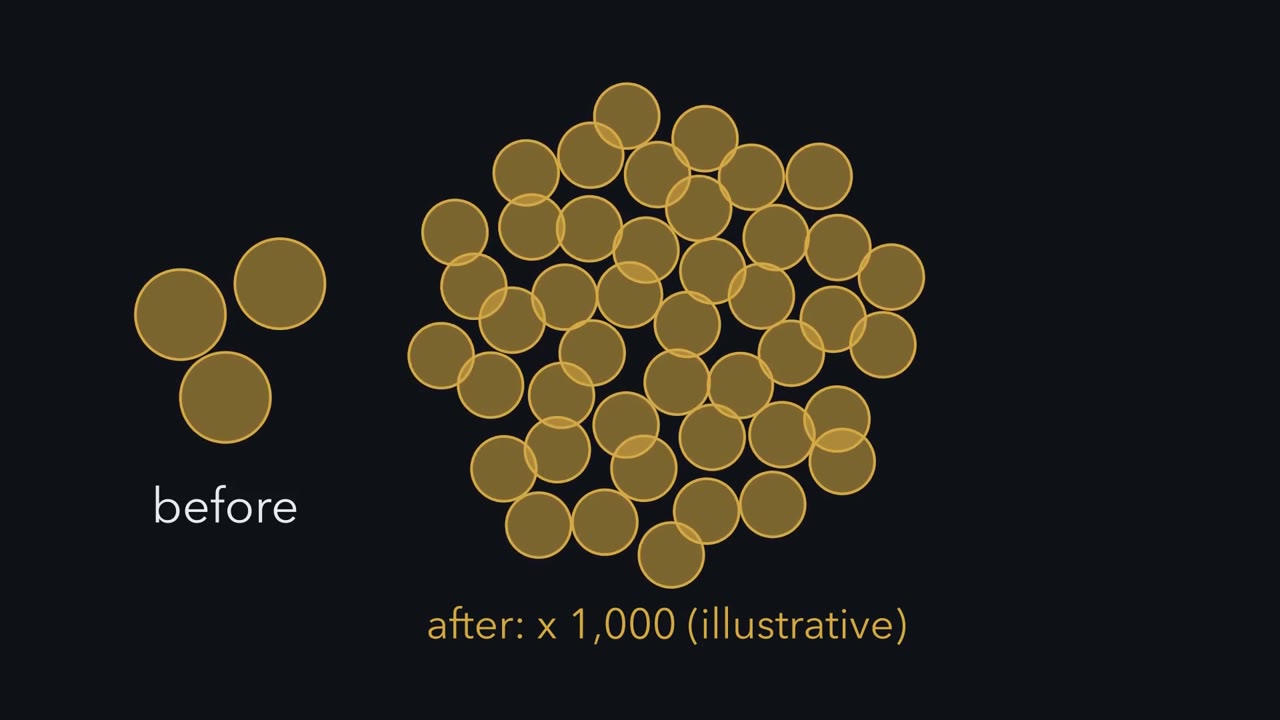
Now an antigen arrives. It drifts past B cell after B cell, and most receptors ignore it. It binds only the few whose receptors already fit. T cells need the antigen shown to them on another cell, as the text explains. Those cells divide. Their descendants form a clone, a population descended from one cell, all starting with the same receptor. The antigen did not mold that receptor. It existed before the antigen arrived. The antigen chooses; it does not shape.
How can your body already hold cells that fit a virus you have never met?
Continue in the lesson: Adaptive Immunity →
3:21 · Free, with captions and a transcript. The lesson has the full text, the questions and the sources.
More films from this lesson
How this film was made. Narration: written from this lesson's text and read by an AI narrator voice (Kokoro, af_heart). Animation: AI-generated in code (Manim) by Claude, a schematic with no drawn molecular structures. Captions come from the narration script. See something wrong? Report it.