Biology Together · Unit 2: Our senses
Smell Detectives
Rewritten on : new text and film. Your notes and highlights stay, but the text around them may have moved.
Why does food taste so dull when you have a cold? Smell cups and a pinched-nose test help a child find out.
Three real-life stories behind this activity, about 2 minutes aloud, or read them below.
The film, 4 minutes, and the safety notes, for the grown-up to look at before the activity.
The hands-on part, done with a child: about 30 minutes.
Pause when the reading reaches a film, and offer to play it. Saved on this device.
Watch the film now, or keep listening
That is the end of the reading
This idea at other levels
An activity for ages 5 to 10 about flavour.
See every levelHide the levels
This lesson also teaches one more idea; its ladder is below.
Flavour: taste plus smell
Flavour is taste from the tongue plus smell from the nose, so food tastes dull when your nose is blocked.
Taught at one level so far: ages 5 to 10.
Ages 5 to 10 · the level you chose
Smell Detectives · this lesson
Pinch your nose and two similar juices taste alike: flavour needs smell.
Biology Together · about 30 min · film 3:38 · Virginia K.5 a, K.5 b
Next door to flavour
- The sense of smellA blocked nose dulls food because most of flavour comes from smells that rise from the back of your mouth.Nearest lesson: Smell and Taste (upper-level college)
- The sense of tasteYour tongue reports only a few tastes, such as sweet and sour, and smell adds the rest.Nearest lesson: Smell and Taste (upper-level college)
The sense of smell
Your nose catches molecules from the air, and your brain reads the pattern as a smell.
Taught at three levels: ages 5 to 10, upper-level college and graduate level.
Graduate · the level you chose
One Receptor per Neuron: How Olfactory Neurons Choose
How a neuron picks one receptor gene out of a thousand and keeps it.
Sensory Systems · about 31 min · film 3:31 · 3 practice questions
From Glomeruli to Piriform Cortex
The cortex scatters the bulb's tidy map, yet similar odours stay similar.
Sensory Systems · about 31 min · film 3:21 · 3 practice questions
College, upper level · the level you chose
Hundreds of receptor types, one per neuron; the brain reads the pattern.
Neuroscience · about 30 min · film 2:42 · 3 practice questions
No lesson on the sense of smell at grade 7 or at high school yet.
Ages 5 to 10 · the level you chose
Smell Detectives · this lesson
Match smell cups, then taste with your nose pinched.
Biology Together · about 30 min · film 3:38 · Virginia K.5 a, K.5 b
Play the ladder · 3 films, about 10 min, from upper-level college to graduate level. Each film waits for you to press play.
Next door to the sense of smell
- The sense of touchAnother sense you can test at home, built on very different sensors.Nearest lesson: The Mystery Feely Bag (ages 5 to 10)
- DiffusionAn odour reaches your nose by spreading through the air.Nearest lesson: Diffusion and Osmosis (grade 7)
Short versions inside this lesson
The grade 7 version · about 1 minute to read
Later in school, children learn that smell and taste are chemical senses: they detect tiny particles called molecules. Smell cells high inside the nose catch molecules from the air and send signals to the brain. Taste cells in taste buds respond to molecules dissolved in saliva. In high school biology, students learn how a cell can recognize one particular molecule, an idea that also explains how cells respond to hormones.
The plainest version · about 1 minute to read
Your nose smells and your tongue tastes. Your tongue can tell sweet, sour, salty and bitter. But when you eat, smells from the food travel up the back of your mouth into your nose. Your brain mixes the smell and the taste together. That mix is called flavour. When your nose is blocked, a lot of the flavour goes away.
Find an idea: every idea, searchable
Which lessons teach an idea, and the notes on each level, were written by AI models from the lessons and checked by a second model. A person has not yet read every one. How we use AI
About this activity what is in it
Rewritten on : new text and film. Notes and highlights stay, but the text around them may have moved.
Before you start
- Hands-on time
- About 30 minutes
- Where
- Indoors
- Ages
- 5 to 10, with an easier and a harder version below
- Grown-up
- Stay with your child the whole time. You handle the extract bottles, poke the holes in the foil and serve the tasting foods.
What you need
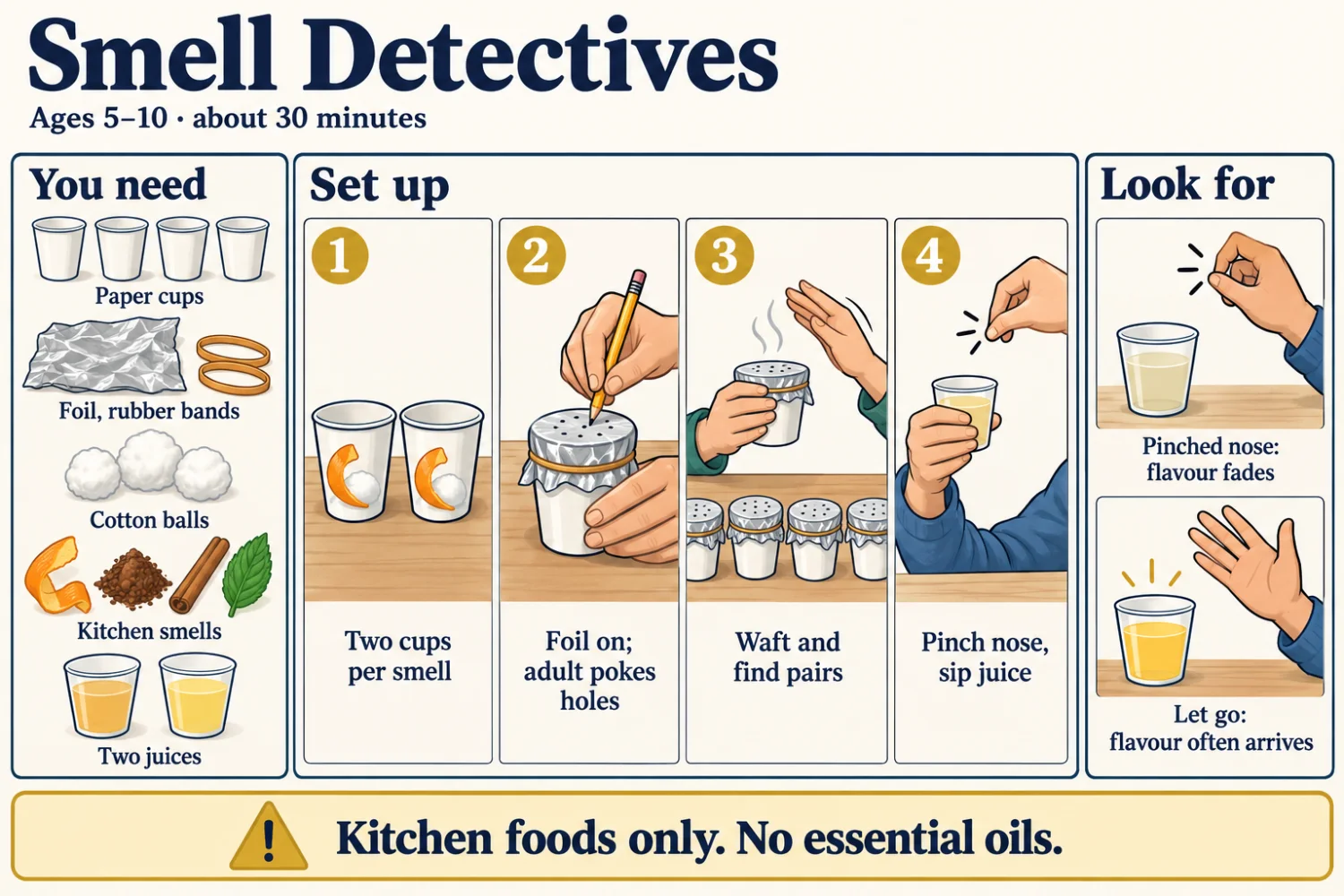
- 6 to 10 small paper cups you cannot see through, plus 2 more for the vanilla test (5 for ages 8 to 10), foil, and rubber bands
- A cotton ball for each cup and a pencil for poking holes
- 3 to 5 kitchen smells: a strip of orange or lemon peel, a teaspoon of ground coffee, a cinnamon stick, a few drops of vanilla extract, a crushed fresh mint leaf
- A marker for labels A, B, C and so on
- Two juices that look alike, such as apple and white grape, 2 tablespoons of each in small cups
- A peeled apple and a peeled pear cut into 1 cm pieces (optional)
- Water for sips between tastes
- The printed observation sheet below (optional)
Virginia science standards SOL K.5 aSOL K.5 b
In this activity. You make covered smell cups from kitchen foods, and your child matches the pairs and names each smell.
The film
 ▶ Watch Smell Detectives: Parent Guide · 3:38
Read the transcript of “Smell Detectives: Parent Guide”
Film transcript: Smell Detectives: Parent Guide
Why does food taste so dull when you have a cold? A few covered cups and a pinched nose let your child find out for themselves. This takes about thirty minutes, with kitchen foods. Your child practices describing smells in words, matching by smell alone, and checking a prediction. They find out how much of flavor comes from the nose. Stay with your child throughout. Use kitchen foods only. Skip essential oils, perfume, cleaners, and unknown liquids. Check food allergies before choosing ingredients. Skip nuts and nut products. Use latex-free bands if anyone has a latex allergy. Put a cotton ball in each paper cup you cannot see through. Add one kitchen smell to each pair.
Try orange peel, coffee, a cinnamon stick, vanilla, or a crushed mint leaf. You cover each cup with foil and a rubber band. Poke four or five holes with a pencil, with the cup on the table. Label the cups with letters and keep a secret key. Show your child how to waft. Hold a cup a hand’s width below the nose. Wave the air toward your face and sniff gently. Ask, 'Is it strong or faint?
Pleasant or not?' Mix up the cups and find the pairs. Next, guess what each smell is, then peel back the foil to check. It is common to know a smell well and still not find its name. Ask, 'Where have you smelled this before?' Make two covered vanilla cups. Add one drop to one cotton ball and six to the other. You handle the extract because it contains alcohol.
Close it and put it out of reach. Compare the smells, resting a minute between rounds. Use the smell cups only for smelling. Wash hands after handling the ingredients. Skip tasting if your child has trouble swallowing. Have them sit, take small sips, and swallow before talking. Pour two juices that look alike, such as apple and white grape, into separate small cups. Mark them one and two. Then have your child close their eyes and pinch their nose. Before your child sips, make a prediction. With their nose pinched, will they be able to tell which juice it is?
Offer a small sip. Have your child signal their guess with their fingers. Then they let go of their nose and swallow. Ask, 'What changed when you let go?' Offer water, then repeat with the other juice. As you breathe out after a sip, aromas can travel from the back of your mouth to your nose. Your brain combines smell and taste. Pinching your nose makes much of the flavor fade. Keep cotton balls, rubber bands, and other small pieces away from children under four. Call nine one one if a child is choking and cannot cough, cry, or talk. Why does food taste dull with a cold? A stuffy nose makes it harder to smell the food.
Compare what your child noticed with what you predicted.
Before you start
- Hands-on time
- About 30 minutes
- Where
- Indoors
- Ages
- 5 to 10, with an easier and a harder version below
- Grown-up
- Stay with your child the whole time. You handle the extract bottles, poke the holes in the foil and serve the tasting foods.
What you need
- 6 to 10 small paper cups you cannot see through, plus 2 more for the vanilla test (5 for ages 8 to 10), foil, and rubber bands
- A cotton ball for each cup and a pencil for poking holes
- 3 to 5 kitchen smells: a strip of orange or lemon peel, a teaspoon of ground coffee, a cinnamon stick, a few drops of vanilla extract, a crushed fresh mint leaf
- A marker for labels A, B, C and so on
- Two juices that look alike, such as apple and white grape, 2 tablespoons of each in small cups
- A peeled apple and a peeled pear cut into 1 cm pieces (optional)
- Water for sips between tastes
- The printed observation sheet below (optional)
Virginia science standards SOL K.5 aSOL K.5 b
The big idea
Hidden smell cups and a pinched-nose taste test give your child practice describing what they sense in words, matching by smell alone, and checking a prediction. Your child finds out how much of what we call flavour comes from the nose.
Say it together (read aloud): “My nose smells and my tongue tastes. When I eat, smells from the food go up into my nose. My brain mixes smell and taste into flavour.”
A child walks into a kitchen and says, “Cookies,” before seeing a single one. The nose got there first.
Smell and taste are two of the five basic senses. The nose smells and the tongue tastes. Your child uses four taste words (sweet, sour, bitter, salty) and three smell words (strong, faint, pleasant) here.
The cups hide the foods. Your child uses smell alone to match them. The taste test brings smell and taste together. When you chew, aromas travel from the back of your mouth into your nose. Your brain combines smell and taste into flavour, the full sense of what food is like. Pinch your nose and much of the flavour fades. The juices may still taste sweet or sour. Foods that seemed different can become hard to tell apart.
For teachers (Virginia standards)
Virginia’s kindergarten standard lists four tastes (sweet, sour, bitter, salty) and three smell words (strong, faint, pleasant). Your child uses all of them here.
What to do
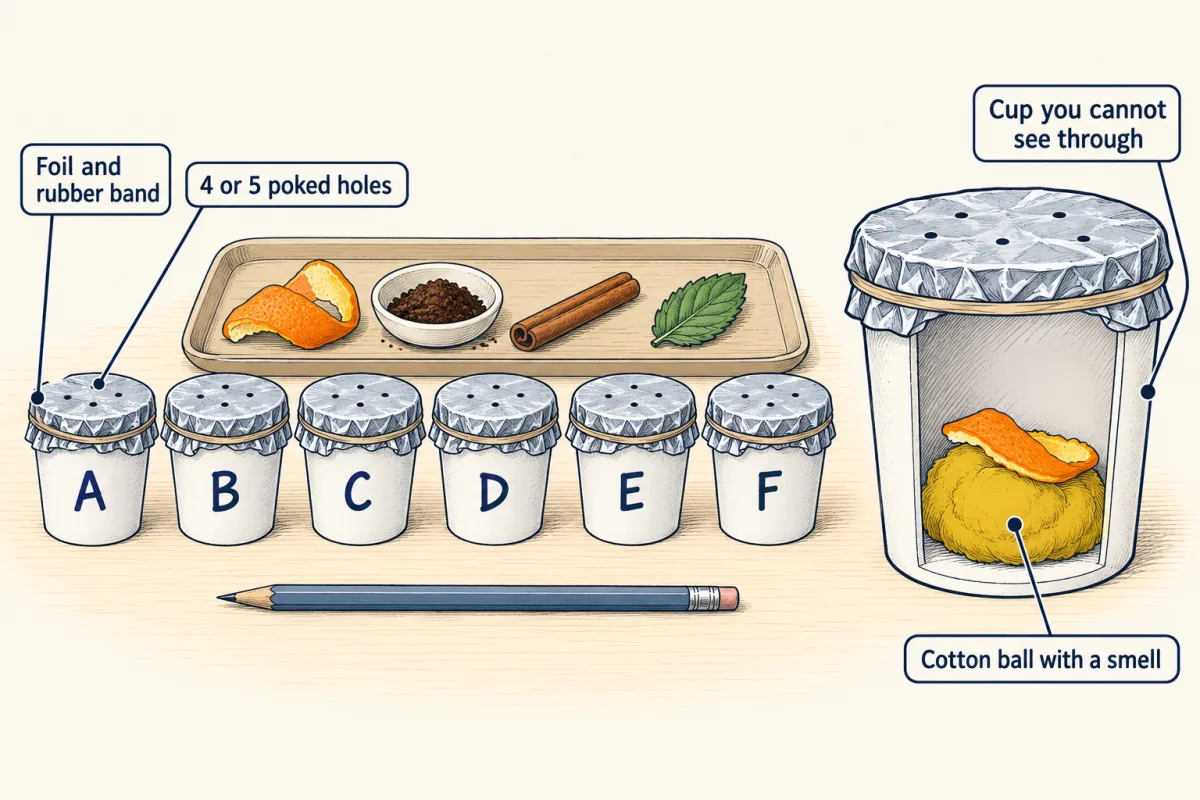
- Make the smell cups. Put a cotton ball in each cup. Add one smell to two cups each, so every smell has a pair: a strip of peel, a pinch of coffee, a piece of cinnamon stick, 3 drops of vanilla, a crushed mint leaf. Cover each cup with foil. Secure it with a rubber band or tape. Set the cup on the table. You poke 4 or 5 holes with a pencil while the cup rests on the table. Label the cups with letters and keep a secret key.
- Learn to waft. Show your child how to hold a cup a hand’s width below the nose and wave the air toward the face. Sniff gently, never hard. Say, “Detectives waft. Wave the smell toward you, then sniff gently.”
- Find the pairs. Mix up the cups. Your child smells each one and puts matching cups side by side. Ask for a describing word for each: “Is it strong or faint? Pleasant or not?”
- Name the smells. Now they guess what each smell is. Write the guesses, then peel back the foil to check. It is common to know a smell well and still not find its name. If your child gets stuck, say, “Where have you smelled this before?”
- Strong or faint. You make two new vanilla cups, one with 1 drop and one with 6 drops. Ask, “Which will smell stronger?” Then check. Rest a minute between rounds, because a smell can seem fainter after many sniffs.
- Predict the taste test. For each child, you pour the two juices into separate small cups marked 1 and 2. Ask, “If you hold your nose, will you still know which juice is which?” Write the prediction.
- Pinch and taste. With eyes closed, your child pinches their nose, takes a small sip and holds it in the mouth. “Which juice is it? Hold up 1 or 2 fingers.” Then they let go of the nose while the juice is still there, and swallow before they say anything. Many children notice more flavour arrive when the nose opens. Ask, “What changed when you let go?” Sip water and repeat with the other juice, or with apple and pear pieces while your child sits still and you watch.
- Debrief. Check the prediction you wrote in step 6, then ask two closing questions:
- “What did the juice taste like while your nose was pinched?”
- “Why do you think food tastes different when you have a cold?” Read Say it together aloud again.
Questions to ask while you do it
Ask your child to guess first, then check.
- “I wonder which cup matches this one. What words describe it?”
- “What do you think will happen when we smell the 6-drop cup?”
- “If you hold your nose, will the juice still taste sweet?”
- “What do you think will happen when you let go of your nose?”
- “Why do you think food tastes different when you have a cold?”
- “Does everyone in the family like the same smells? How could we find out?”
What children often think
-
A child might say “You taste with your tongue only.”
You could try Try the pinched-nose test and ask what changed when they let go. The tongue senses sweet, sour, salty and bitter. Much of the rest of flavour comes from smell, and taste cells also sit on the roof of the mouth and in the throat.
-
A child might say “The tip of my tongue tastes sweet and the back tastes bitter.”
You could try Use a new clean cotton swab for each child: you dip it once in sugar water and touch it to the side of their tongue, then the tip, while they sit still. Throw it away afterwards. Is it sweet both times? The "tongue map" in old books is a myth. Every part with taste buds senses all the basic tastes.
-
A child might say “Smells are good or bad.”
You could try Ask each person at home to rate the coffee cup: nice, not nice, or in between. People often disagree. Smells can be strong or faint, sweet or sharp, and liking a smell is partly a personal thing.
-
A child might say “A stronger smell means there is more of it.”
You could try For one smell that is often true, as the 1-drop and 6-drop cups show. With different things, though, a little of one can smell stronger than a lot of another. Gas companies add a strong-smelling chemical to natural gas, which has no smell, so a leak can be noticed.
Why it works
Smell starts with smell-sensing cells high inside the nose. They respond to tiny particles, called molecules, that drift off things like orange peel or coffee. Smells reach these cells two ways: through the nostrils when you sniff, and from the back of the mouth when you breathe out while chewing. The second route is how food aromas join taste.
Taste buds on the tongue, the roof of the mouth and the throat sense a short list of qualities. Virginia’s kindergarten list is sweet, sour, bitter and salty. Scientists usually add a fifth, umami, a savoury taste found in foods like broth and cheese. Without smell, many foods taste bland. Flavour also includes texture, temperature and spicy heat, so the pinched-nose test does not remove every clue.
The tongue map, with sweet at the tip and bitter at the back, came from a misreading of a 1901 study. That study found only small differences in sensitivity across the tongue.
Easier and harder
Ages 5 to 7
Use three smells (six cups) with big differences, such as orange peel, coffee and mint. Show your child the real foods first, then hide them in cups and play “find the twin.” For the taste test, use one pair of juices and do it once. Your child can draw a face for each smell (happy, so-so, yuck) instead of writing.
Ages 8 to 10
Use five smells (ten cups) and add a fair test. Give each juice three times in random order. Each time, your child holds up 1 or 2 fingers for the juice with the nose pinched, then again after letting go, and swallows before talking. Count correct answers. Make a table and a bar graph: correct with nose pinched, correct with nose open. Ask them to rank five vanilla cups (1 to 5 drops) from faint to strong without looking at the labels.
If it doesn’t go as planned
If the smells are too faint, add more of the food and wait 10 minutes for the smell to build. If your child guesses the juices right with the nose pinched, the colours or textures may differ: cover the cups and close eyes, or switch to two juices that taste more alike. A child who will not taste can be the tester for an adult instead.
Observation sheet
Here is what one filled-in row can look like:
| Cup | Strong or faint? | Do I like it? | My guess | What it really was |
|---|---|---|---|---|
| C | Strong | Yes | Candy | Mint leaf |
Observation sheet
Smell detectives
NameDate
Smell each cup. Find its twin and guess what it is.
| Cup | Strong or faint? | Do I like it? | My guess | What it really was |
|---|---|---|---|---|
With my nose pinched, the juice tasted:
When I let go of my nose, the juice tasted:
stemhop.com · Biology Together
The three stories, told aloud Side Hops: three stories that go with this lesson Side Hops
Three playful ways to talk about smell and flavour
1:46 · Narration: an AI narrator voice (Kokoro, af_heart).
Read the transcript
Hi there! If you are setting up the Smell Detectives cups at home, here are three playful ways to make the big ideas click. First, before you cover a single cup, hand your child five crayons and ask what a drawing looks like with just five colours. That is a lot like the tongue on its own: it senses five basic tastes, sweet, sour, salty, bitter, and savoury umami. Your nose, though, brings nearly four hundred kinds of smell sensors to the table. Put the two together, and simple sweet or sour turns into full flavour. Second, when you show your child how to waft, borrow a trick from a garden snake. Say, "A snake flicks its forked tongue to scoop tiny smell specks out of the air. A gentle wave of your hand sends smell specks to your nose!" Snakes really do flick their tongues to gather tiny particles. The particles then pass through tiny openings in the roof of the mouth to a pair of smell organs. Kids love that picture, and it keeps noses hovering above the foil instead of pressed against it. Finally, take the game outdoors. Next time a light rain sprinkles dry soil, step outside and stay right beside your child while you both take a slow sniff. High-speed cameras at M I T showed that raindrops landing on some kinds of soil trap tiny air bubbles. The bubbles pop and can send hundreds of tiny droplets into the air. Scientists think those droplets can carry the earthy smell into the breeze. Light and moderate rain released more of them than heavy rain did. Have fun sniffing together!
The idea underneath them. You make covered smell cups from kitchen foods, and your child matches the pairs and names each smell.
Your notes
Select any text in the lesson to highlight it or add a note to it. Your highlights and notes are saved in this browser and collected in your notebook.
This browser is not letting the site save anything (a private window or strict privacy settings), so highlights and notes will be lost when you leave the page.
Those are the stories. The idea under them is the one the lesson builds.
That is the film. The rest of the activity is the fun part.
The rest of the activity is here when you want it.
Finish line
Test yourself
4 questions
Questions to talk over together.
Next · Lesson 6
The Listening Walk
How many sounds are there in a quiet backyard? Two still minutes and a sound map help a child find out.
Continue →Rewritten on : new text and film. Notes and highlights stay, but the text around them may have moved.