Biology Together · Unit 7: Seasons and living things
Sleep, Travel or Stay?
Rewritten on : new text and film. Your notes and highlights stay, but the text around them may have moved.
Where do hummingbirds go in winter, and why does a cardinal stay? A sorting game and a window watch find out.
Three real-life stories behind this activity, about 2 minutes aloud, or read them below.
The film, 3 minutes, and the safety notes, for the grown-up to look at before the activity.
The hands-on part, done with a child: about 30 minutes, then a few quick looks later.
Pause when the reading reaches a film, and offer to play it. Saved on this device.
Watch the film now, or keep listening
That is the end of the reading
This idea at other levels
An activity for ages 5 to 10 about meeting the seasons. Next, for an older child: Daily and Seasonal Rhythms (grade 7).
See every levelHide the levels
How living things meet the seasons
Animals and plants use cues like day length and temperature to migrate, hibernate or go dormant through hard seasons.
Taught at two levels: ages 5 to 10 and grade 7.
Grade 7 · the level you chose
Migration, dormancy and hibernation: how monarchs, tree buds and groundhogs get through winter.
Life Science · about 40 min · film 3:38 · Virginia LS.8 a
Ages 5 to 10 · the level you chose
Sleep, Travel or Stay? · this lesson
Sort ten Virginia animals into travel, rest or stay, then watch the window.
Biology Together · about 30 min · film 3:13 · Virginia 2.7 a, 1.7 c, 2.5 c
Next door to meeting the seasons
- Torpor and hibernationSome animals lower their body temperature on purpose through winter to save energy.Nearest lesson: Heat Balance and Body Temperature (a first college course)
- Day length and flowering (photoperiodism)Plants measure the length of the night to tell the season and to time flowering.Nearest lesson: Auxin and Plant Hormones: How Plants Steer Growth (a first college course)
Short versions inside this lesson
The grade 7 version · about 1 minute to read
In grade 7 Life Science, students learn that migration and hibernation are seasonal rhythms, timed by signals such as day length and temperature. They study how dormancy saves energy until conditions improve. They also use long-term records to ask whether a warming climate is shifting when animals arrive, leave or wake up, and what that means for food webs.
The plainest version · about 1 minute to read
Winter is hard for animals because there is less food and it is cold. Animals have different plans. Some travel to places with more food, like hummingbirds. Some rest deeply in a safe spot and live on stored fat, like groundhogs. Others stay and change. Deer grow a thicker coat, and squirrels eat nuts they hid in fall.
Find an idea: every idea, searchable
Which lessons teach an idea, and the notes on each level, were written by AI models from the lessons and checked by a second model. A person has not yet read every one. How we use AI
About this activity what is in it
Builds on:Adopt a Tree (read)Why these?
Rewritten on : new text and film. Notes and highlights stay, but the text around them may have moved.
Before you start
- Hands-on time
- About 30 minutes, plus a 15-minute window watch, repeated in another season
- Where
- Indoors or outdoors
- Ages
- 5 to 10, with an easier and a harder version below
- Grown-up
- Stay with your child for the whole activity, and stay beside them for any outdoor watch. Nobody touches wild animals, and a bird feeder, if you use one, is an adult job.
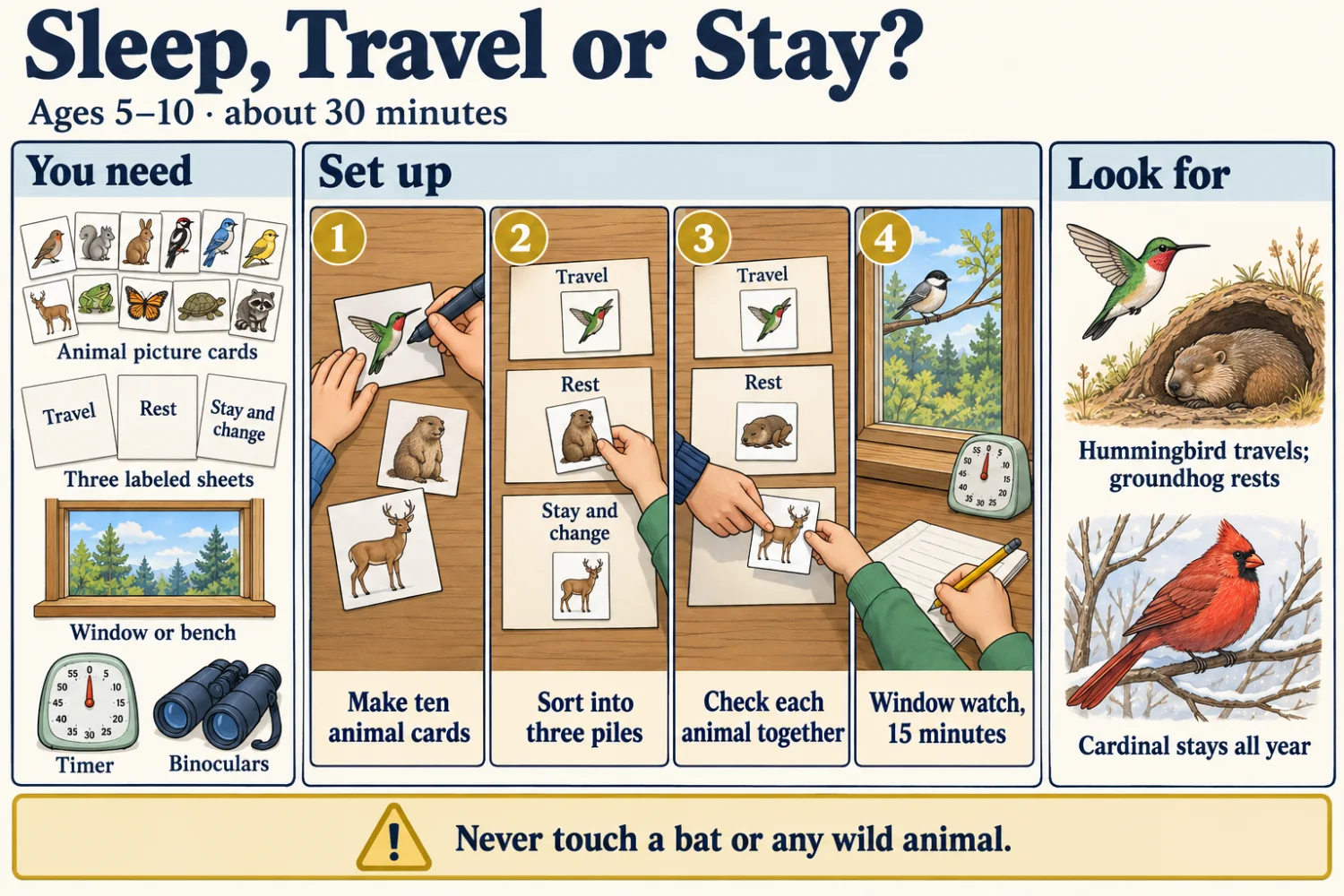
What you need
- 10 picture cards of animals, drawn by hand, printed, or cut from old magazines (list in step 1)
- Three sheets of paper labeled Travel, Rest and Stay and change
- A window with a view of trees, a yard or the sky, or a bench outside
- A clock or timer
- Binoculars (optional)
- A bird feeder (optional; only in winter, see the safety notes)
- Paper and a pencil, or the printed observation sheet below
Virginia science standards SOL 2.7 aSOL 1.7 cSOL 2.5 c
The main idea. A sorting game with picture cards of Virginia animals, then a 15-minute window watch.
The film
 ▶ Watch Sleep, Travel or Stay? A Parent Guide · 3:13
Read the transcript of “Sleep, Travel or Stay? A Parent Guide”
Film transcript: Sleep, Travel or Stay? A Parent Guide
Why does a cardinal stay when hummingbirds leave for winter? Use a card sort and a window watch to explore that with your child. Your child practices sorting with reasons and changing a guess when new evidence comes in. They also count what they see and compare seasons. This takes about thirty minutes, plus a fifteen-minute window watch. Draw, print, or cut out ten animal cards. Label them with these names. Ruby-throated hummingbird, monarch butterfly, tundra swan, groundhog, and bat. Eastern box turtle, wood frog, white-tailed deer, gray squirrel, and northern cardinal. Lay out the three sheets: Travel, Rest, and Stay and change. Let your child sort the cards with no help.
Ask, 'How did you decide?' Write the reasons down, and don't correct anything yet. Now a question for you. Hummingbirds leave Virginia in fall, but cardinals stay all year. What do you predict is the main reason? Cold matters, but food is a big reason. Hummingbirds eat nectar and insects, and those run out in a Virginia winter. So they travel to where food is.
Cardinals stay all year and fluff their feathers in the cold. Use the guide’s animal list to check each card together. Ask, 'Where do you think this one goes?' Let your child move cards. Groundhogs hibernate in burrows. Deer grow a winter coat. Gray squirrels dig up buried nuts. When a card moves, ask, 'What made you change your mind?' Tundra swans are a fun surprise. They nest in the Arctic and fly thousands of miles south to spend winter here. Sit at the window for fifteen minutes. Have your child predict how many kinds of birds you will see. Write down their guess. Tally the birds of each kind and note what they do. An empty yard is a result too.
Stay with your child for the whole activity. Nobody touches a wild animal, alive or dead. Never touch a bat, even one that seems asleep or hurt. Bats can carry rabies. Leave resting turtles and frogs covered where you find them. Use a feeder only in winter. An adult handles it and washes hands after touching it or the seed. Keep birdseed away from children under four. If a child is choking, call nine one one. Repeat the window watch in another season, at the same time of day. Compare the two sheets. Which kinds did you see both times? Which did you see only once? Think about what food was available in each season.
Before you start
- Hands-on time
- About 30 minutes, plus a 15-minute window watch, repeated in another season
- Where
- Indoors or outdoors
- Ages
- 5 to 10, with an easier and a harder version below
- Grown-up
- Stay with your child for the whole activity, and stay beside them for any outdoor watch. Nobody touches wild animals, and a bird feeder, if you use one, is an adult job.
What you need
- 10 picture cards of animals, drawn by hand, printed, or cut from old magazines (list in step 1)
- Three sheets of paper labeled Travel, Rest and Stay and change
- A window with a view of trees, a yard or the sky, or a bench outside
- A clock or timer
- Binoculars (optional)
- A bird feeder (optional; only in winter, see the safety notes)
- Paper and a pencil, or the printed observation sheet below
Virginia science standards SOL 2.7 aSOL 1.7 cSOL 2.5 c
The big idea
A sorting game and a window watch give your child practice sorting with reasons, changing a guess when new evidence comes in, and counting what they see. Your child finds out that winter is hard for animals mostly because food runs short, and that each animal has its own plan: travel, rest deeply, or stay and change.
Say it together (read aloud): “Winter is hard for animals because food runs short. Some travel to find food, and some rest deeply. Others stay and change.”
Your child has probably noticed that some birds disappear in winter and others stay at the feeder. Winter is hard for animals mainly because food runs short, and staying warm uses energy. Each kind of animal has its own way of getting through.
Some animals travel to places with more food and come back later. This is migration. Some rest deeply in a sheltered spot and live on stored fat. In hibernation, an animal’s body cools and its heartbeat slows far below normal sleep. Turtles and frogs go dormant: their bodies cool with the weather and they barely move until spring. Other animals stay active and change: thicker coats, food stored in fall, or a new diet.
For teachers (Virginia standards)
Grade 1 children only need the plain words “travel,” “rest” and “stay and change.” Grade 2 adds the terms migrate, hibernate and dormancy, and asks how food supply changes behavior through the year.
What to do
- Make the cards. Draw, print or cut out 10 animals: ruby-throated hummingbird, monarch butterfly, tundra swan, groundhog, bat, eastern box turtle, wood frog, white-tailed deer, gray squirrel and northern cardinal. Write the name on each card.
- First guess. Lay out the three sheets: Travel, Rest and Stay and change. Ask your child to sort the cards with no help. Ask, “How did you decide?” Write down their reasons. Don’t correct anything yet. Say, “These are our first guesses. We’ll check each one.”
- Check each animal. Go through the cards together, using the list below. Let your child move cards as they learn. Ask before each one, “Where do you think this one goes?” When a card moves, ask, “What made you change your mind?”
- Travel. Hummingbirds leave Virginia in late summer and fall and spend winter from Mexico to Central America. Monarchs fly to mountain forests in central Mexico. Tundra swans come the other way: they nest in the Arctic and fly thousands of miles south to spend winter on Virginia’s rivers and bays.
- Rest. Groundhogs hibernate in burrows. Many Virginia bats hibernate in caves, mines or buildings, though some kinds fly south instead. Box turtles dig into soil. Wood frogs, found mostly in northern and western Virginia, lie under dead leaves and can partly freeze.
- Stay and change. Deer stay and grow a grayish-brown winter coat. Gray squirrels bury nuts in fall and dig them up in winter. Cardinals stay all year and fluff their feathers in the cold. Ask, “Why do you think the cardinal can stay when the hummingbird leaves?”
- Window watch. Sit at a window or outside for 15 minutes. Before you start, ask, “How many kinds of birds do you think we’ll see?” Write the guess down. Count how many birds of each kind you see and note what they are doing. The count depends on the season, the time of day and what grows nearby. An empty yard is a result too.
- Watch again later. Repeat the watch in another season, at the same time of day. Compare the two sheets. Which birds were there both times? Which ones came or went?
- Debrief. Ask two closing questions:
- “Why is winter hard for animals?”
- “Pick one card. What is that animal’s winter plan?” Read Say it together aloud again.
Questions to ask while you do it
Ask your child to guess first, then check.
- “I wonder what a hummingbird would eat here in January. What do you think?”
- “Why do you think the cardinal can stay when the hummingbird leaves?”
- “What do you think a groundhog eats all winter?”
- “If Virginia is ‘south’ for tundra swans, where do you think their summer home is?”
- “Which birds do you think we’ll see this time that we didn’t see last time?”
- “What do you think would happen to a squirrel that forgot where it buried its nuts?”
What children often think
-
A child might say “Birds fly south because they’re cold.”
You could try Ask, "What do hummingbirds eat? Are there flowers in January?" Cold matters, but food is a big reason. Many birds that leave could handle the cold. Their nectar and insects run out, so they go where food is.
-
A child might say “All birds fly south for winter.”
You could try Check the window watch in winter. Cardinals, crows and many other birds stay all year. Tundra swans even fly south to Virginia, so for them Virginia is the warm winter home.
-
A child might say “All animals hibernate in winter.”
You could try Ask, "Have you seen a squirrel in winter? A deer?" Many animals stay active. Bears are a tricky case. Virginia’s black bears spend much of winter in dens without eating, but they wake easily and may walk out on warm days.
-
A child might say “Hibernating animals are just asleep.”
You could try Ask, "When you sleep, do you get cold? Does your heart nearly stop?" A hibernating groundhog can cool to a few degrees above freezing, and its heart slows to just a few beats a minute. It is much deeper than sleep.
Why it works
Winter cuts the food supply for many animals. Insects, nectar and fresh leaves disappear. At the same time, staying warm burns more energy. Each strategy solves that problem a different way.
Migrating animals move to where food is. Changing day length and an inner yearly clock tell many birds when to fatten up and leave, so they go before food runs out. Weather and food can shift the exact day. Monarchs that fly south in fall are a special late-summer generation that lives for months; in spring they start back north and lay eggs, and their descendants finish the trip over several generations.
True hibernators, like groundhogs and many bats, lower their body temperature and heart rate and live on stored fat. Groundhogs still warm up and wake briefly from time to time during the winter. Cold-blooded animals, such as box turtles and wood frogs, cool to the temperature around them and become dormant. Wood frogs survive partial freezing because their liver releases sugar into the blood, which protects their cells from ice.
Animals that stay rely on thick coats, fat, stored food and switching to foods like seeds and bark.
Easier and harder
Ages 5 to 7
Use six cards: hummingbird, monarch, groundhog, box turtle, squirrel and deer. Use the plain words “travel,” “rest” and “stay.” Let your child act each one out: flap away, curl up, or scurry and dig. For the window watch, draw the birds you see and make a tally mark each time one lands.
Ages 8 to 10
Use all 10 cards and add the words migrate, hibernate and dormant. Add a fourth pile, “comes here for winter,” for tundra swans. Make a bar graph of how many birds of each kind you saw. Repeat the watch in winter and in spring at the same time of day, then compare the graphs and explain one difference using food.
If it doesn’t go as planned
If no birds come, try early morning or the hour before sunset, when many birds feed. Sit still and quiet for the first five minutes. If your child can’t name a bird, have them describe it: size compared with a sparrow or a crow, main color, and what it was doing. A drawing is enough. If cards end up in “wrong” piles, ask what evidence would settle it rather than giving the answer.
Observation sheet
Here is what one filled-in row can look like on a winter watch:
| Animal I saw | How many? | What was it doing? |
|---|---|---|
| Cardinal | 2 | Feathers fluffed, sitting in a bush |
Observation sheet
Window watch
NameDate
Watch for 15 minutes. Write or draw each animal you see.
| Animal I saw | How many? | What was it doing? |
|---|---|---|
Date, time and weather:
What changed since my last watch?
stemhop.com · Biology Together
The three stories, told aloud Side Hops: three stories that go with this lesson Side Hops
Three playful ways to talk about winter plans
1:37 · Narration: an AI narrator voice (Kokoro, af_heart).
Read the transcript
Winter animals make a wonderful chat with your child, because you can tie each plan to things they already know.
Start with the tiny travelers. If your child wonders how a little ruby-throated hummingbird makes its long trip south, try saying, "A hummingbird does not pack a suitcase. It packs its own fuel tank." A ruby-throated hummingbird that takes the route across the Gulf of Mexico can nearly double its weight before takeoff. Then it can fly about five hundred miles over open water without stopping. A bird fueling up like a tiny airplane before takeoff is an image many kids enjoy.
Next, during your window watch, look together for a bird that has puffed itself up round on a branch. Those fluffed feathers trap a layer of warm air right next to its skin, a lot like a down vest. On cold days, resting birds often tuck their bare feet up into their belly feathers, so make a game of spotting a bird with hidden feet.
Finally, the next time you help your child zip a raincoat over a fleece sweater, tell them white-tailed deer wear the very same two-layer outfit. Long, hollow outer hairs help keep water out, while the thick, soft fur underneath holds warm air close to the skin. It works so well that snow can sit on a deer's back without melting.
Keep it playful, follow your child's questions, and enjoy spotting winter plans together, from the window or right beside each other outdoors.
The idea underneath them. A sorting game with picture cards of Virginia animals, then a 15-minute window watch.
Your notes
Select any text in the lesson to highlight it or add a note to it. Your highlights and notes are saved in this browser and collected in your notebook.
This browser is not letting the site save anything (a private window or strict privacy settings), so highlights and notes will be lost when you leave the page.
Where this lesson fits
Before thisReview first
- Adopt a TreeThis course · Lesson 25
Watching one tree through the seasons shows how winter changes what living things can find to eat.
After thisStudy next
- Adaptations for SurvivalOne level up · Life Science
It takes the idea of winter coats and changing behavior further, with a hare whose color must match the season.
Suggested by an AI model from the lessons themselves, then checked. How we use AI
Those are the stories. The idea under them is the one the lesson builds.
That is the film. The rest of the activity is the fun part.
The rest of the activity is here when you want it.
Finish line
Test yourself
4 questions
Questions to talk over together.
Next · Lesson 27
Hidden Leaf Colors
Where does the yellow in a fall leaf come from? A sample coffee-filter strip shows that it was there all along.
Continue →Rewritten on : new text and film. Notes and highlights stay, but the text around them may have moved.