Biology Together · Unit 8: Virginia and Chesapeake nature
Roots Hold the Soil
Rewritten on : new text and film. Your notes and highlights stay, but the text around them may have moved.
Why does a muddy stream run brown after a storm? Two trays of soil and a watering can show where the mud comes from.
Three real-life stories behind this activity, about 2 minutes aloud, or read them below.
The film, 3 minutes, and the safety notes, for the grown-up to look at before the activity.
The hands-on part, done with a child: about 35 minutes, then a few quick looks later.
Pause when the reading reaches a film, and offer to play it. Saved on this device.
Watch the film now, or keep listening
That is the end of the reading
This idea at other levels
An activity for ages 5 to 10 about erosion. Next, for an older child: Helping Ecosystems Recover (grade 7).
See every levelHide the levels
Erosion (soil washing away)
Rain and wind carry soil away from bare ground, and plant roots and leaves slow it down.
Two levels here: ages 5 to 10 and grade 7. The lesson at grade 7 was picked by hand for this lesson.
Grade 7 · the level you chose
Helping Ecosystems Recover · also at this level, picked for this lesson
Life Science · about 40 min · Virginia LS.9 c
Ages 5 to 10 · the level you chose
Roots Hold the Soil · this lesson
Bare tray versus grass tray: same pour, muddy cup versus clear cup.
Biology Together · about 35 min · film 3:27 · Virginia 2.8 c, 2.7 b, 2.7 c, 3.8 c, 3.8 d, 4.8 d
Next door to erosion
- What soil is made ofErosion carries away the top layer of soil, which is the part that holds dead plants and nutrients.Nearest lesson: Soil Shake (ages 5 to 10)
- Watersheds and dead zonesSoil washed off bare ground carries fertilizer into creeks and bays.Nearest lesson: A Watershed in a Pan (ages 5 to 10)
Also at grade 7: People Change Habitats
Short versions inside this lesson
The grade 7 version · about 1 minute to read
In grade 7 Life Science, children study how people change habitats and how careful work can help a damaged ecosystem recover. One example is how protecting nesting forests and banning a harmful pesticide helped Virginia’s bald eagles come back. Planting trees and grasses along streams to hold soil is the same kind of repair, and it keeps mud out of rivers and the Chesapeake Bay.
The plainest version · about 1 minute to read
When rain falls on bare dirt, it splashes the dirt loose and carries it away. That is called erosion. Plants help stop it. Their leaves catch the raindrops, and their roots grip the soil like lots of tiny fingers. Soil takes a very long time to make, so plants help us keep it where it belongs.
Find an idea: every idea, searchable
Which lessons teach an idea, and the notes on each level, were written by AI models from the lessons and checked by a second model. A person has not yet read every one. How we use AI
About this activity what is in it
Builds on:Soil Shake (read)A Watershed in a Pan (read)Why these?
Rewritten on : new text and film. Notes and highlights stay, but the text around them may have moved.
Before you start
- Hands-on time
- About 35 minutes, plus 2 to 3 weeks ahead to grow grass from seed, unless you use a piece of sod; and an optional walk after the next rain
- Where
- Outdoors
- Ages
- 5 to 10, with an easier and a harder version below
- Grown-up
- Stay with your child the whole time. You do all the cutting, and you lift the trays once they are wet.
What you need
- 2 matching containers: half-gallon milk or juice cartons laid on their sides with one long side cut away, or 2 small foil baking pans
- Bagged topsoil or garden soil, enough to fill each container about 5 cm (2 inches) deep
- Grass for one container: a piece of sod from a garden centre, or a handful of grass seed sown 2 to 3 weeks ahead
- Scissors or a craft knife (adult only)
- 2 clear plastic cups or jars (not glass) to catch the runoff
- A watering can, or a plastic cup with a few holes poked in the bottom
- A measuring cup
- Books, bricks or blocks to raise one end about 5 to 8 cm
- A ruler and a trowel or old spoon
Virginia science standards SOL 2.8 cSOL 2.7 bSOL 2.7 cSOL 3.8 cSOL 3.8 dSOL 4.8 d
In this activity. You set up two sloped trays of soil, one bare and one covered in grass, and pour the same "rain" on both.
The film
 ▶ Watch Roots Hold the Soil: Parent Guide · 3:27
Read the transcript of “Roots Hold the Soil: Parent Guide”
Film transcript: Roots Hold the Soil: Parent Guide
After a storm, a stream can run brown with mud. Where does that mud come from? Two trays of soil and a watering can will show you. Once the trays are ready, the test takes about thirty-five minutes. Your child makes a guess and compares the cups after giving both trays the same rain. They practice explaining what the cups show. Stay with your child throughout. Use bagged soil and plain, untreated seed. Sow it thickly in one tray two to three weeks ahead. Keep it moist in a sunny spot. Or press sod into the tray that day. Fill the bare tray with bagged soil about five centimeters deep. If you grew grass from seed, use the same bagged soil in both trays.
You cut a small notch at the low end of each. Raise the other ends on books, to the same height. Set a clear plastic cup under each notch. Give both trays the same slope and the same rain. One tray is bare, and the other has grass. Ask your child, 'Which cup will get more mud?' Write the guess down before you pour. For gentle rain, hold the watering can about twenty centimeters above the high end. Pour two cups over about thirty seconds. Repeat with the same amount, height, and speed. What do you predict the cups will look like?
The bare tray's runoff is usually cloudier. The grass tray's cup often has less water. Ask, 'Where did the soil in this cup come from?' Check the guess. After ten minutes, measure the settled soil with a ruler. Empty the cups. Pour two fresh cups onto each tray, taking about five seconds per tray. Look for small channels called rills. After ten minutes, measure the settled soil again. Lift the grass with a spoon to see the roots. Leaves and stems soften the impact of falling drops. Roots grip the soil and help water soak in. On bare soil, raindrops can knock grains loose. Water flowing downhill can carry those grains into the cup. Stay with your child.
You do the cutting and lift the wet trays. Keep small pieces and seed away from children under four. Call nine one one if choking. Never taste plants, soil, or seed. Wash hands with soap and water afterward. For an optional walk, check the weather and choose shade or use sun protection. Wait until rain stops and at least thirty minutes after the last thunder. Stay together on a dry path where you have permission. Stay away from roads, storm drains, steep crumbling banks, and bodies of water. Never walk through floodwater. At a bare patch, ask, 'How could we fix it?' Check for ticks afterward. Wash hands with soap and water after handling soil or plants.
Before you start
- Hands-on time
- About 35 minutes, plus 2 to 3 weeks ahead to grow grass from seed, unless you use a piece of sod; and an optional walk after the next rain
- Where
- Outdoors
- Ages
- 5 to 10, with an easier and a harder version below
- Grown-up
- Stay with your child the whole time. You do all the cutting, and you lift the trays once they are wet.
What you need
- 2 matching containers: half-gallon milk or juice cartons laid on their sides with one long side cut away, or 2 small foil baking pans
- Bagged topsoil or garden soil, enough to fill each container about 5 cm (2 inches) deep
- Grass for one container: a piece of sod from a garden centre, or a handful of grass seed sown 2 to 3 weeks ahead
- Scissors or a craft knife (adult only)
- 2 clear plastic cups or jars (not glass) to catch the runoff
- A watering can, or a plastic cup with a few holes poked in the bottom
- A measuring cup
- Books, bricks or blocks to raise one end about 5 to 8 cm
- A ruler and a trowel or old spoon
Virginia science standards SOL 2.8 cSOL 2.7 bSOL 2.7 cSOL 3.8 cSOL 3.8 dSOL 4.8 d
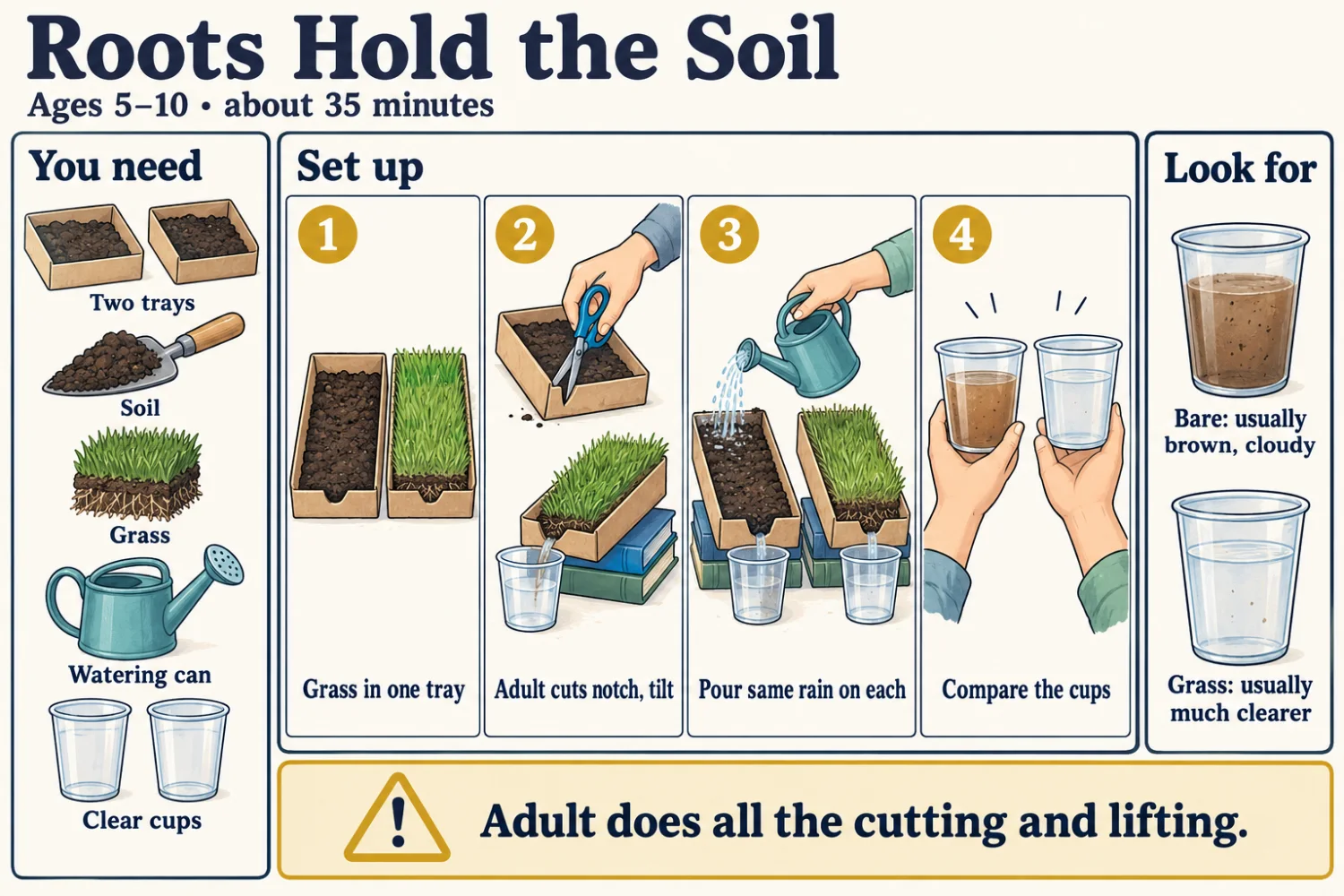
The big idea
Two trays, the same rain, two cups to compare. Your child practices making a guess, giving both trays the same rain and checking the guess against what the cups show. For a fair test of what grass changes, grow the grass from seed in the same soil used in the bare tray. Your child finds out that plants hold soil in place.
Say it together (read aloud): “Rain can wash bare dirt away. Leaves catch the raindrops. Roots grip the soil and keep it in place.”
After a hard rain, look at a bare patch of dirt next to a lawn. The bare patch often has little channels and a fan of mud at the bottom. The grass beside it looks the same as before. That difference is the whole activity.
Rain and wind move soil from one place to another. This is called erosion. Plants slow it down. Leaves and stems catch falling drops before they hit the ground. Roots grip the soil and help water soak in instead of running off.
Erosion can be fast, like a flood or mudslide, or slow, like a beach wearing away a little each year. Soil forms very slowly, so it is worth keeping. Muddy runoff also carries soil into streams and, in much of Virginia, the Chesapeake Bay.
For teachers (Virginia standards)
Virginia’s standards ask grade 2 children to model how plants reduce the effects of wind and water. Grade 3 and 4 children go further and plan ways to cut erosion in their schoolyard or neighbourhood.
What to do
- Grow the grass (2 to 3 weeks ahead). Fill one container with damp soil and sprinkle grass seed thickly on top. Perennial ryegrass is one of the fastest lawn grasses to sprout. Keep it moist in a sunny spot. Ryegrass usually sprouts in 3 to 10 days; some grasses, such as Kentucky bluegrass, can take up to a month. Or skip this step and press a piece of sod into the container on the day.
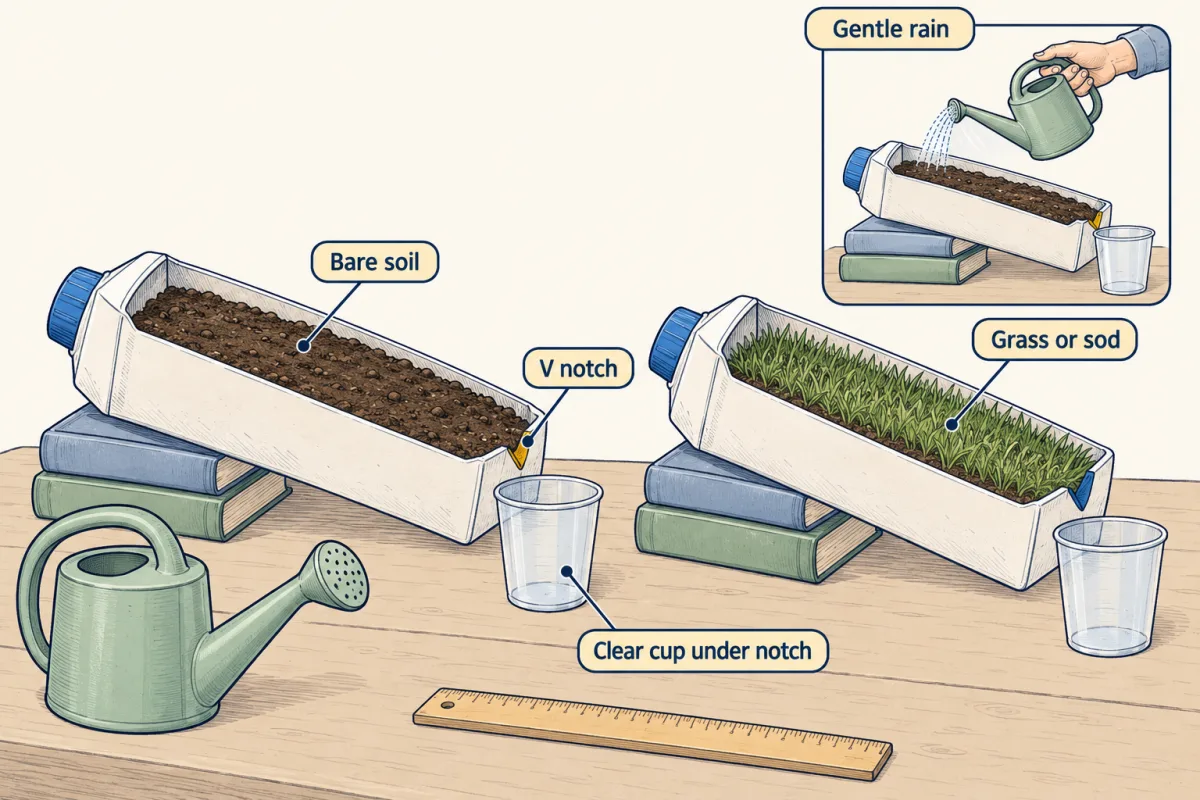
- Set up the slopes. Fill the second container with the same soil to the same depth, about 5 cm. You cut a small V notch at the low end of each container so water can pour out; a child does not use the scissors or craft knife. Set the notched end of each just over the edge of a table, step or low wall, and raise the other end on books, both to the same height. Set a clear cup below each notch. Say, “We give both trays the same slope and the same rain. One tray is bare, and the other has grass.”
- Predict. Ask your child, “Which cup will get more mud? Which will get more water?” Write both guesses down before any water is poured. Any guess is fine; the cups will check it.
- Gentle rain. Measure 2 cups (about 500 mL) of water into the watering can. Pour it slowly over the high end of the bare tray, from about 20 cm up, over about 30 seconds. Do the same for the grass tray. Use the same amount, height and speed for both.
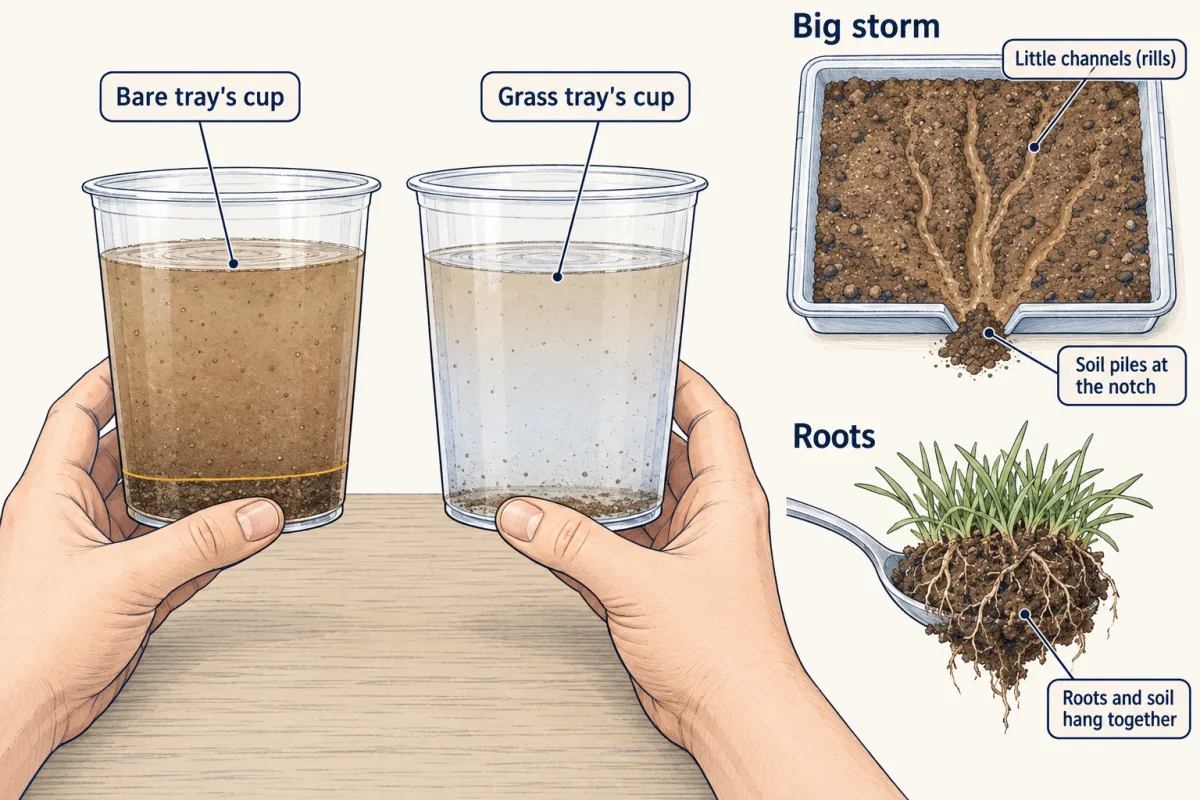
- Compare the cups. Hold both cups up to the light. The bare tray’s cup is usually brown and cloudy. The grass tray’s cup is usually much clearer, and often has less water in it. Ask, “Where did the soil in this cup come from?” Then check the guess together: “Which cup did you pick? What do the cups say?” Let the cups sit 10 minutes, then measure the layer of soil on the bottom with a ruler.
- Big storm. Empty the cups. Ask, “What do you think will happen if we pour much faster?” Pour 2 more cups onto each tray, this time in about 5 seconds. Look at the bare soil for little channels, called rills, and for soil piling up at the notch. Then let the cups sit 10 minutes and measure the soil layers again.
- Look at the roots. Lift one edge of the grass with a spoon. Look at how the roots and soil hang together in one clump. Ask, “What do you think the roots are doing under the grass?”
- Erosion walk. After the next rain, walk around your yard, schoolyard or park. Find bare spots, gullies or mud washed onto a sidewalk. Ask your child how to fix each one: plant grass, spread mulch, or put down leaves.
- Debrief. After comparing the cups, ask two closing questions:
- “Which tray lost more soil? How do you know?”
- “What did the grass do to keep its soil?” Read Say it together aloud again.
Questions to ask while you do it
Ask your child to guess first, then check.
- “I wonder which cup will look muddier. Why do you think so?”
- “What do you think will happen if we pour much faster?”
- “Where did the soil in this cup come from?”
- “What do you think the roots are doing under the grass?”
- “If this muddy water ran into a creek, what might it do to the animals there?”
- “Where outside have you seen bare dirt? What could we plant there?”
What children often think
-
A child might say “The grass tray will make more mud because it has more stuff.”
You could try That is a fair guess, so test it. Write it down, pour, and hold the two cups side by side. Then lift the grass and look at the roots. Roots wrap around the soil and hold it in a clump.
-
A child might say “Rocks and dirt never move.”
You could try Ask where the mud in the cup came from a minute ago. Then look for sand on a sidewalk after rain or a muddy stream. Soil moves all the time, sometimes quickly in a storm and sometimes slowly over years.
-
A child might say “Rain only hurts the soil in big storms.”
You could try Look at the gentle-rain cup from the bare tray. Was there any soil in it? Small rains move a little soil each time. Over many rains, that adds up to a lot, which is why slow erosion matters too.
-
A child might say “The grass drinks up the mud.”
You could try Ask, "Did the mud go into the grass, or did it never leave the tray?" Lift the grass and look. The soil stayed in place because roots and leaves held it, not because the plants took it in.
Why it works
A falling raindrop hits bare soil hard enough to knock grains loose and splash them up. Loose grains then ride away in the thin sheet of water running downhill. Plant leaves and stems take the impact first, so the drops reach the soil more gently. Roots bind the soil together and leave small channels that help water soak in, so there is less runoff to carry soil away.
A faster pour moves more water across the surface at once, so it carries more soil and cuts rills. Farmers, road crews and stream restoration teams use the same idea when they plant cover crops, grass strips and trees along streams. Rows of trees called windbreaks slow the wind across fields and keep dry soil from blowing away. Soil forms slowly from rock and rotting plants: an inch of topsoil can take hundreds of years.
Easier and harder
Ages 5 to 7
Do only the gentle rain and the root look. Skip measuring. Ask your child to point to the muddier cup and tell you which tray it came from. Let them draw the two cups with crayons, one brown and one clear. On the walk, find one bare spot and one grassy spot and compare them.
Ages 8 to 10
Add a third tray covered with a layer of dead leaves or mulch, and keep everything else the same. Measure the water in each cup in mL and the soil layer in mm, and make a bar graph of the soil layers. Have your child write which tray lost the most soil and why. Then pick one bare spot at home or school, draw a plan to fix it, and check it after the next three rains.
If it doesn’t go as planned
If almost no water comes out of either tray, the soil was dry and soaked it all up. Water both trays the day before so they start equally damp. If the grass seed grew thin and patchy, the difference between the cups will be smaller; use sod or sow the seed more thickly. If water runs over the sides, make the V notch deeper or tip the trays less.
Observation sheet
Here are sample observations for the gentle rain. Add the soil measurements from your own cups.
| Rain | Tray | Muddy or clear? | Soil in the bottom (mm) |
|---|---|---|---|
| Gentle rain | Bare | Brown and cloudy | Measure with the ruler |
| Gentle rain | Grass | Much clearer | Measure with the ruler |
Observation sheet
Roots hold the soil
NameDate
Pour the same rain on both trays. Look at each cup.
| Rain | Tray | Muddy or clear? | Soil in the bottom (mm) |
|---|---|---|---|
| Gentle rain | |||
| Gentle rain | |||
| Big storm | |||
| Big storm |
The tray that lost more soil was:
I think this happened because:
stemhop.com · Biology Together
The three stories, told aloud Side Hops: three stories that go with this lesson Side Hops
Three playful ways to talk about roots and rain
1:45 · Narration: an AI narrator voice (Kokoro, af_heart).
Read the transcript
Before you pick up the watering can, here are three easy ways to make this muddy little experiment stick.
First, while you pour onto the grass tray, try calling the leaves the dirt's umbrella. Kids get that picture right away. Big trees do the same job. In one Forest Service study in Southern California, a medium-sized tree was estimated to catch about two thousand three hundred eighty gallons of rain in a year. All those leaves help shield the soil below. Grass leaves do that for your tray, which is one reason the grass tray stays calmer than the bare one.
Second, ask your child a silly question: if you were a tiny grain of dirt on bare ground, what would a big raindrop feel like? You might hear a splash, a wave, or a water balloon. All good answers. Then share the real number. The biggest raindrops can fall at about twenty miles an hour, and when they land on bare dirt, they can splash grains of it right up into the air.
Finally, take the idea outside on your next park walk. Find a park path away from roads that passes under a big tree's outer branches, and count big steps together as you walk away from the trunk. Many people picture roots stopping right under the trunk, so this is a fun surprise: a tree's big roots usually grow in the top eighteen inches of soil, and some trees' roots spread four times as wide as the branches above. Your child may be standing right on top of them.
Keep it light, let your child guess first, and enjoy getting a little muddy together.
The idea underneath them. You set up two sloped trays of soil, one bare and one covered in grass, and pour the same "rain" on both.
Your notes
Select any text in the lesson to highlight it or add a note to it. Your highlights and notes are saved in this browser and collected in your notebook.
This browser is not letting the site save anything (a private window or strict privacy settings), so highlights and notes will be lost when you leave the page.
Where this lesson fits
Before thisReview first
- Soil ShakeThis course · Lesson 23
You see what soil is made of there, so you know what is washing away here.
- A Watershed in a PanThis course · Lesson 28
You watch rain run downhill there, and this lesson shows what that water carries along.
After thisStudy next
- Creek CrittersThis course · Lesson 30
Muddy runoff ends up in creeks, so you can see what lives in the water it reaches.
Elsewhere on the siteFilms, simulations and method films in other courses
- Two Sides of Every EcosystemFilm · Life Science
Nonliving conditions such as muddy water help decide which living things can survive in a stream.
Suggested by an AI model from the lessons themselves, then checked. How we use AI
Those are the stories. The idea under them is the one the lesson builds.
That is the film. The rest of the activity is the fun part.
The rest of the activity is here when you want it.
Finish line
Test yourself
4 questions
Questions to talk over together.
Next · Lesson 30
Creek Critters
Is a creek just water? A strainer, a white tray and a few turned rocks show what lives in it.
Continue →Rewritten on : new text and film. Notes and highlights stay, but the text around them may have moved.