Physiology · Skim version
Pregnancy, Birth and Lactation
Read the full lesson → Skim the whole course →
The guiding idea
In the minutes after birth, a newborn's lungs go from taking a small share of the heart's output to carrying nearly all that the right ventricle pumps. What has to change for blood to make that turn?
In the minutes after birth, a newborn's lungs go from taking a small share of the heart's output to carrying nearly all that the right ventricle pumps.
-
The placenta: the fetus’s lung, gut and kidney
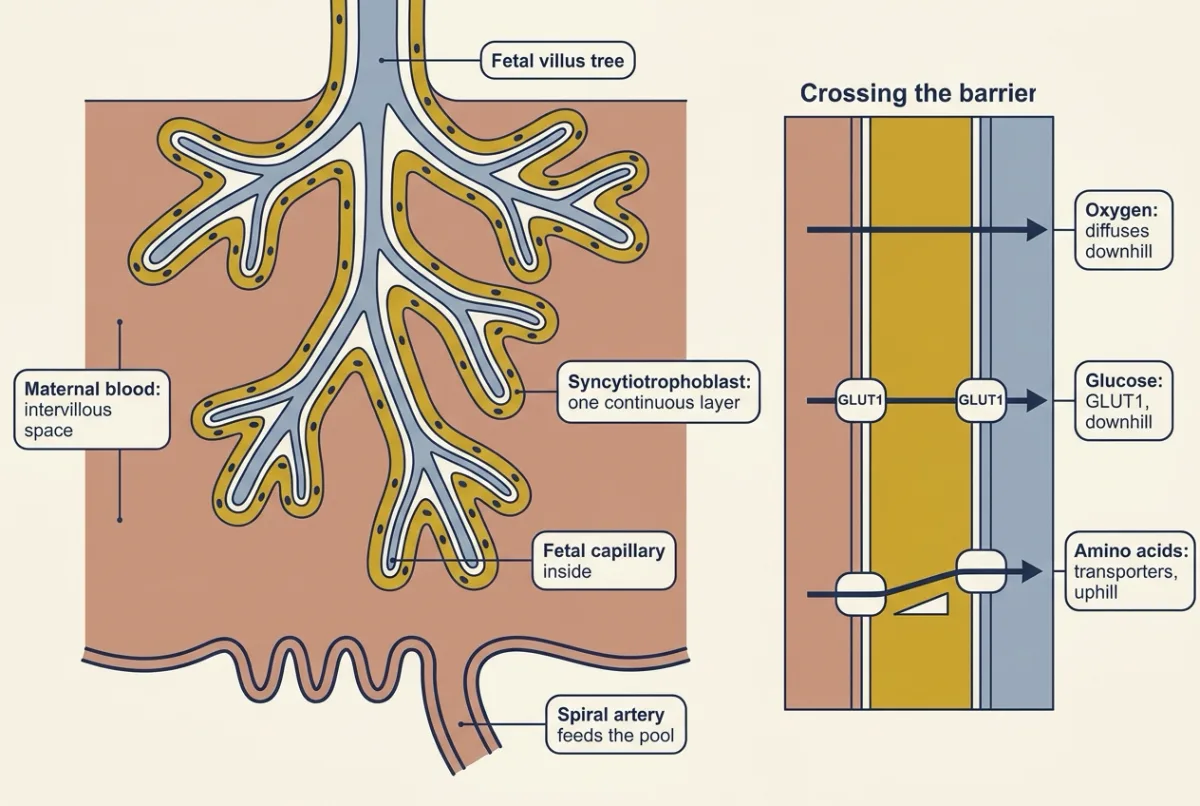
Mother's and fetus's blood lie close but do not mix: everything crosses the syncytiotrophoblast, oxygen and glucose moving downhill and several amino acids carried uphill by transporters on both of its membranes. AI-generated illustration -
The placenta is also an endocrine organ
-
The mother re-sets her circulation, breathing and kidneys
-
Where fetal blood goes
-
At birth the lungs and the placenta trade places
-
Labour: lifting progesterone’s block
-
Milk: prolactin fills, oxytocin empties
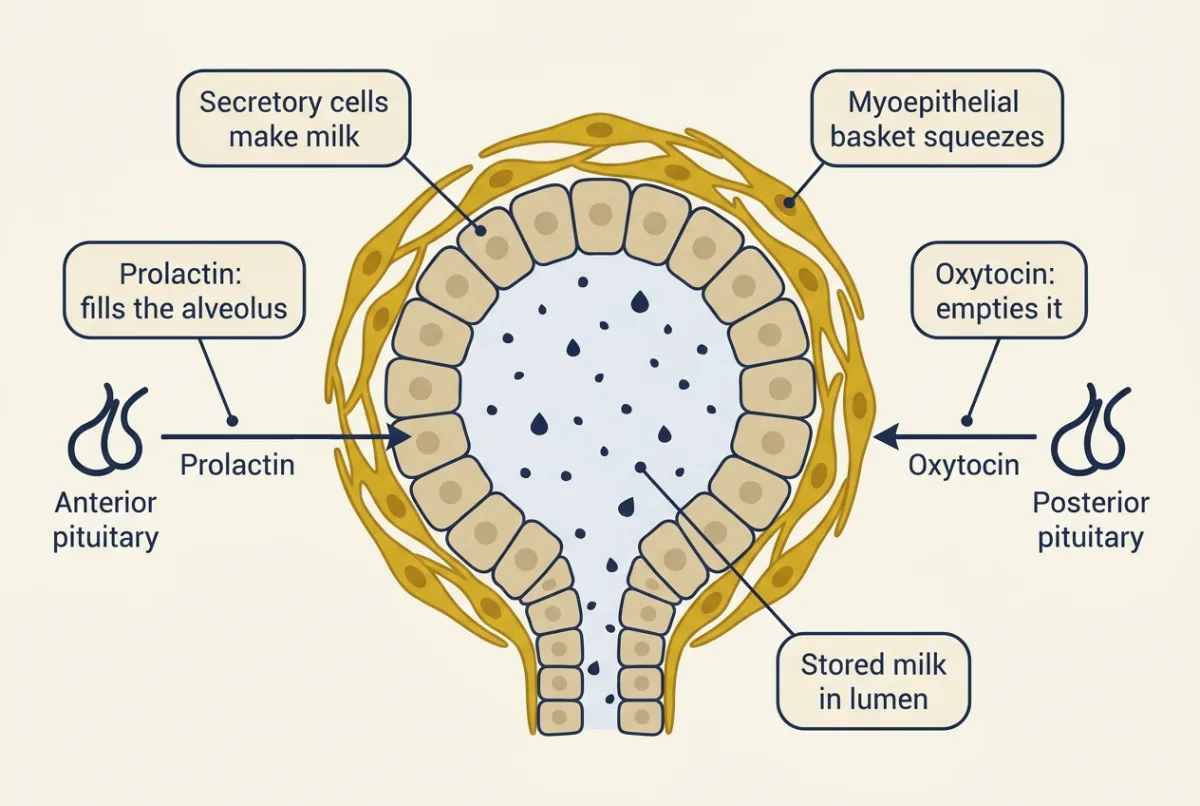
Prolactin fills the alveolus by driving secretion from its lining cells; oxytocin empties it by contracting the myoepithelial basket around it. Suckling releases both, and infant cues such as crying can also release oxytocin. AI-generated illustration -
Design problem
-
Going deeper
Where this lesson fits
Before thisReview first
- Cardiac Output and Venous ReturnThis course · Lesson 7
Maternal output rising 40 percent and the preload lost when the cord is clamped both rest on venous return.
- The Ovarian Cycle and FertilityThis course · Lesson 28
The corpus luteum and progesterone that hCG rescues in early pregnancy come from this lesson.
After thisStudy next
- Exercise: The Whole Body at WorkThis course · Lesson 30
It uses the same chain of output, oxygen delivery and ventilation to ask which link limits the whole body.
Elsewhere on the siteFilms, simulations and method films in other courses
- Why Blood Needs an S-Shaped CarrierFilm · Organismal Biology
Fetal oxygen supply relies on hemoglobin carrying oxygen and releasing it where tissues need it.
- Radioactive and stable isotope tracersMethod film
The placenta lesson's transfer of oxygen, glucose and amino acids is measured by following labelled molecules across it.
Suggested by an AI model from the lessons themselves, then checked. How we use AI