Biology Together · Unit 2: Our senses
The Listening Walk
Rewritten on : new text and film. Your notes and highlights stay, but the text around them may have moved.
How many sounds are there in a quiet backyard? Two still minutes and a sound map help a child find out.
Three real-life stories behind this activity, about 2 minutes aloud, or read them below.
The film, 4 minutes, and the safety notes, for the grown-up to look at before the activity.
The hands-on part, done with a child: about 30 minutes, then a few quick looks later.
Pause when the reading reaches a film, and offer to play it. Saved on this device.
Watch the film now, or keep listening
That is the end of the reading
This idea at other levels
An activity for ages 5 to 10 about hearing. Next, for an older child: Adaptations for Survival (grade 7).
See every levelHide the levels
Hearing
Sound is a vibration that the ear turns into nerve signals, and the brain finds its pitch and where it came from.
Three levels here: ages 5 to 10, grade 7 and upper-level college. The lesson at grade 7 was picked by hand for this lesson.
College, upper level · the level you chose
High pitch peaks at the stiff base, low at the floppy apex.
Neuroscience · about 34 min · film 2:30 · 3 practice questions
No lesson on hearing at high school yet.
Grade 7 · the level you chose
Adaptations for Survival · also at this level, picked for this lesson
Life Science · about 40 min · Virginia LS.7 b
Ages 5 to 10 · the level you chose
The Listening Walk · this lesson
Two still minutes and a sound map; cupped hands make bigger ears.
Biology Together · about 30 min · film 3:41 · Virginia K.5 a, K.5 b, 1.5 b, 3.4 b
Next door to hearing
- The sense of balance (vestibular system)The inner ear that hears also holds the canals and stones that sense head turns and tilts.Nearest lesson: Hearing and Balance (upper-level college)
- Sensory codingThe ear sends only spikes to the brain, so pitch and loudness must be read from which cells fire and how fast.Nearest lesson: Principles of Sensory Coding (upper-level college)
Short versions inside this lesson
The grade 7 version · about 1 minute to read
In grade 7 Life Science, children sort adaptations into physical ones (body parts, coverings, colours) and behavioural ones (actions such as migrating). They read real survival data on snowshoe hares whose white or brown coats did or did not match the ground. They also learn that adaptations often have trade-offs, and that populations, not single animals, change over many generations.
The plainest version · about 1 minute to read
Your ears catch sounds. A sound can be loud or soft, and high like a bird or low like a truck. You have two ears, one on each side, so your brain can tell which way a sound came from. Some animals, like cats and horses, have big ears they can turn toward a sound. Cupping your hands behind your ears makes your ears bigger for a moment.
Find an idea: every idea, searchable
Which lessons teach an idea, and the notes on each level, were written by AI models from the lessons and checked by a second model. A person has not yet read every one. How we use AI
About this activity what is in it
Rewritten on : new text and film. Notes and highlights stay, but the text around them may have moved.
Before you start
- Hands-on time
- About 30 minutes, optional: repeat at another time of day, such as early morning or late afternoon while it is still light, and compare maps
- Where
- Indoors or outdoors
- Ages
- 5 to 10, with an easier and a harder version below
- Grown-up
- Stay with your child the whole time, close enough to touch. Choose a spot away from roads and water.
What you need
- Paper and crayons or pencils, with a clipboard or a book to lean on
- A timer, such as a phone
- A towel or mat to sit on outdoors
- A pet cat, dog or horse to watch, or pictures of animals with large ears (optional)
- The printed observation sheet below (optional)
Virginia science standards SOL K.5 aSOL K.5 bSOL 1.5 bSOL 3.4 b
In this activity. You and your child sit still outside for two minutes and draw a sound map of everything you hear: near or far, loud or soft, high or low, made by something living or not.
The film
 ▶ Watch The Listening Walk: Parent Guide · 3:41
Read the transcript of “The Listening Walk: Parent Guide”
Film transcript: The Listening Walk: Parent Guide
How many sounds are there in a quiet backyard? Most of the time we hear without really listening. Two still minutes and a sheet of paper let your child find out. In about thirty minutes, your child sits still, counts sounds, and draws a map of them. Then they test their own ears. Your child practices listening closely, sorting what they hear, and checking a guess. Gather paper, crayons, a clipboard or book, a timer, and a mat. Pick a spot you have permission to use, away from roads, driveways, ponds, and streams. Stay close enough to touch. Ask first, 'How many different sounds do you think we will hear in two minutes?' Write the number down.
Then set the timer. Your child closes their eyes and holds up one finger for each new sound. When the timer ends, ask, 'Was it more or fewer than you thought?' Expect anything from a few sounds to a dozen or more, depending on the place and time of day. Now the sound map. Put a dot in the middle of the paper and label it 'me'. Your child draws each sound in the direction it came from. Near sounds go close to the dot, far sounds near the edge. Add one rule at a time. Loud sounds are drawn big, and soft sounds small. High and low are a different thing, called pitch. Add an arrow up for a high sound, and down for a low one. Last, circle the sounds made by living things, like birds, insects, dogs, and people. Talk about the tricky ones.
Rustling leaves come from a tree, but the wind makes them move. Choose a quiet, steady sound. Use a guarded fan on a stable surface with its cord tucked away. Sit your child at least an arm's length back. Have them face the sound and listen. Then have them cup their hands, fingers together. A question for you. Your child keeps the hands cupped, then turns their back to the fan. Will the sound get louder, fainter, or stay the same?
Most children hear it louder with hands cupped. Have them turn around with their hands still cupped. It usually sounds fainter. The bigger funnels now face away from the sound. Cats and horses have large ears they can turn toward a sound. Ask, 'What do you think a cat's big ears help it do?' Watch only a pet your child knows, and stay beside them. Stay close enough to touch the whole time. Cup hands only for quiet, everyday sounds, never toward a road. If something loud starts, move away. Nothing goes into the ear. Nothing from the ground goes in mouths. Small objects like pebbles and acorns can choke children under four. Call nine one one if a child is choking.
Never taste wild plants, berries, or mushrooms. Wash hands after touching them. Check for ticks after sitting in grass. Ask what your child noticed when they cupped their hands. Look back at the map together and trace where the sounds came from.
Before you start
- Hands-on time
- About 30 minutes, optional: repeat at another time of day, such as early morning or late afternoon while it is still light, and compare maps
- Where
- Indoors or outdoors
- Ages
- 5 to 10, with an easier and a harder version below
- Grown-up
- Stay with your child the whole time, close enough to touch. Choose a spot away from roads and water.
What you need
- Paper and crayons or pencils, with a clipboard or a book to lean on
- A timer, such as a phone
- A towel or mat to sit on outdoors
- A pet cat, dog or horse to watch, or pictures of animals with large ears (optional)
- The printed observation sheet below (optional)
Virginia science standards SOL K.5 aSOL K.5 bSOL 1.5 bSOL 3.4 b
The big idea
Most of the time we hear without listening. Ask a child to sit still for two minutes, eyes closed, and count the sounds, and the backyard fills up: a bird, a car, wind in a tree, a far-off dog. Your child practices listening closely, sorting sounds, and testing a guess with their own ears.
Say it together (read aloud): “Our outside ears are funnels that catch sound. Two ears help our brain tell where a sound comes from.”
Ears catch sound and the brain makes sense of it. Use four words to describe the sounds you hear: loud, soft, high and low. Loud and soft tell how strong a sound is. High and low are a different thing, pitch: high like a bird, low like a truck. Having two ears, one on each side of the head, helps the brain tell which way a sound came from.
Many animals have large outer ears they can turn, such as cats and horses. These ears gather sound like funnels. Cupping hands behind the ears gives a child a bigger funnel and lets them feel the difference.
For teachers (Virginia standards)
Virginia’s kindergarten standard pairs ears with hearing and gives four words for sounds: loud, soft, high and low. In grade 1, Virginia asks children to link body parts with what they do. In grade 3, it calls features like these adaptations: body parts or behaviours that help a living thing survive where it lives.
What to do
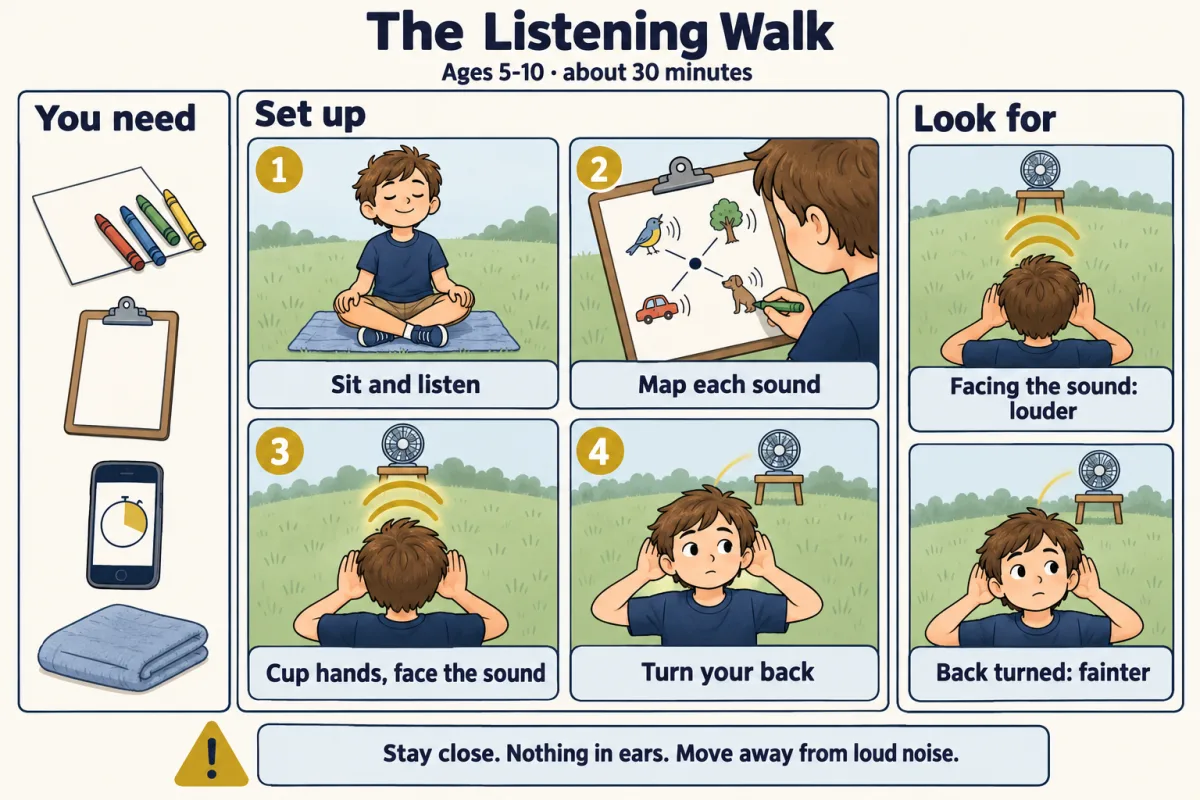
- Pick a spot. Find a place to sit outside, such as a yard, a park bench or the schoolyard. On a cold or rainy day, sit near a window opened no more than 4 inches, with chairs and anything to climb on moved away from it. A screen will not stop a child falling out.
- Predict. Ask, “How many different sounds do you think we will hear in two minutes?” Write the number down.
- Sit and listen. Set a timer for two minutes. Your child closes their eyes and holds up one finger for each new sound. Expect anything from a few sounds to a dozen or more, depending on the place and the time of day. When the timer ends, check the guess: “Was it more or fewer than you thought?”
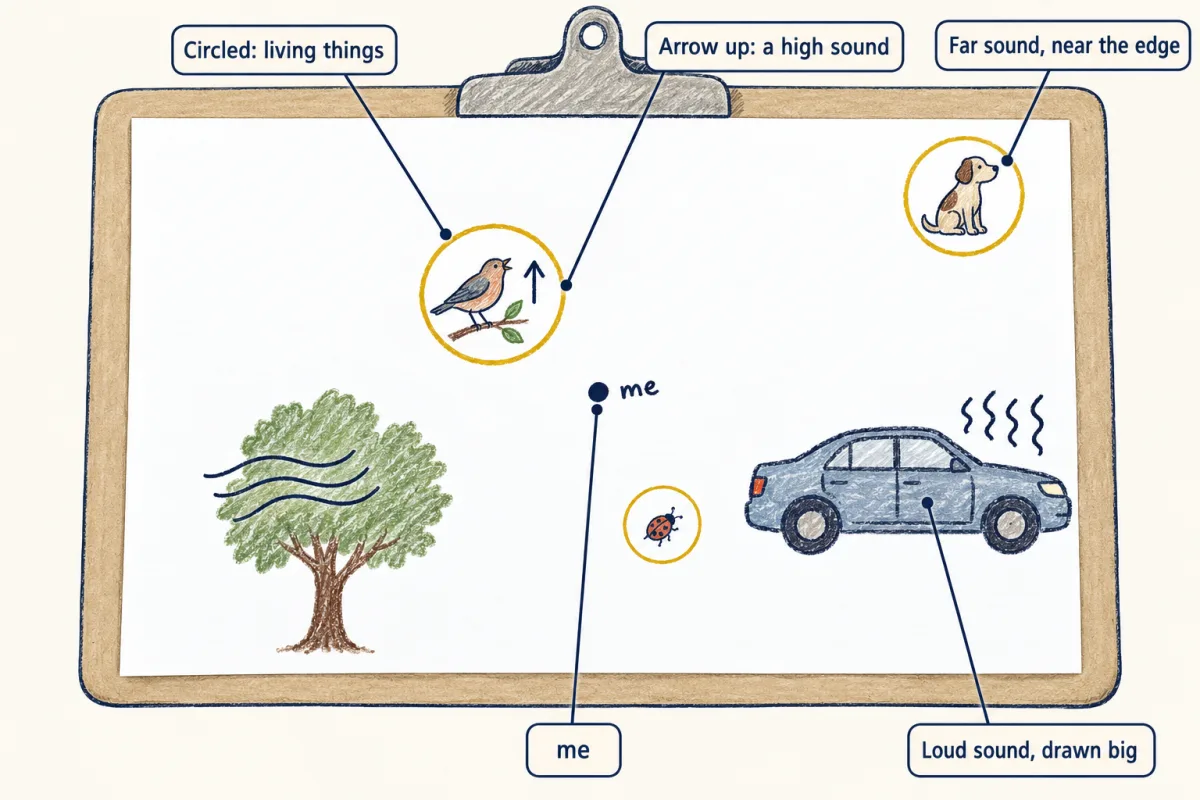
- Make a sound map, one rule at a time. Put a dot in the middle of the paper and label it “me.” Your child draws each sound in the direction it came from. Start with one sound together, such as a bird. First ask, “Near or far?” Near sounds go close to the dot and far sounds go near the edge. Then ask, “Loud or soft?” Loud sounds are drawn big, soft sounds small. Last, for older children, ask, “High or low?” Add an arrow pointing up for a high sound and down for a low one. Then your child maps the rest.
- Living or not. Circle the sounds made by living things, such as birds, insects, dogs and people. Talk about the tricky ones. Rustling leaves come from a tree, but the wind makes them move.
- Cupped-hand ears. Find one steady sound, such as an air conditioner, a fan or wind in the trees. If you use a fan, choose one with a guard, set it where it cannot tip, keep the cord out of the way, and have your child sit at least an arm’s length from it. Ask, “What will happen if you cup your hands behind your ears?” Your child faces the sound and cups both hands behind the ears, fingers together. Most children hear it louder.
- Turn around. Ask your child to predict first: “What will happen if you turn your back to the sound?” Then, keeping the cupped hands in place, they turn their back to the sound. The sound usually gets fainter, because the funnels now point the wrong way.
- Watch animal ears (optional). If you have a cat or dog that your child knows well, stay beside your child, keep a little space from the pet, and watch its ears when someone quietly opens a cupboard nearby. Watch a horse only from outside its fence or stall, with an adult who knows the horse handling it. Do not startle the animal, and never walk behind a horse. Do not use a stranger’s or stray animal. Or look at pictures of animals with large ears and talk about what those ears might help with.
- Debrief. Ask two closing questions:
- “What changed when you cupped your hands, if anything?”
- “What do you think a cat’s big ears help it do?” Read Say it together aloud again.
Questions to ask while you do it
Ask your child to guess first, then check.
- “How many sounds do you think we will hear? Was it more or fewer?”
- “Is that sound near or far? How can you tell without looking?”
- “I wonder if that loud sound is close. What else could make it loud?”
- “What do you think will happen when you cup your hands behind your ears?”
- “What will happen if you turn your back to the sound?”
- “What do you think a cat’s big ears help it do?”
What children often think
-
A child might say “It was silent.”
You could try Sit for two more minutes and count each sound on a finger. Listen for a hum, the wind or your own breathing. Places with no sound at all are rare. Quiet sounds are easy to miss until you stop and listen for them.
-
A child might say “Loud sounds are always close.”
You could try Ask about thunder or a plane high overhead. Are they close? Then whisper right next to them. How loud a sound seems depends on how loud it was to begin with and how far it travelled. Sounds get fainter as they travel.
-
A child might say “Animals hear just like us.”
You could try Ask, "Can you turn your ears like a cat?" Many animals can turn their outer ears toward a sound. Some hear differently too: dogs and cats hear high sounds that are too high for people to hear at all.
-
A child might say “I hear with the outside part of my ear.”
You could try Try the cupped hands again. The outside part catches sound and sends it inward, like a funnel. The parts that turn sound into signals for the brain are deep inside the head, behind a thin eardrum that is easy to hurt. That is why nothing ever goes in the ear.
Why it works
Sound is a vibration that travels through air. The part of the ear you can see is called the pinna. It funnels sound into the ear canal. Its shape boosts sounds from the front a little and dims sounds from behind. Cupped hands make a bigger funnel facing forward, so a sound in front seems louder and a sound behind seems fainter.
The brain finds direction partly by comparing the two ears. A sound from the left reaches the left ear a tiny bit sooner and a little louder than the right ear.
Cats have many small muscles that turn each pinna a long way, and each ear can move on its own. Horses can point each ear in a different direction. Large, movable ears are a physical adaptation, and turning them toward a sound is a behaviour. Features like these build up in a population over many generations. A single animal does not grow bigger ears because it needs them.
Easier and harder
Ages 5 to 7
Listen for one minute instead of two, and skip the arrows for high and low. Your child can draw each sound as a small picture and tell you whether it was loud or soft. For the cupped-hand test, ask only “louder or quieter?” Then let them be the one to say “Turn around” to you.
Ages 8 to 10
Do the sound map at two places or two times of day, then compare in a table: number of sounds, living, nonliving, loudest, highest. Make a bar graph of living and nonliving sounds. For a fair test of cupped hands, use the same sound, the same spot and three tries each way, and rate loudness from 1 to 5. Ask what other things could change the result.
If it doesn’t go as planned
If your child cannot sit still for two minutes, start with 30 seconds and build up. If a busy road drowns out everything else, map it from where you sit (do not move closer to the road), then try again at a quieter time or place. If the cupped hands seem to make no difference, pick a steady hissing or rustling sound, such as a fan or leaves in the wind, instead of a deep hum, and make sure the fingers are closed. Cupped hands boost middle and high sounds more than low ones.
Observation sheet
Here is what two filled-in rows can look like:
| Sound | Loud or soft? | High or low? | Living or nonliving? |
|---|---|---|---|
| Bird | Soft | High | Living |
| Car | Loud | Low | Nonliving |
Observation sheet
My sound map
NameDate
Put yourself in the middle. Draw each sound where you heard it.
| Sound | Loud or soft? | High or low? | Living or nonliving? |
|---|---|---|---|
With cupped hands, the sound got:
When I turned around, the sound got:
stemhop.com · Biology Together
The three stories, told aloud Side Hops: three stories that go with this lesson Side Hops
Three ways to talk about ears on your listening walk
1:37 · Narration: an AI narrator voice (Kokoro, af_heart).
Read the transcript
Hi there. Before you and your child head out for the listening walk, here are three easy ways to chat about ears along the way. First, a silly fact that kids love to repeat. When you hear chirps in the grass, ask, "Guess where a bush cricket keeps its ears? Not on its head. Right on its front legs!" Then add the bonus: many grasshoppers have ears on the sides of their bellies. It is a playful way to show that animals do not all hear the way people do. Second, look for a bird. Stay close enough to touch your child. From where you're sitting, look for a robin or a sparrow. Ask your child to find its ears. They will hunt and hunt and not see any flaps at all. Unlike cats, dogs and people, birds have no outer ear flap sticking out. Feathers usually hide the ear openings. Birds still have outer, middle and inner ear parts. Third, when the walk is over, try a dreaming question. Ask, "If you could borrow any animal's ears for a day, whose would you pick, and what would you listen for?" You might hear about floppy bunny ears, huge elephant ears, or ears that spin like a robot's. Cheer every idea, and then ask which way they would point them. There is no wrong answer, and you may get a wonderful drawing out of it. None of these need to be a quiz. Toss out a funny bug fact, a quick bird hunt or a big question, and let your child lead the noticing.
The idea underneath them. You and your child sit still outside for two minutes and draw a sound map of everything you hear: near or far, loud or soft, high or low, made by something living or not.
Your notes
Select any text in the lesson to highlight it or add a note to it. Your highlights and notes are saved in this browser and collected in your notebook.
This browser is not letting the site save anything (a private window or strict privacy settings), so highlights and notes will be lost when you leave the page.
Where this lesson fits
After thisStudy next
- Beak BuffetThis course · Lesson 16
Your child sees again how a body part's shape suits a job, like big ears for gathering sound.
- Fur, Feathers and ScalesThis course · Lesson 15
Another body covering or part that helps an animal live where it lives, found by feeling the real thing.
Suggested by an AI model from the lessons themselves, then checked. How we use AI
Those are the stories. The idea under them is the one the lesson builds.
That is the film. The rest of the activity is the fun part.
The rest of the activity is here when you want it.
Finish line
Test yourself
4 questions
Questions to talk over together.
Next · Lesson 7
What Do Plants Need?
Does a plant really need sunlight if it already has water? Four cups and a cupboard give a fair answer.
Continue →Rewritten on : new text and film. Notes and highlights stay, but the text around them may have moved.