Pitch Becomes Place
Read the transcript of “Pitch Becomes Place”
Film transcript: Pitch Becomes Place
How does your ear know whether a tone is high or low? Uncoil the cochlea. Along it runs the basilar membrane, carrying the hair cells. Near the base, where sound enters, it is narrow and stiff. Toward the apex it is wide and floppy. So each place has a natural frequency, high where the membrane is stiff, low where it is floppy. Sound sets up a travelling wave that moves from the base toward the apex. A high tone's wave slows and grows near its matching place, close to the base. It peaks there, then dies away. Now a low tone enters at the same base. Where will its wave peak?
Near the apex, where the membrane is floppy and its natural frequency is low. Frequency becomes position. This map is called tonotopy. Above about 1 kHz, each doubling of frequency takes nearly the same length of membrane. Georg von Békésy measured these waves. His peaks were far broader than a living ear's tuning. Something in a living ear adds energy. That something is the outer hair cells. They change length when their voltage changes. The motor is a membrane protein called prestin. Each outer hair cell is braced between the basilar membrane and the structures above it. Here is the loop. The membrane moves, and an outer hair cell's bundle is pushed.
Its voltage swings, and prestin shortens and lengthens the cell. Its push is timed to go with the membrane's motion, like pushing a swing. That adds energy near the peak. The same switch, used as a motor. It sharpens tuning and raises sensitivity. The boost is largest for quiet sounds. Lose the outer hair cells, and the threshold of hearing rises: quiet sounds drop below it. If the inner hair cells and their nerve fibres still work, sounds above the new threshold are still heard. But tuning blurs. Inner hair cells supply most of the auditory nerve. They report the place. The brain reads pitch from where the active cells are.
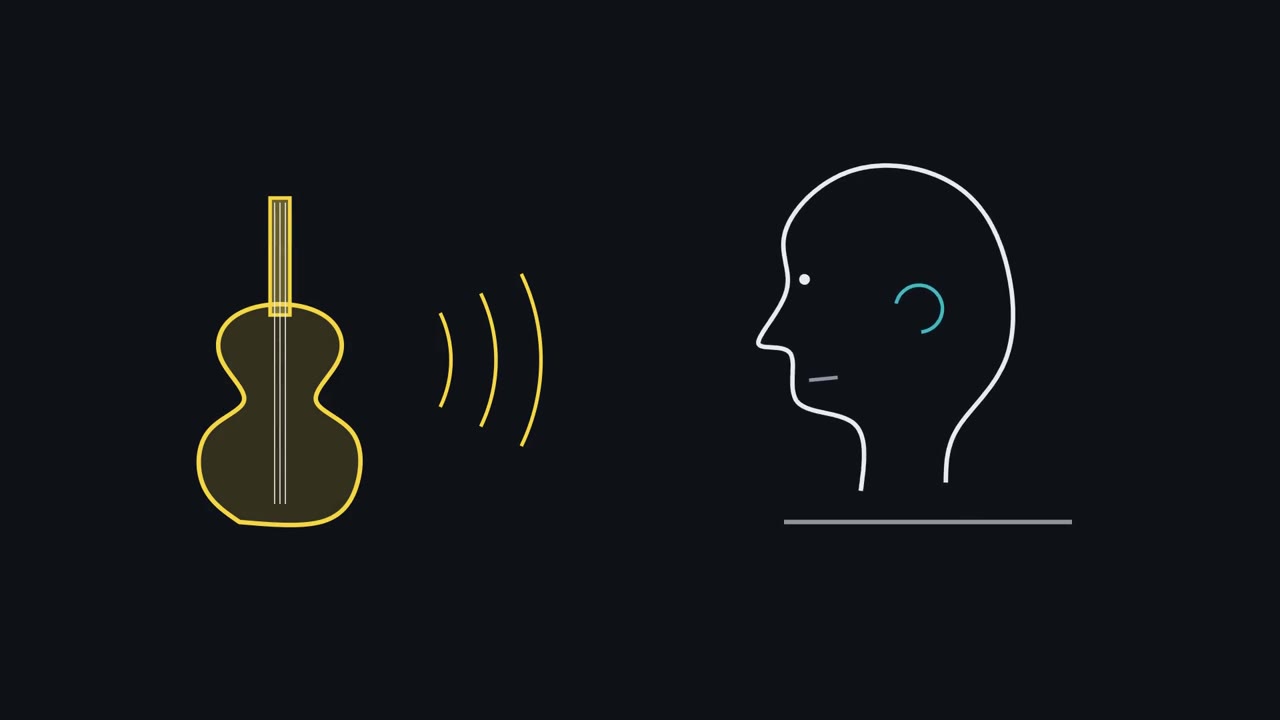
The same kind of cell tells you that a violin is playing an A and that your head is turning left. How does one cell type do both jobs?
Continue in the lesson: Hearing and Balance →
2:30 · Free, with captions and a transcript. The lesson has the full text, the questions and the sources.
More films from this lesson
How this film was made. Narration: an AI narrator voice (Kokoro, af_heart) reading narration written from this lesson's text. Animation: AI-generated in code (Manim) by Claude, a schematic with no drawn molecular structures. Captions come from the narration script. See something wrong? Report it.