Biology · Skim version
Energy in Ecosystems
Read the full lesson → Skim the whole course →
The guiding idea
An osprey on the Chesapeake Bay eats fish, and the fish eat plankton, so how much of the sunlight the plankton caught ever reaches the osprey?
At each step, only part becomes tissue the next level can eat.
From the film: Why Energy Pyramids Narrow
- At each step, only part becomes tissue the next level can eat.
- Food-web arrows point from food to eater, following the energy.
- Heat, uneaten matter and undigested matter leave less energy in new tissue.
- About 10 percent is a rough model, not a fixed rule.
From the film: Energy Flows, Matter Returns
- Energy flows through ecosystems, while matter cycles and can be reused.
- Light energy becomes food energy, motion and heat.
- Decomposers return carbon to air and water, not usable energy to producers.
- Energy comparisons require matching measurements over the same area and time.
-
Explore: build an energy pyramid
-
Explain: who eats whom in the Bay
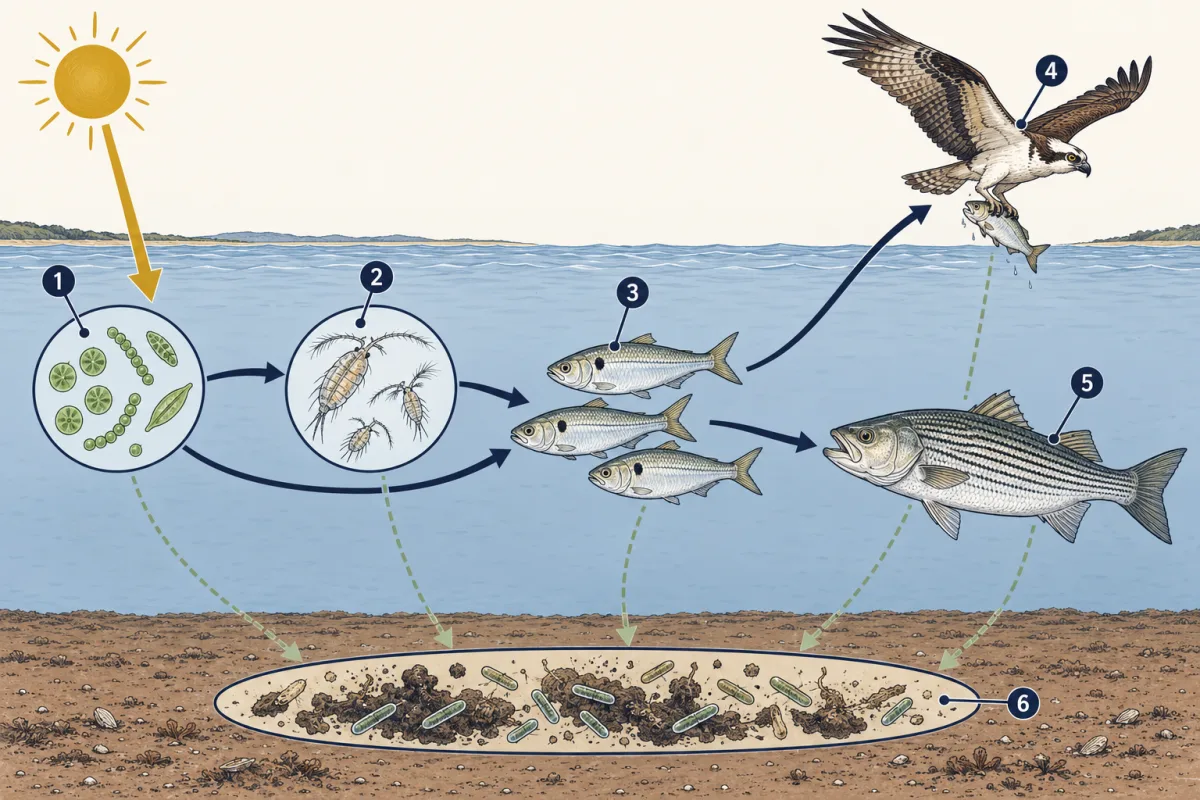
- phytoplankton
- zooplankton
- Atlantic menhaden
- osprey
- striped bass
- decomposers
-
Explain: why each level gets less
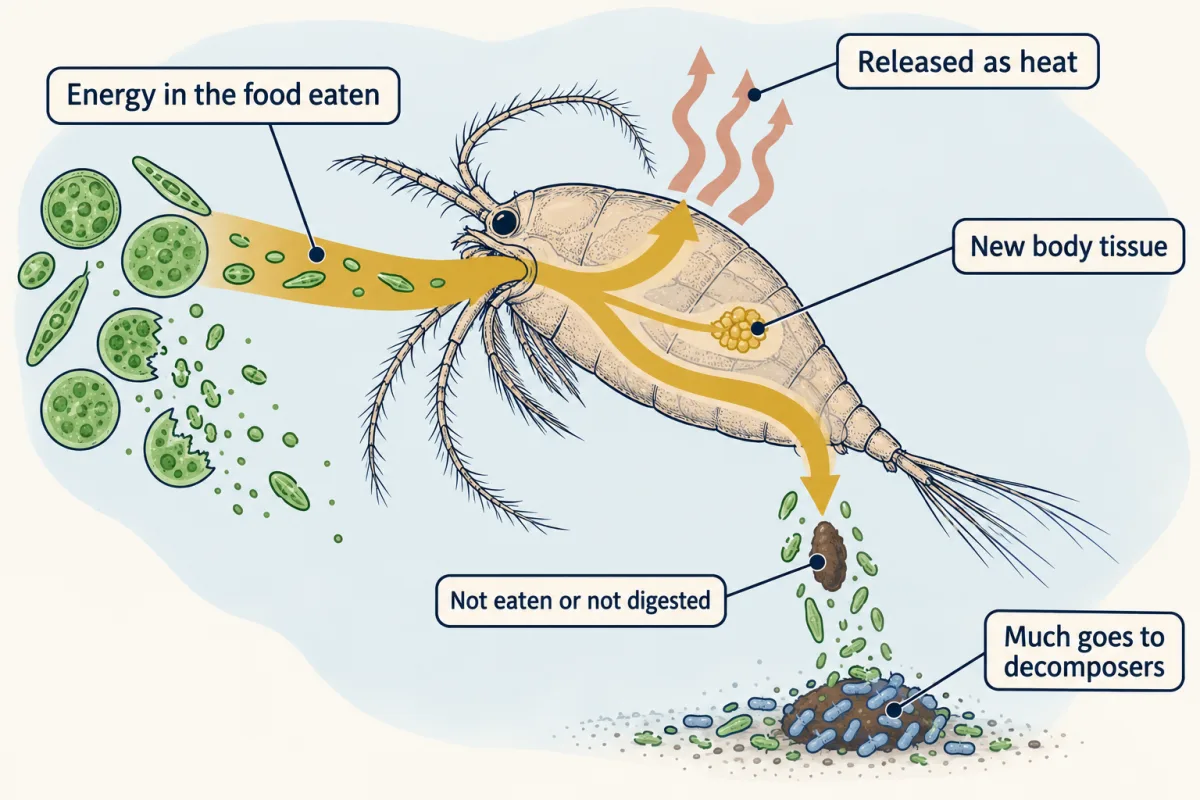
Where the energy in food goes at one step, not to scale: much is released as heat, some is left uneaten or undigested for decomposers, and only the rest becomes new tissue. AI-generated illustration -
Explain: energy flows, matter cycles
-
Elaborate: real energy budgets and osprey diets
-
Evaluate: check your thinking
Where this lesson fits
Before thisReview first
- Respiration and ATPThis course · Lesson 5
You need cellular respiration from there to see why much energy leaves each level as heat.
- Capturing SunlightThis course · Lesson 4
You need how producers store sunlight as food energy from there to start the pyramid.
After thisStudy next
- Matter CyclesThis course · Lesson 31
It follows carbon and other matter as it returns to producers, the cycling side of this lesson's contrast.
Elsewhere on the siteFilms, simulations and method films in other courses
- A forest floor over five yearsSimulation · Life Science
The forest-floor simulation shows decomposers returning carbon while the sun keeps supplying energy, matching the energy-flows, matter-cycles idea.
- Set Up: Who Eats Whom?Film · Biology Together
It shows with picture cards and yarn how a hawk depends on grass through a chain of who eats whom.
Suggested by an AI model from the lessons themselves, then checked. How we use AI