Biology Together · Unit 5: Animal bodies, homes and adaptations
Backyard Habitat Hunt
Rewritten on : new text and film. Your notes and highlights stay, but the text around them may have moved.
Is anything living in a patch of plain grass? A string square and ten minutes of close looking answer that.
Three real-life stories behind this activity, about 2 minutes aloud, or read them below.
The film, 3 minutes, and the safety notes, for the grown-up to look at before the activity.
The hands-on part, done with a child: about 30 minutes.
Pause when the reading reaches a film, and offer to play it. Saved on this device.
Watch the film now, or keep listening
That is the end of the reading
This idea at other levels
An activity for ages 5 to 10 about habitats. Next, for an older child: Habitat and Niche (grade 7).
See every levelHide the levels
Habitats
A habitat is the place that gives a living thing the food, water, shelter and space it needs.
Taught at two levels: ages 5 to 10 and grade 7.
Grade 7 · the level you chose
One spruce forest, five warblers: the habitat is the place they share.
Life Science · about 40 min · Virginia LS.6 d
Ages 5 to 10 · the level you chose
Backyard Habitat Hunt · this lesson
Find what one ant needs inside a string square: food, water, shelter, space.
Biology Together · about 30 min · film 3:23 · Virginia 2.5 a, 2.5 b, 1.5 a, 3.5 a, 4.3 a
Next door to habitats
- The ecological nicheA habitat is where an animal lives, and a niche is how it lives there, so two animals can share one place.Nearest lesson: Habitat and Niche (grade 7)
- How people change ecosystemsCutting forest and building on fields remove habitats, which is a main way people harm wildlife.Nearest lesson: People Change Habitats (grade 7)
Short versions inside this lesson
The grade 7 version · about 1 minute to read
In grade 7 Life Science, students learn to tell a habitat from a niche. A habitat is where an animal lives. A niche is its role there: what it eats, what eats it, and how it uses the space. Students study five kinds of birds that share one spruce forest by feeding in different parts of the same trees.
The plainest version · about 1 minute to read
Every animal needs food, water, air, a safe place to hide, and enough room. The place where it finds all of these is its habitat. An ant's habitat might be one corner of the yard. Some parts of a habitat are living, like grass and trees. Some are not living, like rocks, soil and rainwater. The animal needs both kinds.
Find an idea: every idea, searchable
Which lessons teach an idea, and the notes on each level, were written by AI models from the lessons and checked by a second model. A person has not yet read every one. How we use AI
About this activity what is in it
Builds on:Alive or Not? (read)Why these?
Rewritten on : new text and film. Notes and highlights stay, but the text around them may have moved.
Before you start
- Hands-on time
- About 30 minutes
- Where
- Outdoors
- Ages
- 5 to 10, with an easier and a harder version below
- Grown-up
- Stay with your child the whole time, within arm’s reach. You do any log or rock rolling, and you decide what is safe to touch.
What you need
- About 4.5 metres of string or yarn
- 4 sticks, pencils or tent pegs for corners
- A metre stick or tape measure (or a step-sized guess)
- A magnifying glass (optional)
- A pencil or twig, for gently parting grass and leaves (never for poking animals)
- Garden gloves for the adult
- Paper, a pencil and a clipboard, or the printed observation sheet below
Virginia science standards SOL 2.5 aSOL 2.5 bSOL 1.5 aSOL 3.5 aSOL 4.3 a
In this activity. You and your child mark a one-metre square of yard or park with string and look closely at everything in it, or gently roll a log and put it back.
The film
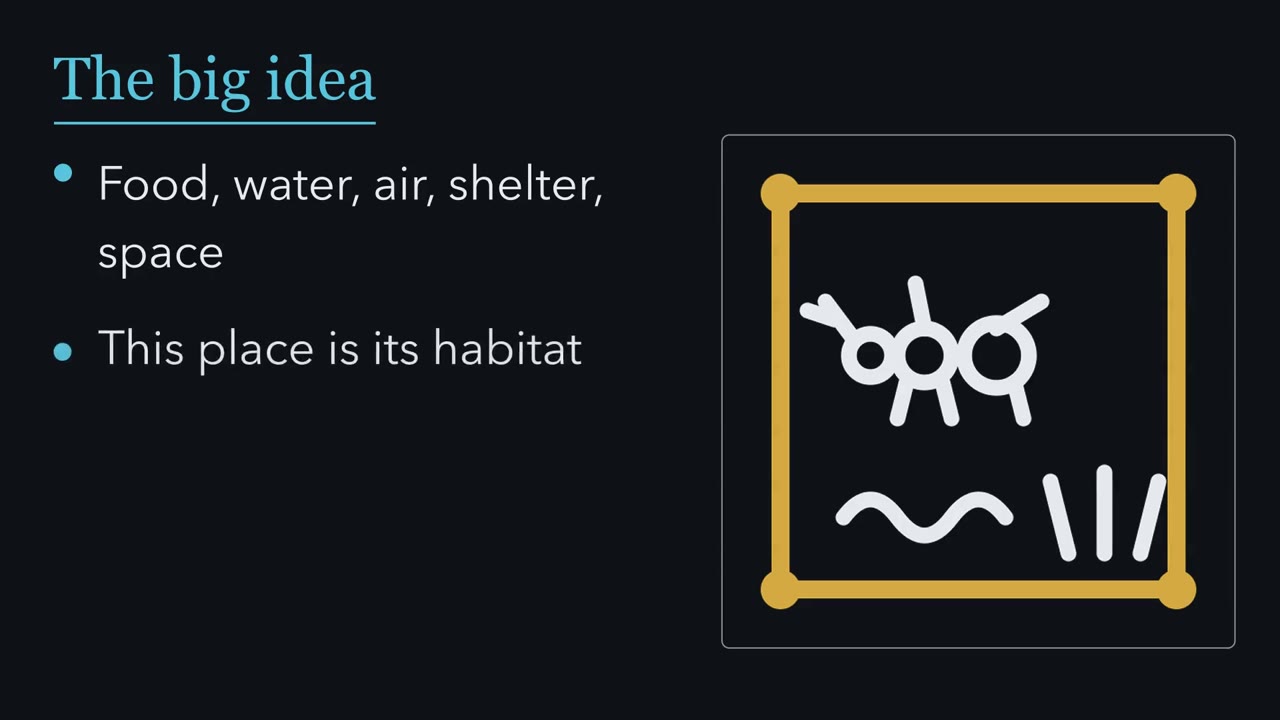 ▶ Watch Backyard Habitat Hunt: Parent Guide · 3:23
Read the transcript of “Backyard Habitat Hunt: Parent Guide”
Film transcript: Backyard Habitat Hunt: Parent Guide
What lives in a patch of plain grass? Give your child ten minutes to look closely and test a guess. A string square gives you a place to start. Here is what your child practices today. They practice slowing down, looking closely, and testing a guess with a count. They also sort living parts from nonliving parts. They discover one big idea. Every animal needs a habitat that supplies food, water, air, shelter, and space. Stay within arm's reach the whole time. Choose dry ground away from roads and water. Check for glass, sharp litter, and ant mounds. Keep pebbles, small pegs, and other small objects away from children under four. Call nine one one if choking.
Setup uses simple items. Bring about four and a half meters of string, four sticks, a pencil, and paper. Add a magnifying glass if you have one, plus garden gloves for rolling a log. Push the four sticks about one meter apart and wrap the string around them. Before you look, ask your child, “How many animals do you think we will find in our square?” Write down the guess. Then spend ten minutes looking closely. Part the grass gently with a pencil, and count each animal you see inside the string. Now picture that square before you kneel. From up here, it looks like plain grass. What do you predict you will see moving in the square once you part the grass?
Here, parting the grass reveals an ant and a spider. Your square may look different with the season and weather. Grass itself is alive, too. When you finish looking, compare your count with your child’s guess. Next, help your child sort the square into two lists. List living things like grass and ants, and nonliving things like soil, rocks, and sunlight. Then pick one animal together. Ask, Where does this ant eat? Where could it find water? Together, trace its shelter and space. You can skip the log. If you look under one, have your child stand back while you put on garden gloves. Choose a light log and roll it toward you without lifting it. Look underneath, then gently roll it back into place.
Never put hands or feet where you cannot see. Step back if you see a snake. Watch animals where they are. Keep your hands off them. Never taste plants, berries, or mushrooms. Handle any glass lens yourself. Keep every magnifying glass pointed away from the sun. Pull up the sticks and string, and put back any leaves you moved. Wash hands with soap and water and check for ticks afterward. Think back to the animal you watched. Its habitat is the place it finds what it needs.
Before you start
- Hands-on time
- About 30 minutes
- Where
- Outdoors
- Ages
- 5 to 10, with an easier and a harder version below
- Grown-up
- Stay with your child the whole time, within arm’s reach. You do any log or rock rolling, and you decide what is safe to touch.
What you need
- About 4.5 metres of string or yarn
- 4 sticks, pencils or tent pegs for corners
- A metre stick or tape measure (or a step-sized guess)
- A magnifying glass (optional)
- A pencil or twig, for gently parting grass and leaves (never for poking animals)
- Garden gloves for the adult
- Paper, a pencil and a clipboard, or the printed observation sheet below
Virginia science standards SOL 2.5 aSOL 2.5 bSOL 1.5 aSOL 3.5 aSOL 4.3 a
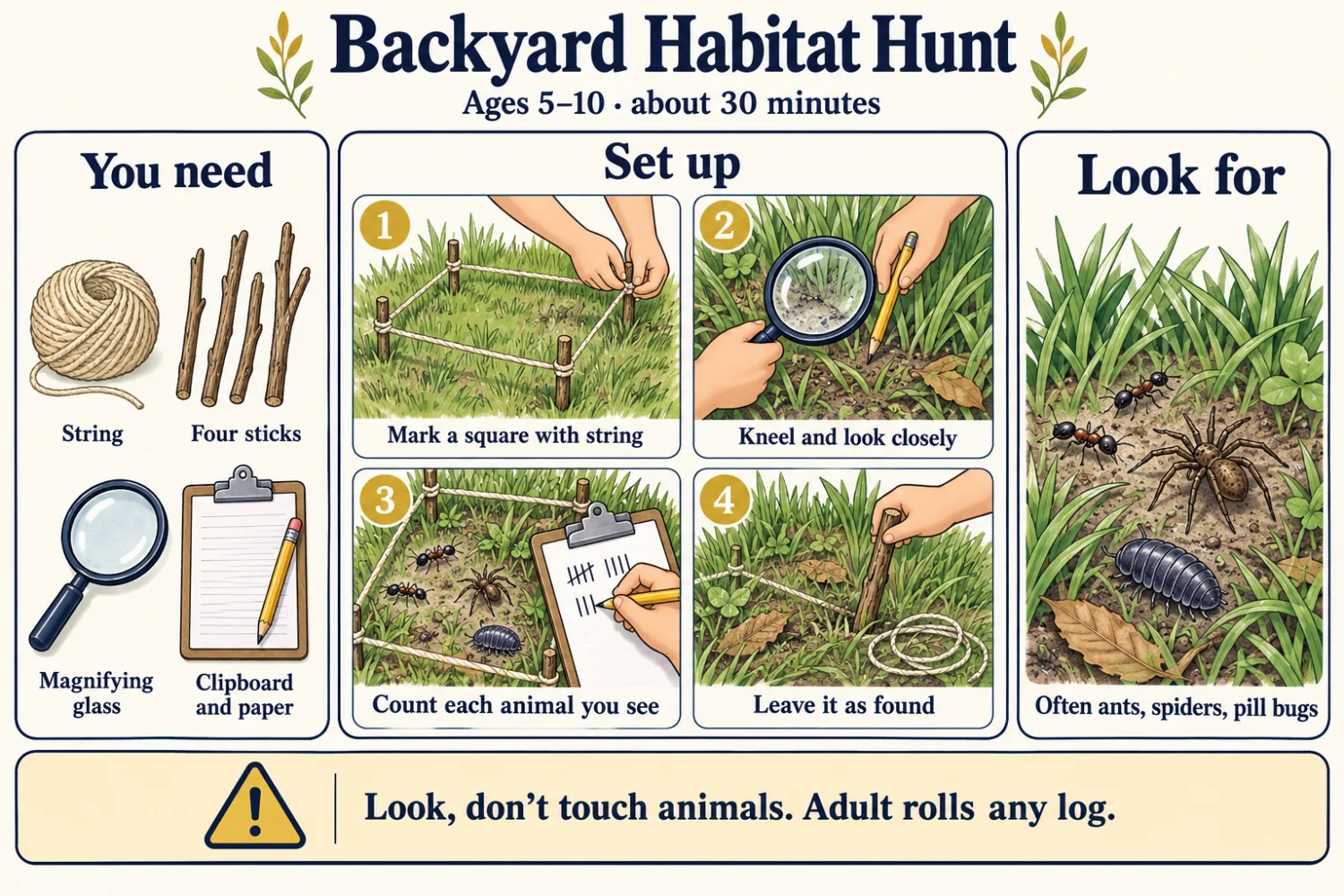
The big idea
Plan about 30 minutes outside. Your child will count animals to test a guess and sort living and nonliving things. Together, look for clues about what one animal needs.
Say it together: “Every animal needs food, water, air, a safe place to hide, and room to move. The place that gives it all of those is its habitat. A habitat has living parts, like grass, and nonliving parts, like soil and rocks.”
From standing height, a lawn looks like a green carpet. On hands and knees, it turns busy. You might see ants carrying crumbs, spiders on tiny webs or beetles running for cover.
Each animal depends on both living parts (plants, animals, fungi) and nonliving parts (soil, rocks, water, air, sunlight). Shelter can be living, like a tree, or nonliving, like a rock or a crack in the soil. If one need is missing, the animal may move away or may not survive.
The string square shrinks a whole yard to a size a child can study. Older children can count one kind of animal as a population—a group of one kind of living thing in one place. All the kinds living there together make a community.
What to do
Work one job at a time: count first, sort second, then trace one animal’s needs.
- Pick a spot. Choose a lawn patch, garden edge or schoolyard corner, and check it for hazards first. To study under a small log instead, skip the square. Guess how many animals are under it. Follow Step 5 and count the animals you see before the adult rolls the log back. Then compare your count with your guess.
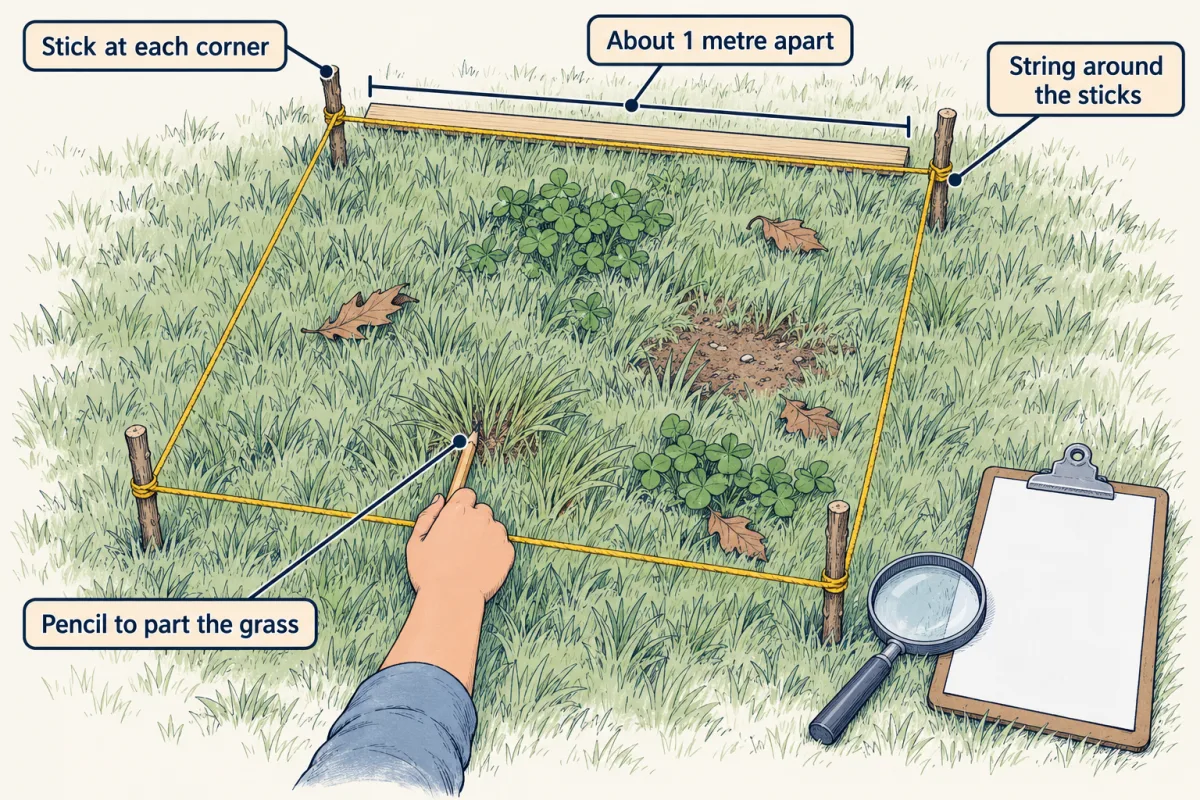
- Mark the square. Push the 4 sticks in about 1 metre apart and wrap the string around them to frame 1 square metre.
- Predict before you look. Before parting the grass, ask: “How many animals do you think live in our square? More or fewer than your fingers?” Write the guess down.
- Look closely for 10 minutes. Kneel and part the grass gently with a pencil. Check the soil, under fallen leaves and at plant bases, using a magnifying glass if you have one. Expect ants, spiders, small beetles, pill bugs or earthworms, depending on the season and weather. Ask, “What can you see moving near the soil?” Count each animal inside the square, list birds or flying insects separately, and compare with the guess.
- Roll a log (optional). First ask: “What do you think is hiding under this log? Why would it pick that spot?” With children standing back, the adult wears gloves and rolls a light log or flat rock toward themselves. Look for pill bugs, worms, beetles, millipedes or, in damp woods, a small salamander. Watch for a minute or two, noticing the cool, damp soil. Ask: “What do you think will happen to the pill bugs if we leave the log rolled over?” Roll it back slowly so animals on the ground can crawl back beside it.
- Sort living and nonliving. Model one of each first: “This grass is living, and this rock is nonliving. What else can you sort?” List living things (grass, clover, ants, a mushroom) and nonliving things (soil, a rock, a puddle, sunlight, air).
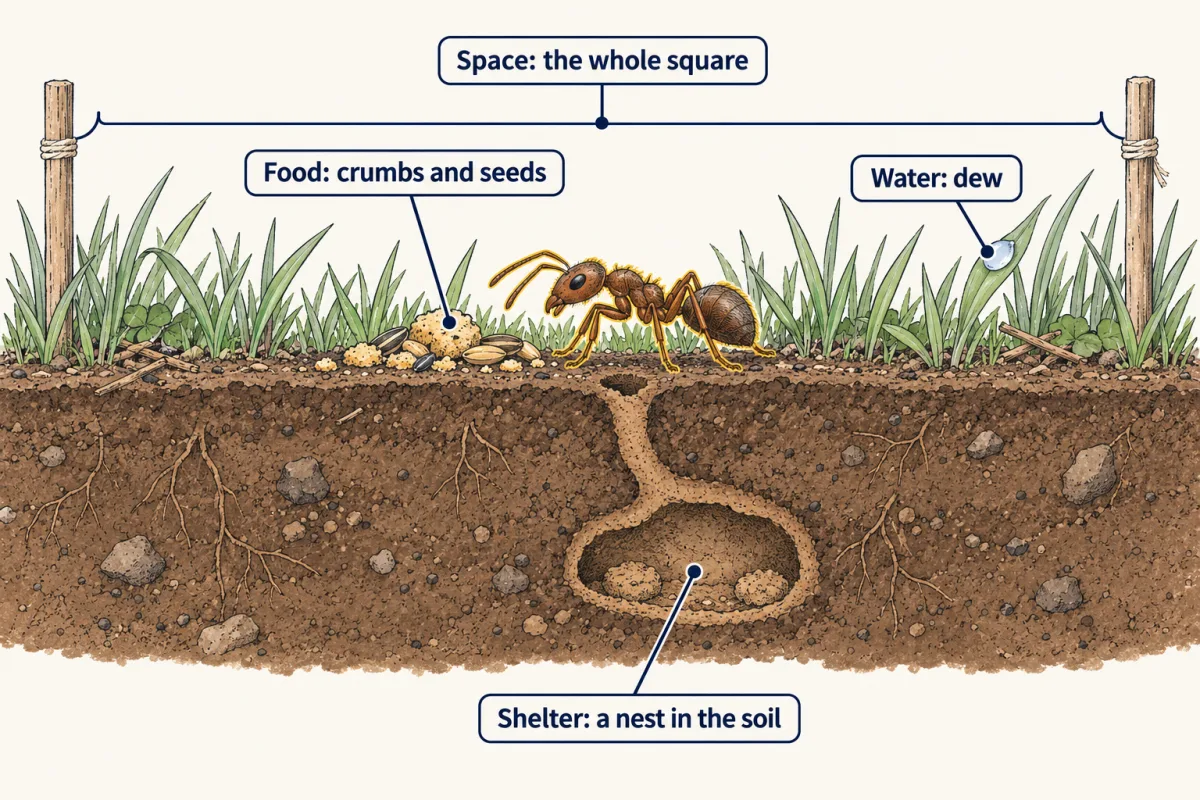
- Trace one animal’s habitat. Pick one animal your child spotted. Ask, “Where could it find food and water? Where could it hide? How much space might it use?” An ant might eat crumbs and seeds, drink dew, shelter in a soil nest, and use the square and nearby ground as space.
- Leave it as you found it. Pull up the sticks and string, and put back any leaves you moved.
With a class, give each group of three its own square and one job (counting, sorting or the four needs), then share results.
Two-question wrap-up
Bring your child back to the “Say it together” idea:
- “What living and nonliving things did we find that our animal might use?”
- “If we took away its water or its hiding place, what would happen?”
Questions to ask while you do it
Ask your child to guess first, then check.
- “How many animals do you think we’ll find? More or fewer than your fingers?”
- “I wonder what this ant eats. Where could it find water?”
- “What do you think is living under this log? Let’s guess before we look.”
- “Is the soil alive? Is anything in it alive?”
- “What do you think will happen to the pill bugs if we leave the log rolled over?”
- “If people built a patio on this square, which animals would have to move?”
What children often think
-
A child might say “A habitat is where an animal sleeps.”
You could try Ask, "Where does the ant eat? Where does it get water?" A habitat is more than a bed. It is the whole place that gives an animal food, water, shelter and space. Sleeping is only one use of shelter.
-
A child might say “Rocks and dirt aren’t part of a habitat. Only plants and animals are.”
You could try Ask what the pill bugs were doing under the log. They hide there because it is damp and dark. Soil, water, rocks and sunlight are nonliving parts of a habitat, and animals depend on them too. The pill bugs need damp soil and a dark hiding place as much as they need food.
-
A child might say “There’s nothing living in plain grass.”
You could try Don’t argue; count. Ten minutes on hands and knees usually turns up ants or spiders. And the grass is alive too, so the square already has many living things.
-
A child might say “The bugs under the log will be happier in our jar.”
You could try Ask, "Where does it get food and water in the jar? Where can it hide?" The log and the ground around it already give it those. That is why we look at it where it lives, and put the log back.
Why it works
A habitat is the place where an animal lives and finds what it needs. What counts depends on the animal, not on a label like “forest” or “yard.” A very small animal can meet all of its needs in a small space. A soil mite may spend its life in a small patch of soil and leaf litter, while a robin uses many backyards. That is why 1 square metre can hold parts of many animals’ habitats at once, though most animals you spot also use ground outside the square.
Under a log, the soil stays cooler and damper than in the open. Animals that dry out easily, such as pill bugs and salamanders, gather there. Rolling the log back matters because their shelter is part of their habitat; a log left upside down may dry out.
Habitats also change. Mowing, a dry spell, a new patio or a change of seasons can remove food, water or shelter. Unmowed or planted patches often hold more kinds of animals than short lawn, though results vary with the place and weather.
Easier and harder
Ages 5 to 7
Skip the log and the counting. Hunt for three living things and three nonliving things inside the square, and draw them. Pick one animal and draw it in its home, with something it eats, something it drinks and a place it hides. Five minutes of looking is plenty.
Ages 8 to 10
Compare two squares: one in mowed lawn and one in a garden bed or unmowed edge. Count animals for the same 10 minutes in each and make a bar graph. Count one kind, like one kind of ant, as a population. List all kinds together as the community. Then build a shoebox model of one animal’s habitat showing its food, water, shelter and space.
If it doesn’t go as planned
On a cold, hot or very dry day, small animals may stay hidden. Try early morning, after rain or in a shady spot with leaf litter. If your child loses interest, switch to a “find five” challenge: five animals, five plants, five nonliving things. If you find nothing under a log, put it back and try a damper place another day.
Observation sheet
Worked example: Animal: Ant · How many? Make a tally mark for each ant you see. · Where was it? Write the spot where you saw it. Possible food: crumbs and seeds · Possible water: dew on grass · Possible shelter: a nest in the soil.
Observation sheet
My habitat square
NameDate
Count and draw what you find inside your string square.
| Animal | How many? | Where was it? |
|---|---|---|
My animal gets food from:
It gets water from:
It hides in:
stemhop.com · Biology Together
For teachers: Virginia standards
Virginia’s Science Standards of Learning name food, water, air, shelter and space as animal needs. In Virginia’s kindergarten and grade 2 framework, once-living items such as rotting leaves and logs are grouped as living.
The three stories, told aloud Side Hops: three stories that go with this lesson Side Hops
Three playful ways to talk about backyard habitats
1:44 · Narration: an AI narrator voice (Kokoro, af_heart).
Read the transcript
Here are three playful ways to help the habitat idea click while you are outside together. First, the worm line. If your child looks at plain brown dirt and says it cannot be part of anyone's home, try saying, "A worm breathes through its skin, so damp dirt is part of its home." Earthworms have no lungs at all. They breathe right through their moist skin, and they need soil about as damp as a wrung-out sponge. Suddenly the mud matters. Second, the sponge test. If you looked under a log, gently roll it back while your child stands back. Then wet two matching kitchen sponges with the same amount of water and set them on a sunny outdoor table. Cover one with an upside-down bowl. Later in the day, let your child squeeze both. Pill bugs are crustaceans, not insects, and they dry out easily. They even curl into a tight ball to hold in water. That is why the log goes back. Third, the bee patch. On a walk, find a short, freshly mowed lawn next to a taller patch full of clover and dandelions. Keep your child close, stay a step back, and watch the bees without touching them. Forest Service researchers and their colleagues studied sixteen yards. Lawns mowed every three weeks had about two and a half times as many lawn flowers as lawns mowed every week. Lawns mowed every two weeks had the most bees, but fewer kinds of bees. Ask your child which patch looks like a better place to be a bee, and let them tell you why. Happy hunting.
The idea underneath them. You and your child mark a one-metre square of yard or park with string and look closely at everything in it, or gently roll a log and put it back.
Your notes
Select any text in the lesson to highlight it or add a note to it. Your highlights and notes are saved in this browser and collected in your notebook.
This browser is not letting the site save anything (a private window or strict privacy settings), so highlights and notes will be lost when you leave the page.
Where this lesson fits
Before thisReview first
- Alive or Not?This course · Lesson 1
Your child needs to sort living from nonliving things there to make the two lists here.
After thisStudy next
- Who Eats Whom?This course · Lesson 21
It takes the food that animals find in their habitat and shows who eats whom.
- Creek CrittersThis course · Lesson 30
It repeats this close looking and counting in a creek habitat, with different animals living there.
- Soil ShakeThis course · Lesson 23
It looks closely at the soil that many square-metre animals use for shelter.
Elsewhere on the siteFilms, simulations and method films in other courses
- Two Sides of Every EcosystemFilm · Life Science
It shows how living and nonliving parts of a place decide which animals can live there.
Suggested by an AI model from the lessons themselves, then checked. How we use AI
Those are the stories. The idea under them is the one the lesson builds.
That is the film. The rest of the activity is the fun part.
The rest of the activity is here when you want it.
Finish line
Test yourself
4 questions
Questions to talk over together.
Next · Lesson 20
Make a Fossil Print
How do we know what lived here before people? Making fossil prints shows how a shell or a footprint can be saved in rock.
Continue →Rewritten on : new text and film. Notes and highlights stay, but the text around them may have moved.