How a Signal Marks One Protein
Read the transcript of “How a Signal Marks One Protein”
Film transcript: How a Signal Marks One Protein
A cell holds many proteins. How can oxygen make it destroy HIF-1α and spare the rest? Watch the target, not the tag. Yellow ubiquitin is reusable. Grey proteins are possible targets. Green E3 is the selector. E1 spends ATP to activate ubiquitin, then holds it temporarily.
E2 receives and carries that activated tag. E3 brings loaded E2 beside a target it recognizes. Ubiquitin usually lands on a target lysine. The tag is common; recognition makes the transfer selective. The same relay can serve many targets because the selector can change. Different E3 receptors fit different target features. E1 and E2 keep ubiquitin moving. The E3 receptor decides which grey block enters the green grip. A degron is the target feature an E3 recognizes. It can be a short sequence, a chemical change, or both. Signals can create that feature or strengthen its contact. Signals change protein fate by changing what an E3 can recognize.
Now follow oxygen into this rule. HIF-1α is made continuously in the cells pictured here. When oxygen is available, a prolyl hydroxylase uses it as a reaction substrate. The enzyme adds a hydroxyl group to a proline on HIF-1α. That small badge completes a degron. Here are two HIF-1α targets. One carries the hydroxyl badge, and one does not. Which target will VHL grip?
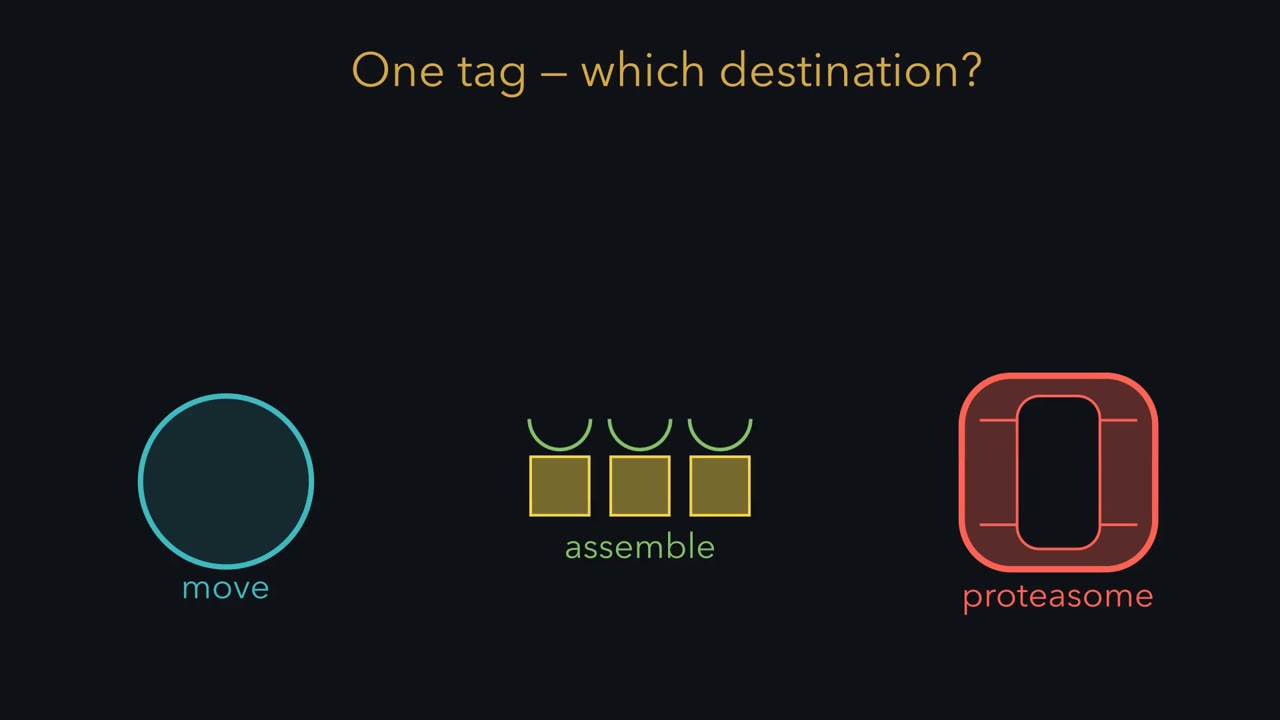
VHL closes around the hydroxylated target. A peptide with hydroxyproline bound VHL tightly without cell extract. The same peptide with ordinary proline did not. The modification itself supplies the recognized feature. Once VHL holds HIF-1α, the ligase builds a ubiquitin chain. A red proteasome accepts the marked target and breaks it down. New HIF-1α keeps entering the system. With oxygen, removal keeps its level low. When oxygen falls, the hydroxylase completes its reaction less often. Fewer HIF-1α molecules gain the badge. VHL finds fewer targets, while synthesis continues.
HIF-1α accumulates, pairs with ARNT, and helps switch on low-oxygen genes. Notice what changed and what stayed shared. Oxygen changed the target feature VHL could read. It did not invent a new ubiquitin or proteasome. Signals change protein fate by changing what an E3 can recognize.
Why would a cell build a protein only to destroy it within minutes?
Continue in the lesson: Ubiquitin and Regulated Proteolysis as Signals →
3:29 · Free, with captions and a transcript. The lesson has the full text, the questions and the sources.
More films from this lesson
How this film was made. Narration: written from this lesson's text and read by an AI narrator voice (Kokoro, af_heart). Animation: AI-generated in code (Manim) by Claude, a schematic with no drawn molecular structures. Captions come from the narration script. See something wrong? Report it.