Two Lines, Two Crossings
Read the transcript of “Two Lines, Two Crossings”
Film transcript: Two Lines, Two Crossings
Touch and pain enter the cord by the same root. How can one cut remove touch on one side, pain on the other? Picture a slice through the cord, back at the top. Touch runs in blue, pain in red. The blue line carries fine touch, vibration and position sense. Its main branch climbs on its own side, with no synapse until the medulla. Other branches synapse in the dorsal horn. There, a second axon crosses and climbs to the thalamus. A thalamic neuron relays the signal to cortex. So the blue line crosses in the medulla. The red line carries pain and temperature. Its sensory axon synapses in the dorsal horn, near where it entered. The next axon crosses within a segment or two, and climbs the opposite side.
So the red line crosses in the spinal cord. Now cut the right half of the cord at the tenth thoracic segment, Which side loses touch, and which loses pain? Fine touch, vibration and position sense are lost on the right. The blue line has not crossed yet. Pain is lost on the left. The red fibres in the right half have already crossed from the left. Now look closer. Follow one left pain fibre entering one segment below the cut. In this simple example, its pathway reaches the other side a segment or two higher. Crossing at the cut, it is lost. Crossing above the cut, it is spared.
So the pain loss on the left begins one or two segments below the cut. On the right, at the cut itself, a narrow band can lose sensation too. The cut damages the sensory fibres entering there, and the dorsal horn they reach. Fine touch lost on one side and pain on the other is the core of the Brown-Séquard pattern. Run it backwards. Pain is lost in the right leg, vibration in the left. Which half of the cord is cut?
The left half. Vibration rides the blue line, which stays on its own side. For these two routes, where a line crosses tells you where the damage is.
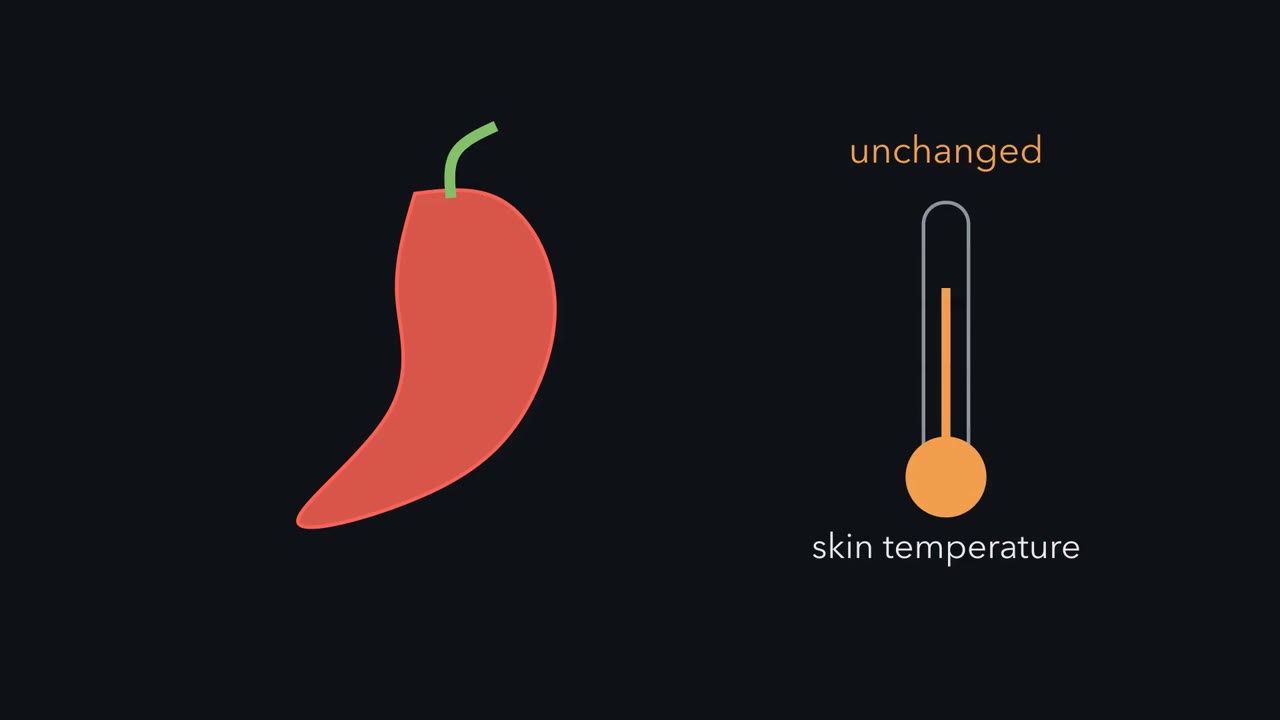
Capsaicin carries no heat, yet it opens the same channel that heat above about 43 °C opens. What is the skin actually measuring?
Continue in the lesson: Touch and Pain →
2:33 · Free, with captions and a transcript. The lesson has the full text, the questions and the sources.
More films from this lesson
How this film was made. Narration: an AI narrator voice (Kokoro, af_heart) reading narration written from this lesson's text. Animation: AI-generated in code (Manim) by Claude, a schematic with no drawn molecular structures. Captions come from the narration script. See something wrong? Report it.