Turning the Report Up and Down
Read the transcript of “Turning the Report Up and Down”
Film transcript: Turning the Report Up and Down
Why can the same touch feel fine one day and hurt the next? After a mild sunburn, a brushing shirt hurts. A shower that used to sting a little now hurts a great deal. Pain from a normally harmless touch is allodynia. Greater pain from something already painful is hyperalgesia. Same stimulus, different report. Its size can be reset at three levels. First, the ending. Injured tissue releases mediators such as bradykinin, which sensitize nociceptors. Second, the dorsal horn. Here, touch can change pain. Bang your shin and you rub it. Gentle rubbing mainly excites touch fibres, yet it hurts less. In 1965, Ronald Melzack and Patrick Wall proposed a gate.
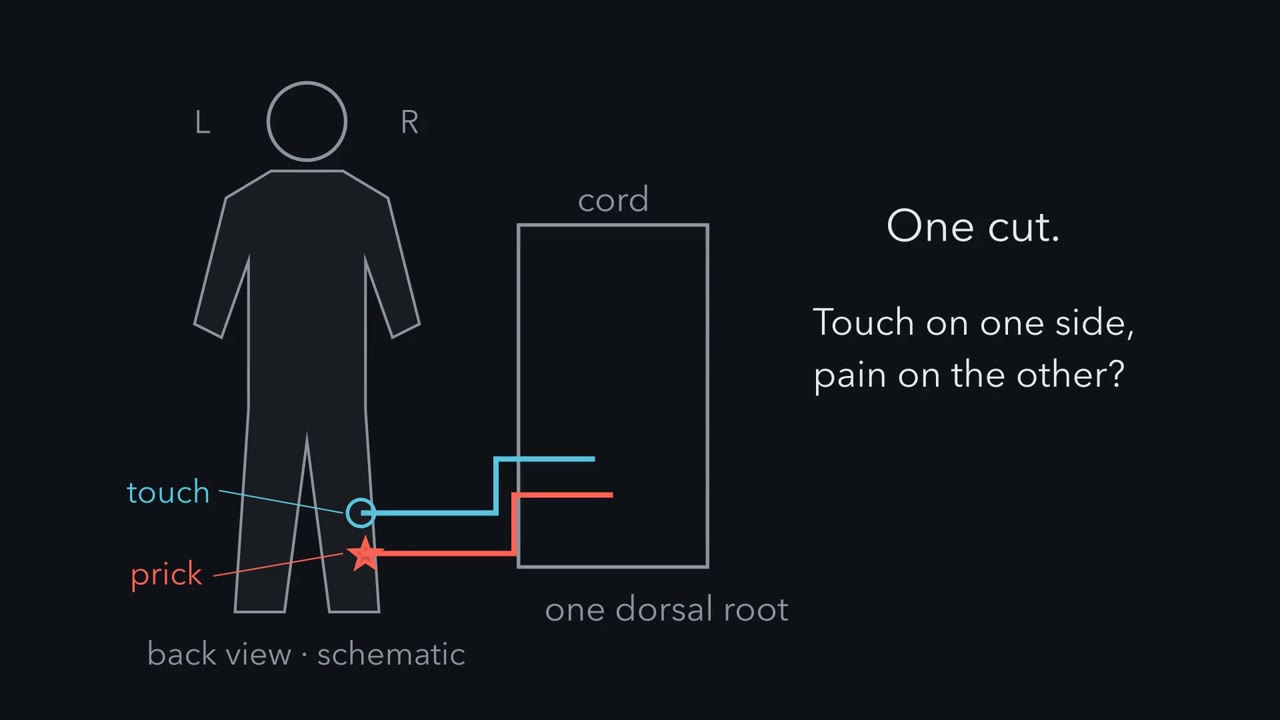
Picture two cells. A transmission cell sends the signal up, excited by both touch and pain fibres. An inhibitory interneuron damps that cell. Touch fibres excite the interneuron. Pain fibres suppress it. So rubbing adds damping, and less signal goes up. But touch also excites the transmission cell directly. Rubbing helps only if the added damping wins.
In their 1965 diagram, the damping acted on the incoming fibres themselves. This circuit is a simplified version. Now remove the inhibitory interneuron. What does a light touch do? Nothing damps touch now. Touch alone can drive the transmission cell, sending a signal up the pain line. In 2014, Duan and colleagues removed inhibitory neurons of the dynorphin lineage in mice. Now light touch evoked pain-like withdrawal. Touch input was driving a pain line. That tests one form of spinal gating in mice, not the 1965 diagram as drawn. Third, the brainstem. It projects down to the dorsal horn, and can turn its signals up or down. In rodents, one group of cells, called ON cells, bursts just before a withdrawal from heat. Another group, called OFF cells, pauses just before it.
OFF cells suppress pain-related processing, and ON cells facilitate it. Control runs both ways. A withdrawing paw is indirect evidence about pain. By itself, it does not show what the animal feels. A nociceptor's firing is a report. Pain is what the nervous system makes of it.
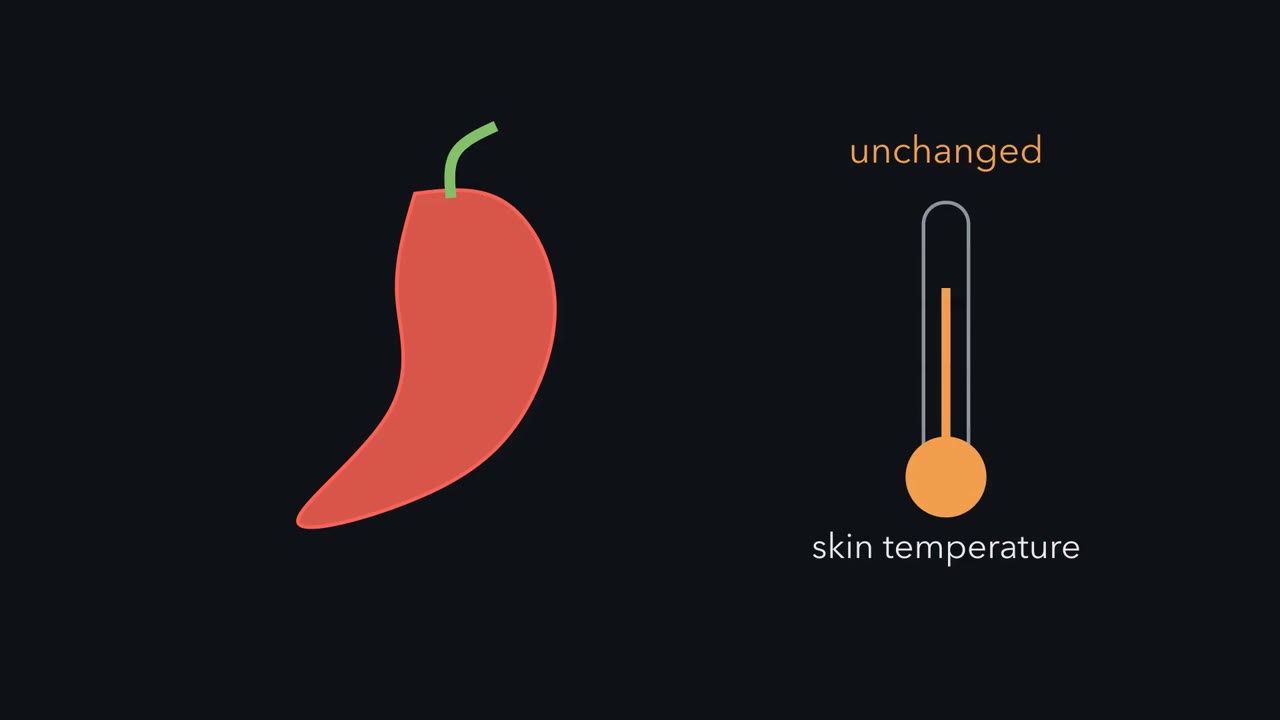
Capsaicin carries no heat, yet it opens the same channel that heat above about 43 °C opens. What is the skin actually measuring?
Continue in the lesson: Touch and Pain →
2:52 · Free, with captions and a transcript. The lesson has the full text, the questions and the sources.
More films from this lesson
How this film was made. Narration: an AI narrator voice (Kokoro, af_heart) reading narration written from this lesson's text. Animation: AI-generated in code (Manim) by Claude, a schematic with no drawn molecular structures. Captions come from the narration script. See something wrong? Report it.