A Cell Keeps Its Answer Ready
Read the transcript of “A Cell Keeps Its Answer Ready”
Film transcript: A Cell Keeps Its Answer Ready
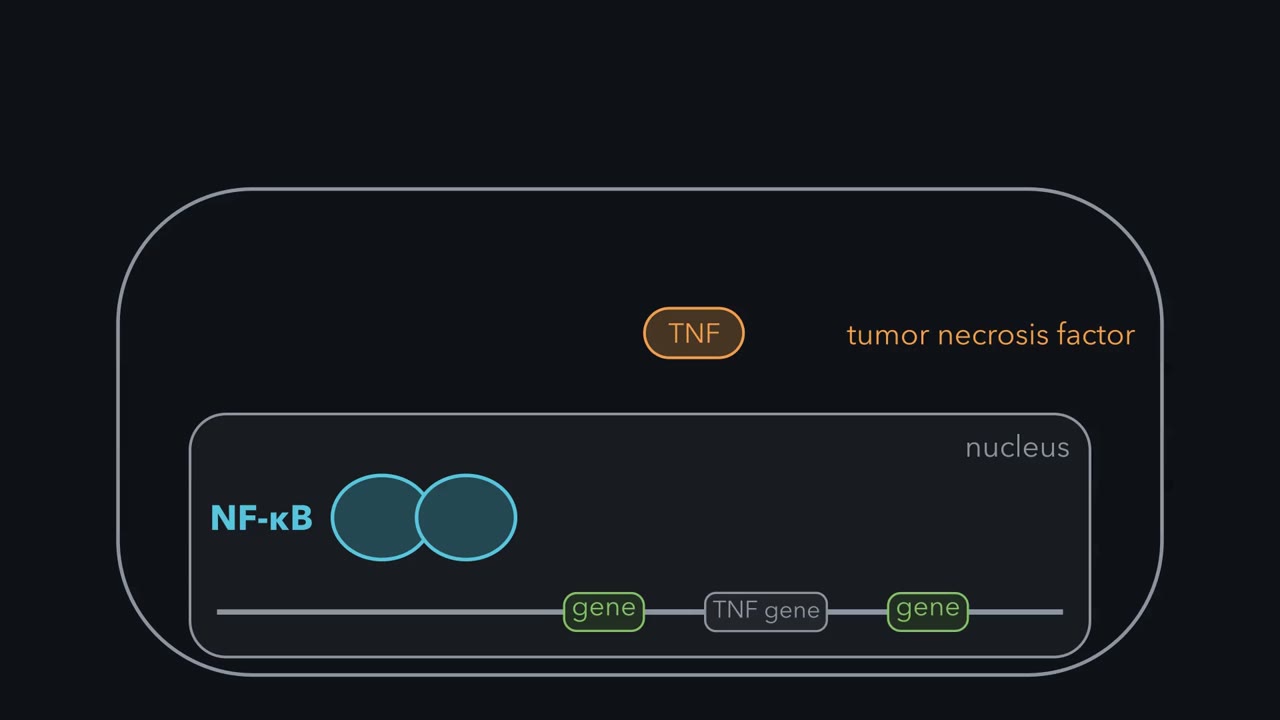
How does a cell recognize an enemy it has never met, and answer within minutes? A macrophage is a white blood cell that swallows microbes. Within minutes of touching a bacterium, it begins to change its gene expression. So what links a touch at the membrane to genes in the nucleus? The answer was waiting in the cytoplasm the whole time. The answer is NF-κB, a transcription factor. It is a pair of proteins that bind DNA and switch genes on. In a resting cell, it is already made and folded. It waits in the cytoplasm, held by its inhibitor, IκB. IκB covers the signal that would send NF-κB into the nucleus. A bacterial molecule, lipopolysaccharide, holds two Toll-like receptors side by side. The pair docks an adaptor, MyD88, which stacks with IRAK kinases into a tower.
An activated IRAK binds TRAF6, which builds a ubiquitin chain joined through lysine 63. Together with head-to-tail chains, it gathers TAK1 next to IKK. TAK1 switches on IKK, the IκB kinase. IKK adds two phosphates to IκB. Even then, IκB still holds NF-κB. A second ligase adds a chain joined through lysine 48. That chain sends IκB to the proteasome, which destroys it. Now nothing covers the signal that sends NF-κB into the nucleus. Now NF-κB, already folded, enters the nucleus. The two proteins wrap around the DNA, and each reads one half of its site. NF-κB switches on its genes. Nothing had to be transcribed or translated first. So NF-κB reaches its genes within minutes.
Take a cell line with no NF-κB activity, and block its protein synthesis. Lipopolysaccharide still makes the activity appear. So the protein must already have been there, inhibited. Here is the rule. Finish the activator, hold it outside the nucleus, and remove its inhibitor when the signal comes.
How does a cell recognize an enemy it has never met, and answer within minutes?
Continue in the lesson: Innate Immunity: Toll-like Receptors and NF-κB →
2:24 · Free, with captions and a transcript. The lesson has the full text, the questions and the sources.
More films from this lesson
How this film was made. Narration: an AI narrator voice (Kokoro, af_heart) reading narration written from this lesson's text. Animation: AI-generated in code (Manim) by Claude, a schematic with no drawn molecular structures. Captions come from the narration script. See something wrong? Report it.