Take Away the Cool Line
Read the transcript of “Take Away the Cool Line”
Film transcript: Take Away the Cool Line
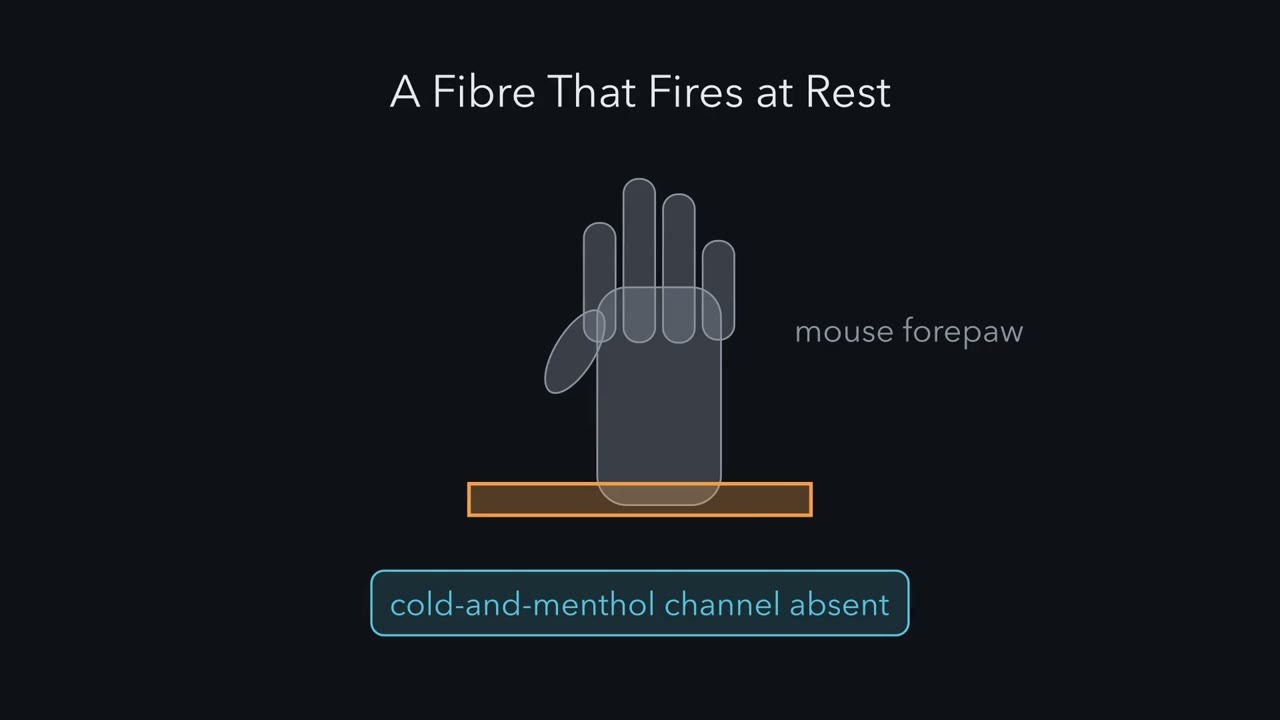
If warming quiets the cool line, what happens to warmth when that line is gone? First, the task. A head-fixed mouse rests a forepaw on a small plate at 32 degrees. It licks to report a change. Trained mice reported a warming step of 1 degree. A mouse that licked on every trial would score hits without detecting anything. So some trials are catch trials, with no temperature change. A lick then is a false alarm. An index called d′ compares the two. It separates detection from how freely the mouse licks. Licking as often on catch trials as on warming trials gives a d′ prime near zero.
Now the knockouts. TRPM8 is the main channel behind the cool fibres' response to cooling. Remove it. What happens to the cool fibres' resting firing? And can the mouse still report warming? Without TRPM8, the cool fibres lose their ongoing firing. Warming has nothing left to silence. And the mice failed completely to report warming, even after 10 days of training.
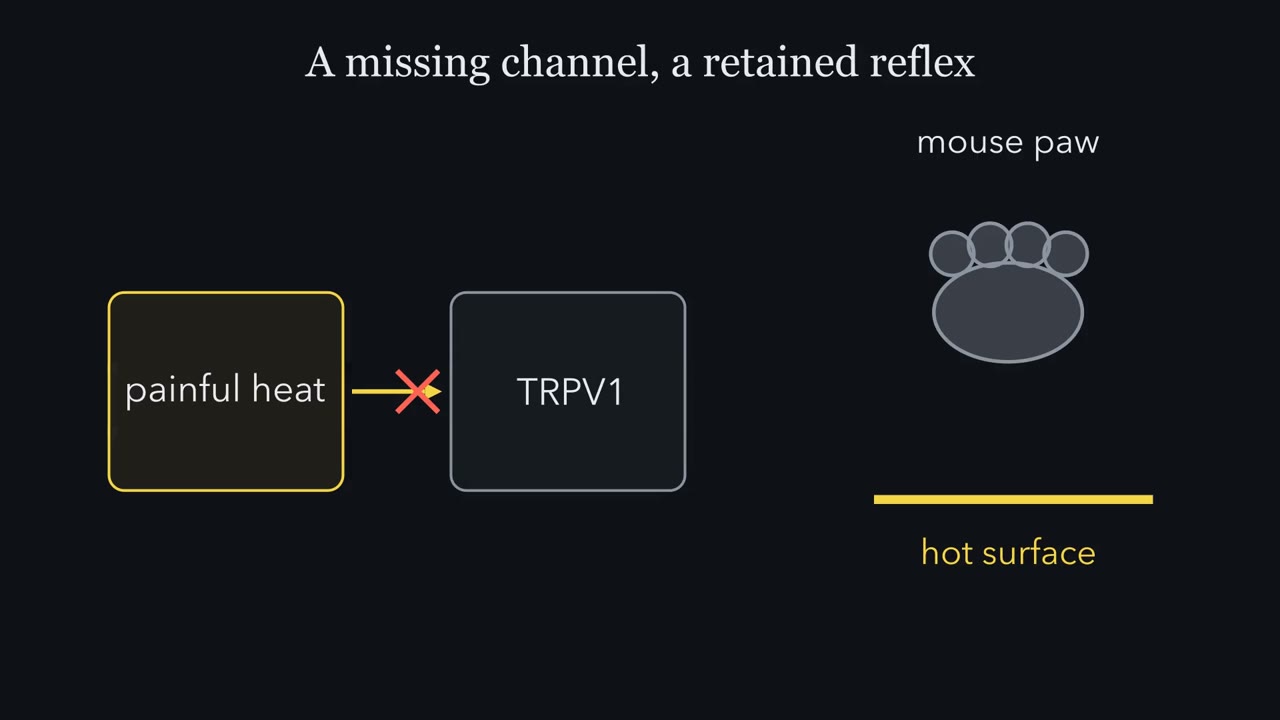
Not because heat opens TRPM8. Removing it removes the firing whose fall is part of the warmth signal. Now remove heat channels instead. Mice without TRPV1, or without TRPM2, still detected warming. Even mice lacking three heat channels still detected warming, with reduced sensitivity. Heat-channel loss blunts. TRPM8 loss abolished the cold report in this task. And TRPM8 knockout mice still had warm-excited fibres, in normal proportions. If each line alone were enough to drive a report, the remaining warm responses should have supported one. In these mice, they did not.
The findings support a role for reduced cool input. Warm-excited input may also contribute, but its separate effect on sensitivity was not isolated. How the brain combines the two lines is not known. One gap remains. The resting cool firing was recorded in isolated skin, not in a behaving mouse. The skin under the stimulator sat at the same 32 degrees. Joining the two is still an inference, not a recording. Another preparation points the other way. In mouth-warming experiments, blocking TRPV1 removed the imaged warmth responses. So does gentle warmth rest mainly on warm fibres, or on quieter cool fibres? That is not settled. Keep the bath in mind.
A resting condition is part of the stimulus, not a neutral background.
Mice lacking the cold-and-menthol receptor TRPM8 failed completely to learn to report forepaw warming in a 10-day task. Why would a cold receptor matter for warmth?
Continue in the lesson: Hot, Warm, Cool and Cold →
3:15 · Free, with captions and a transcript. The lesson has the full text, the questions and the sources.
More films from this lesson
How this film was made. Narration: an AI narrator voice (Kokoro, af_heart) reading narration written from this lesson's text. Animation: AI-generated in code (Manim) by Claude, a schematic with no drawn molecular structures. Captions come from the narration script. See something wrong? Report it.