A Cut That Shifts the Frame
Read the transcript of “A Cut That Shifts the Frame”
Film transcript: A Cut That Shifts the Frame
Proteins headed for the cell surface fold inside the endoplasmic reticulum. If unfolded chains arrive faster than they can be folded, the cell needs to know. The unfolded protein response does this with three sensors. One is IRE1, which spans the membrane. When unfolded protein builds up, IRE1 molecules cluster. Clustering switches on an RNA-cutting activity in their cytoplasmic ends. In its best-known job, IRE1 cuts a segment out of one messenger RNA. In animals, that message is XBP1. A ligase then joins the ends. Only the spliced message yields an active transcription factor. Look at the piece that is removed. In XBP1 it is 26 nucleotides. That is not a multiple of three.
So the reading frame shifts, and the protein gains a new tail. That factor orders more chaperones. Chaperones help proteins fold, so folding capacity rises. This is the repair branch. Keep this order. IRE1 clusters. The message is cut and joined. The frame shifts. An active factor appears.
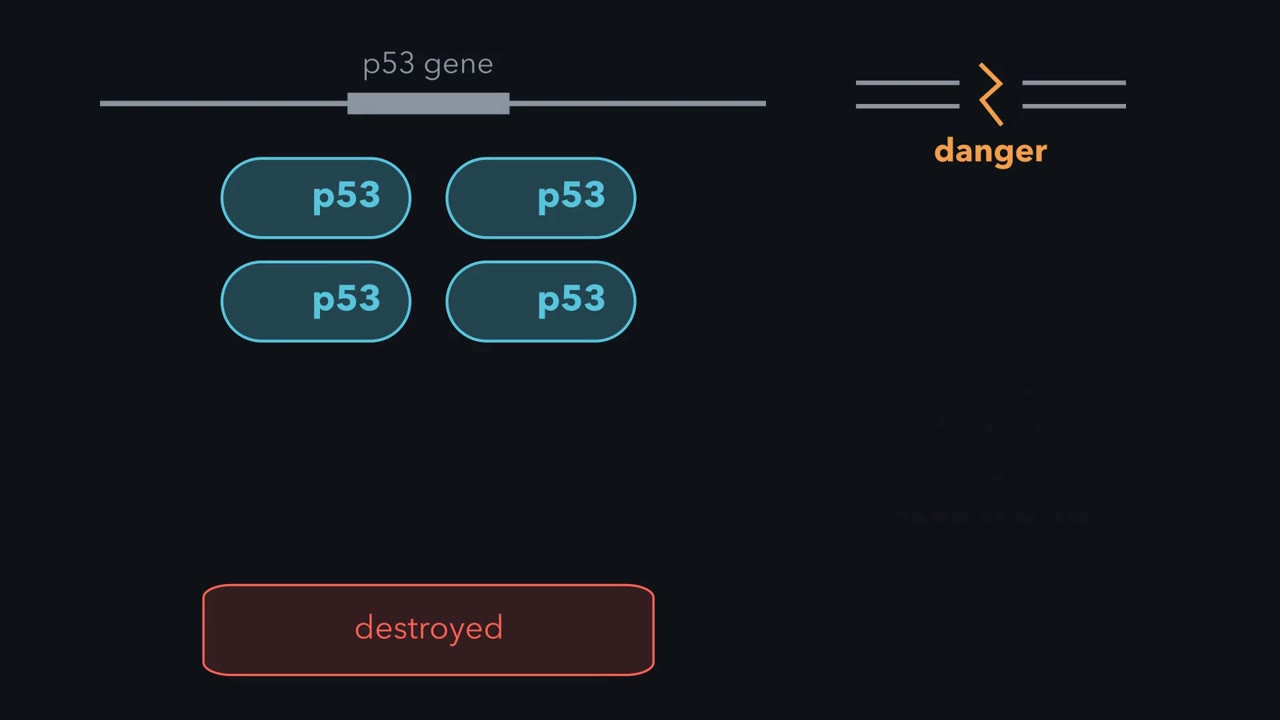
Your cells build p53 all day and destroy it almost as fast. Why make a guardian only to shred it?
Continue in the lesson: Stress Signals: p38 and JNK, p53, Unfolded Proteins and Oxidants →
1:36 · Free, with captions and a transcript. The lesson has the full text, the questions and the sources.
More films from this lesson
How this film was made. Narration: an AI narrator voice (ElevenLabs, Sarah) reading narration written from this lesson's text. Animation: AI-generated in code (Manim) by Claude, a schematic with no drawn molecular structures. Captions come from the narration script. See something wrong? Report it.