Isolation Follows Ecology
Read the transcript of “Isolation Follows Ecology”
Film transcript: Isolation Follows Ecology
If barriers are side effects of adapting to different habitats, isolation should follow the habitat. So what happens when fish adapted to the same habitat, but from different lakes, meet? In the monkeyflowers, the strongest early gates were habitat and pollinators.
Were those gates built to keep the species apart? Or did they come free with adaptation? One answer is divergent selection, which favours different traits in different places. Two populations adapt to different habitats, and mating between them falls as a side effect.
No one designs the barrier. Selection acts on individuals, and isolation appears along the way. Isolation that arises like this is called ecological speciation. How could you test it? Use evolution that repeated itself. Several small lakes in British Columbia each hold two forms of threespine stickleback. The benthic form feeds on the bottom. The limnetic form feeds in open water. Each lake's pair is thought to have arisen on its own. Rundle, Schluter and colleagues ran hundreds of laboratory mating trials, with fish from three lakes. They paired fish of the same and different forms, from the same and different lakes. A benthic fish from one lake meets a benthic fish from another lake.
Their ancestors split apart separately. Will they mate? Yes. Same-form pairs from different lakes showed no strong isolation. But benthic and limnetic fish were strongly isolated, whichever lakes they came from. Look at what each idea predicted. If ancestry mattered, fish from one lake would mate best. If ecology mattered, fish of one form would mate best, wherever they came from. So isolation followed ecology, not ancestry.
Drift alone would be unlikely to repeat the same pattern lake after lake. Divergent selection is the likely cause. Now return to the monkeyflowers. The red one grows mainly at lower elevations, the pink one higher up. Their flowers suit different pollinators. The pink flower is wide, with a small nectar reward, and bumblebees visit it. The red flower has a narrow tube and a large reward, and hummingbirds visit it. Those adaptations are themselves the gates.
Plants adapted to different elevations rarely meet. A pollinator that favours one flower carries little pollen to the other. Fish or flowers, the lesson is the same. Adapt to different places and partners, and isolation often grows as a side effect.
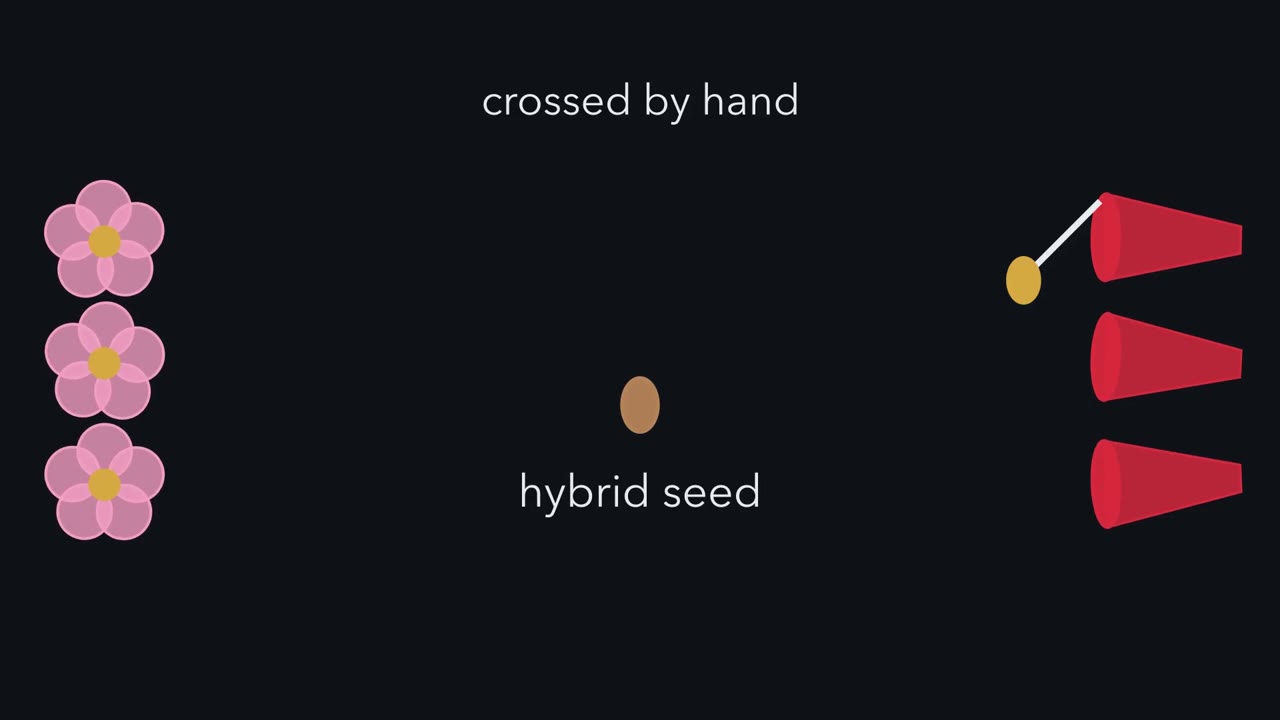
Two monkeyflowers can be crossed by hand, yet they almost never exchange genes in the wild. What barriers hold them apart, and how did adapting to different places and pollinators build those barriers?
Continue in the lesson: Speciation: How Barriers to Gene Flow Evolve →
3:25 · Free, with captions and a transcript. The lesson has the full text, the questions and the sources.
More films from this lesson
How this film was made. Narration: an AI narrator voice (Kokoro, af_heart) reading narration written from this lesson's text. Animation: AI-generated in code (Manim) by Claude, a schematic with no drawn molecular structures. Captions come from the narration script. See something wrong? Report it.