Two Kinds of Zero
Read the transcript of “Two Kinds of Zero”
Film transcript: Two Kinds of Zero
Sources, rescue and corridors all rest on one record: which ponds are occupied. Three visits, no toads heard. Is the pond empty? A survey sheet would simply score it as a zero. A zero on a survey sheet has two meanings. The pond may truly be empty. Or toads were there, and the observer missed them on every visit. So surveyors return to each site several times in one season, while occupancy is assumed not to change. Each visit scores a one for detected, and a zero for not. Three visits give a history, like 110, or 010. A 010 history shows a pond that was occupied, and missed twice. Take eight ponds that really hold toads. Each visit detects them with a probability of one half, independently of the other visits. After three visits, how many ponds look empty?
About one, on average. With independent visits, three misses in a row happen one time in eight. Each extra visit halves that chance again. Harder species are missed more often. When each visit finds them only 3 times in 10, about 1 occupied pond in 3 comes out all zeros. No single site can settle it, but many sites together can.
Across them, the pattern of histories carries the answer. A model estimates the chance of detection and the fraction occupied, together. A naive count lights only the ponds with a detection. The corrected estimate is higher, because some silent ponds hold toads. Treat every silent pond as empty, and occupancy is counted low. Darryl MacKenzie and colleagues published this method. They tested it on volunteer surveys of wetlands in Maryland, made two years earlier. American toads were detected at least once at only about a third of the wetlands analysed. The model put the fraction occupied near one half. The method has rules of its own. Occupancy must stay fixed across a season's visits.
Toads must never be recorded where they are absent. And detection must be independent among sites and among visits. So a zero is a result of looking, not proof of absence. How hard you looked belongs in the analysis, before any pond is called empty.
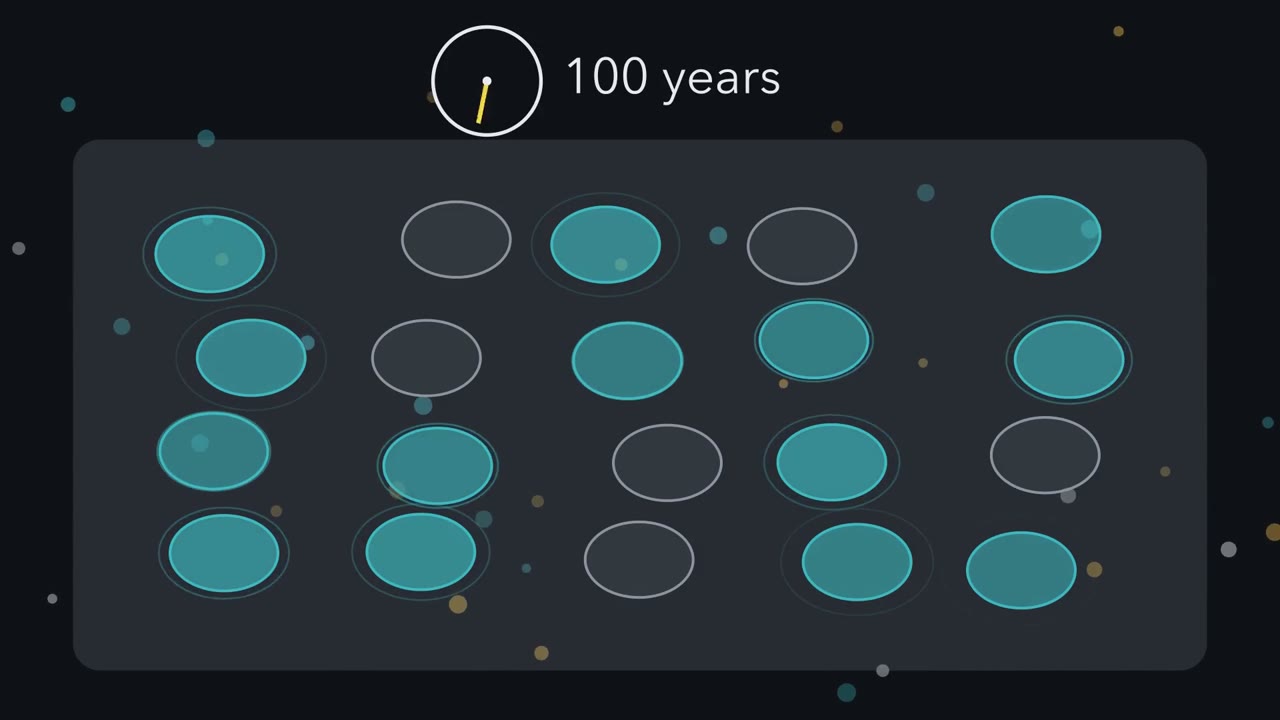
If each pond's frogs last only about a decade, why can a region still have frogs a century later?
Continue in the lesson: Movement and Spatial Populations →
2:58 · Free, with captions and a transcript. The lesson has the full text, the questions and the sources.
More films from this lesson
How this film was made. Narration: an AI narrator voice (Kokoro, af_heart) reading narration written from this lesson's text. Animation: AI-generated in code (Manim) by Claude, a schematic with no drawn molecular structures. Captions come from the narration script. See something wrong? Report it.