Does Every Gram Cost the Same?
Read the transcript of “Does Every Gram Cost the Same?”
Film transcript: Does Every Gram Cost the Same?
A human is more than two thousand times heavier than a mouse. Does the human burn two thousand times as much energy every day? The first film showed why a thick, busy body pumps blood and air. That flow has to deliver whatever the tissue burns. So how much does a body burn? In 1883, Max Rubner asked a simple question. Does every gram of an animal cost the same to run? He studied resting dogs of many sizes. Dogs suit the question well. One species spans a wide range of sizes. So size can change without changing the kind of animal. Take one dog that is ten times heavier than another. If every gram cost the same, it would make ten times the heat.
Does it? No. Total heat rose with size, but much less steeply than mass. Each kilogram of a small dog made more heat than each kilogram of a big one. Then Rubner divided each dog's heat by its estimated body surface. The values came out roughly equal. Heat tracked surface more closely than mass. In 1932, Max Kleiber gathered resting rates for animals from rats to steers. He plotted them on logarithmic axes, where a power law becomes a straight line. Metabolic rate equals a constant, called a, times body mass raised to a power, called b. On these axes, b is the slope of the line. If b were one, every kilogram would cost the same. Kleiber's line had a slope near three quarters.
Rubner's surface rule implies two thirds. Now place a mouse and a human on the widely used three-quarter fit. The human burns far more in total, but only a few hundred times more. Divide each by body mass. Each kilogram of mouse burns about seven times as much as each kilogram of human. That is a fitted prediction, not a single measurement. In most comparisons of adult mammals and birds, b is positive but below one. So total rate rises more slowly than mass, and rate per kilogram falls as mass rises. Treat three quarters as a fit, not a law. The exponent changes with the animals, their state and the method. Its cause is still debated. So across most adult mammals and birds, bigger animals burn more in total.
But they burn less per kilogram.
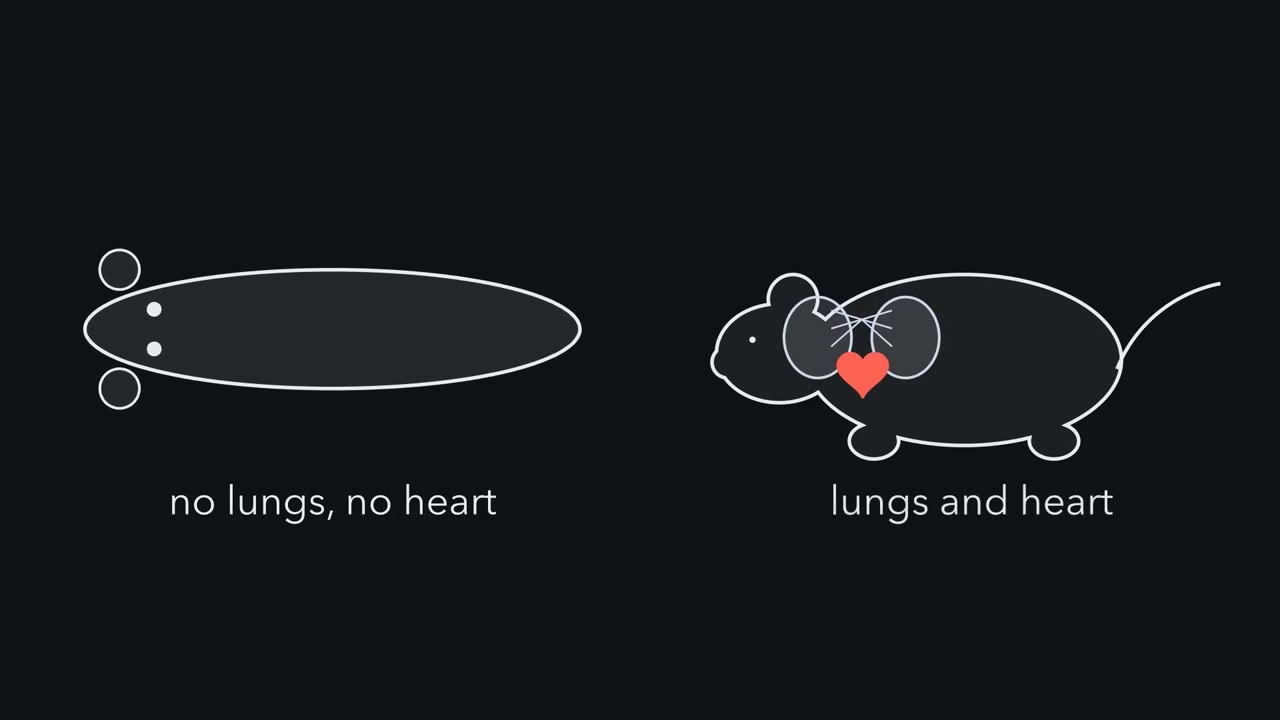
A flatworm has no lungs and no heart. Why can't a mouse manage the same way?
Continue in the lesson: Size, Scale and Surface →
3:05 · Free, with captions and a transcript. The lesson has the full text, the questions and the sources.
More films from this lesson
How this film was made. Narration: an AI narrator voice (Kokoro, af_heart) reading narration written from this lesson's text. Animation: AI-generated in code (Manim) by Claude, a schematic with no drawn molecular structures. Captions come from the narration script. See something wrong? Report it.