Press play to start at .
Pairing Up to Launch the Second Wave
From the film
- Paired factors widen gene choices and drive a slower second wave.
- A bZIP factor joins two helices along a leucine zipper and grips two DNA half-sites with positively charged tips.
- If n proteins pair freely they make n(n + 1) / 2 pairs, while flanking charges rule out unstable pairs such as Fos–Fos.
- First-wave c-fos mRNA makes Fos protein, which pairs with Jun to form AP-1 and switch on slower second-wave genes.
Read the transcript of “Pairing Up to Launch the Second Wave”
Film transcript: Pairing Up to Launch the Second Wave
Tap a sentence to play from there.
- 0:02 In the first film, signals flipped pre-made factors to launch genes in minutes.
- 0:08 How does a cell build many distinct DNA switches from few genes, and stretch a brief signal into hours?
- 0:16 Many nuclear factors belong to the basic leucine zipper, or bZIP, family, including CREB. A bZIP protein cannot grip DNA well alone; it works as a pair.
- 0:29 Two helices zip along a stripe of leucines.
- 0:33 Below that zipper, positively charged tips, drawn to negatively charged DNA, part like chopsticks to grip two half-sites.
- 0:42 Pairing multiplies choices, because swapping one partner changes which DNA site the pair prefers. With n proteins that all pair freely, the count is n × (n + 1) / 2.
- 0:56 That counts same-partner pairs plus mixed pairs.
- 1:00 Take 3 proteins: 3 × 4 = 12; 12 / 2 = 6 distinct pairs.
- 1:08 In real cells, not every pair is stable.
- 1:12 Two bZIP families, Jun and Fos, build the factor AP-1.
- 1:17 Jun pairs with Jun or with Fos.
- 1:19 Fos cannot pair stably with itself, because negatively charged residues beside its zipper repel each other.
- 1:27 Try the partner rule yourself.
- 1:31 Suppose a cell makes 2 Jun proteins and 2 Fos proteins.
- 1:36 Pause and predict: with no Fos–Fos pairs allowed, how many distinct pairs can form?
- 1:47 Seven pairs, because the rule removes only the Fos–Fos pairs.
- 1:52 2 Jun proteins make 3 Jun–Jun pairs: 2 × 3 / 2 = 3.
- 1:59 2 Fos × 2 Jun add 4 mixed pairs.
- 2:03 3 + 4 = 7. Four free proteins would make 4 × 5 / 2 = 10.
- 2:10 Swapping partners also tunes DNA grip.
- 2:14 A Fos–Jun pair holds DNA more tightly than Jun–Jun.
- 2:19 It also prefers a 7-letter DNA site, one letter shorter than CREB's 8-letter site.
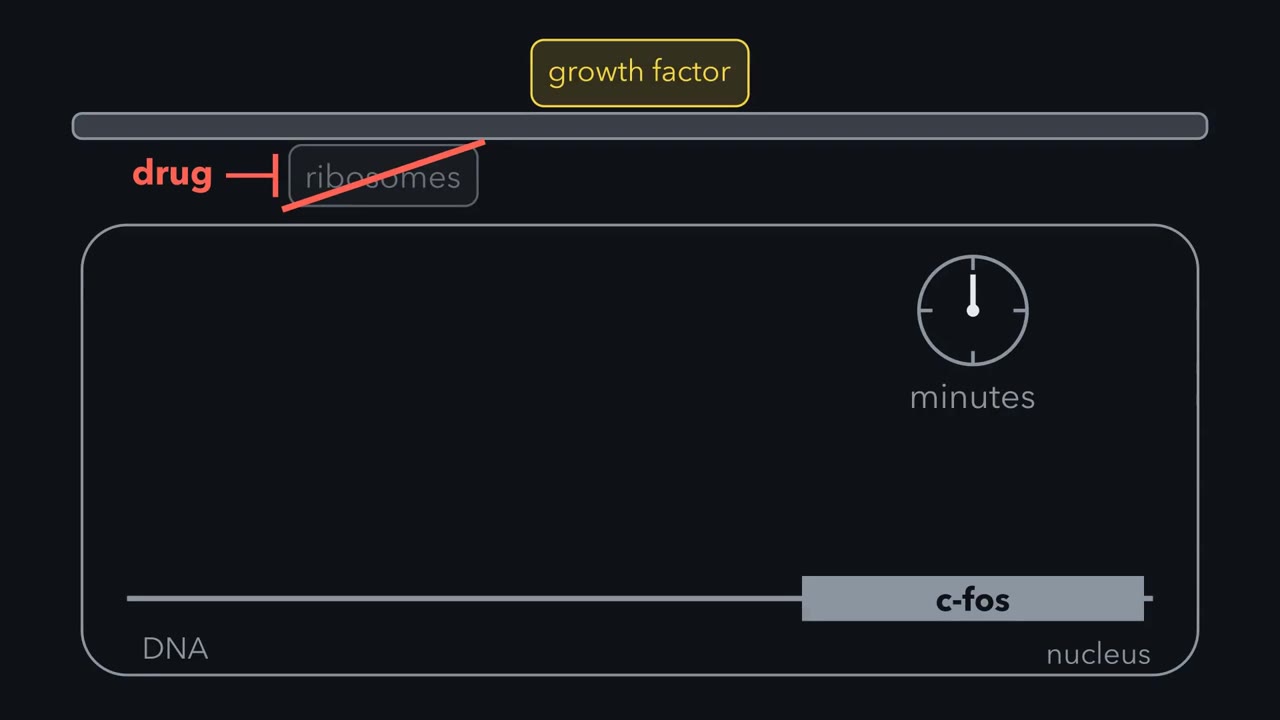
- 2:26 Back to the first film's gene, c-fos.
- 2:28 Pre-made factors switch on c-fos transcripts within minutes.
- 2:35 When ribosomes are running, those transcripts build new Fos protein.
- 2:41 Fos enters the nucleus and zips with Jun to form AP-1.
- 2:45 On immune genes like interleukin-2, AP-1 sits beside NFAT from the first film.
- 2:53 Two pathways then meet at one DNA site.
- 2:56 Paired factors widen gene choices and drive a slower second wave.
- 3:02 Newly assembled AP-1 switches on later genes over hours.
- 3:07 Because that wave waits for newly made Fos and other first-wave proteins, a brief signal becomes a lasting program.
- 3:16 Staining Fos hours later marks neurons that were strongly excited.
Immediate early genes: the same idea, other levels
A level is a place to start, not a rank. If this loses you, the rung below teaches the same idea, told more simply.
Graduate · the level you chose
Signaling to the Nucleus: CREB, AP-1 and Immediate Early Genes · this lesson
c-fos switches on with ribosomes stopped; its products start a second wave.
Cell Signaling · about 17 min · film 3:22 · 3 practice questions
Next door
- Long-term potentiation: A Synapse That Could Learn · 3:43 · College: going further Neurons that were active light up these genes, and lasting changes in a synapse need new gene activity.
- The Ras to MAPK cascade: Ras to ERK: Three Kinases in Series · 3:14 The relay of kinases ending at ERK is one of the routes that turns these genes on after a signal.
More films from this lesson
Continue in the lesson: Signaling to the Nucleus: CREB, AP-1 and Immediate Early Genes →
Free, with captions and a transcript. The lesson has the full text, the questions and the sources.
How this film was made. Narration: an AI narrator voice (Kokoro, af_heart) reading narration written from this lesson's text. Animation: AI-generated in code (Manim) by Claude, a schematic with no drawn molecular structures. Captions come from the narration script. See something wrong? Report it.