Two Enemies, One Gall
Read the transcript of “Two Enemies, One Gall”
Film transcript: Two Enemies, One Gall
In the first film, birds made one moth morph survive better than the other. Now take a gall. If wasps attack small galls and birds attack large ones, which gall is safest? The goldenrod gall fly lays an egg in a bud of tall goldenrod. The plant grows a round gall around the larva. The larva spends the winter inside. The gall is made by insect and plant together, and galls vary widely in size. Line the galls up by size, small on the left, large on the right. Above them we will draw relative fitness. That is how well larvae in galls of each size survive, compared with the average. A point above the dashed line means better than average. From the left come the wasps.
A parasitoid develops on or in a host and ultimately kills it. This parasitoid wasp attacks larvae in small galls more than in large ones. Many small galls go dark. From the right come the birds. Birds more often peck open the large galls and take the larva inside. Many large galls go dark too. So the middle survives best, with two named enemies pressing from opposite sides. Take a simple model where the two enemies are equally strong. The fitness curve rises, peaks over intermediate galls, and falls again.
Favouring the middle over both extremes is called stabilizing selection. Below, the spread of gall sizes narrows. Now, in the model, make wasp attack heavier than bird attack. Does the average surviving gall stay in the middle?
No. In the model, the peak slides toward larger galls, away from the stronger enemy. The spread still narrows, but the average moves up. Favouring one end like this is directional selection. So one trait can carry a stabilizing and a directional component at once. A field study found this pattern in central Pennsylvania, across twenty fields over two years. Parasitoid attack was more frequent than bird attack in those fields. Intermediate galls survived best, and selection also favoured larger galls. Now flip the hump into a dip. The middle does worst, and both ends do better. That shape is called disruptive selection.
Theory predicts it when individuals crowd onto the commonest resource, and those that use something different do better. One end, the middle, or both ends. Directional, stabilizing and disruptive are shapes of one curve. They are not boxes a trait must fit. So read the curve first, then name the mode.
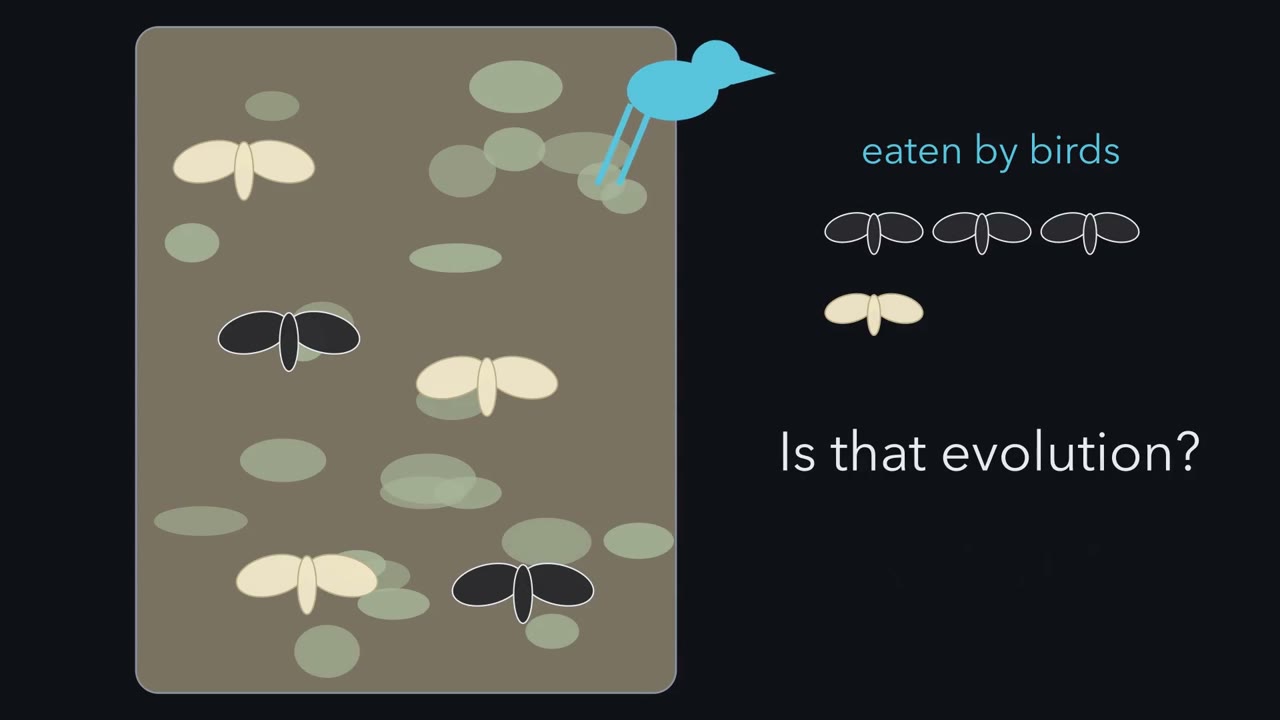
On lichen-covered trees, birds find dark moths more easily than pale ones. Is that evolution yet, and what else would you need to know?
Continue in the lesson: Natural Selection in Ecological Context →
3:17 · Free, with captions and a transcript. The lesson has the full text, the questions and the sources.
More films from this lesson
How this film was made. Narration: an AI narrator voice (Kokoro, af_heart) reading narration written from this lesson's text. Animation: AI-generated in code (Manim) by Claude, a schematic with no drawn molecular structures. Captions come from the narration script. See something wrong? Report it.