When Stopping Harm Is Not Enough
Read the transcript of “When Stopping Harm Is Not Enough”
Film transcript: When Stopping Harm Is Not Enough
The first film showed eagles recovering after people reduced harm and protected nesting places. But what if the harm stops and an ecosystem still cannot restart? A bare Virginia bay gives us that puzzle. The water moves, but no meadow grows. The bay once held eelgrass meadows. A disease was a living, or biotic, change. A hurricane was a nonliving, or abiotic, change. Together they wiped out the eelgrass in these coastal bays. The green meadow disappeared. Few green plants remained to continue the cycle. Later, the water could support eelgrass again. Yet almost no plants remained to make seeds. Once the disease and storm had passed, the door was open.
But nothing nearby could walk through it. Recovery was blocked by a missing starter population. Suitable conditions alone could not make seeds appear. Conditions are suitable again, but there is almost no seed source. Will the meadow refill by itself? Or must something supply the missing starter? Keep watching the empty bay while you choose. Notice which piece the picture lacks.
Scientists supplied the starter. They spread eelgrass seeds by hand in marked plots. This is restoration: helping a damaged ecosystem recover. The action did not build a finished meadow. It placed living starters where suitable conditions could support them. Their choice matched the barrier they had found. Seeds grew into plants. Those plants made more seeds, which moved beyond the plots. Green patches widened into a meadow over time. The recovery used both human help and the plants' own reproduction once the missing starter returned. The plots became sources instead of final borders. Recovery does not mean an exact rewind. A restored place can improve while some parts remain missing.
It can also gain kinds of organisms absent from a nearby natural meadow. Ecosystems keep changing, even during successful recovery. Different does not automatically mean failed. That limit changes the first decision. Protecting a healthy ecosystem is safer than trying to rebuild it later. When damage has happened, first reduce its cause. Then ask what remains, what is missing, and what evidence will show progress. Restoration begins with diagnosis, not one favorite tool. The eagle and eelgrass stories use different parts of one rule. Remove the harm, protect what remains, and help ecosystems recover over time. The needed help may be protection, a missing starter, or another repair.
The outcome still needs patient measurement. The rule guides action without promising a perfect return.
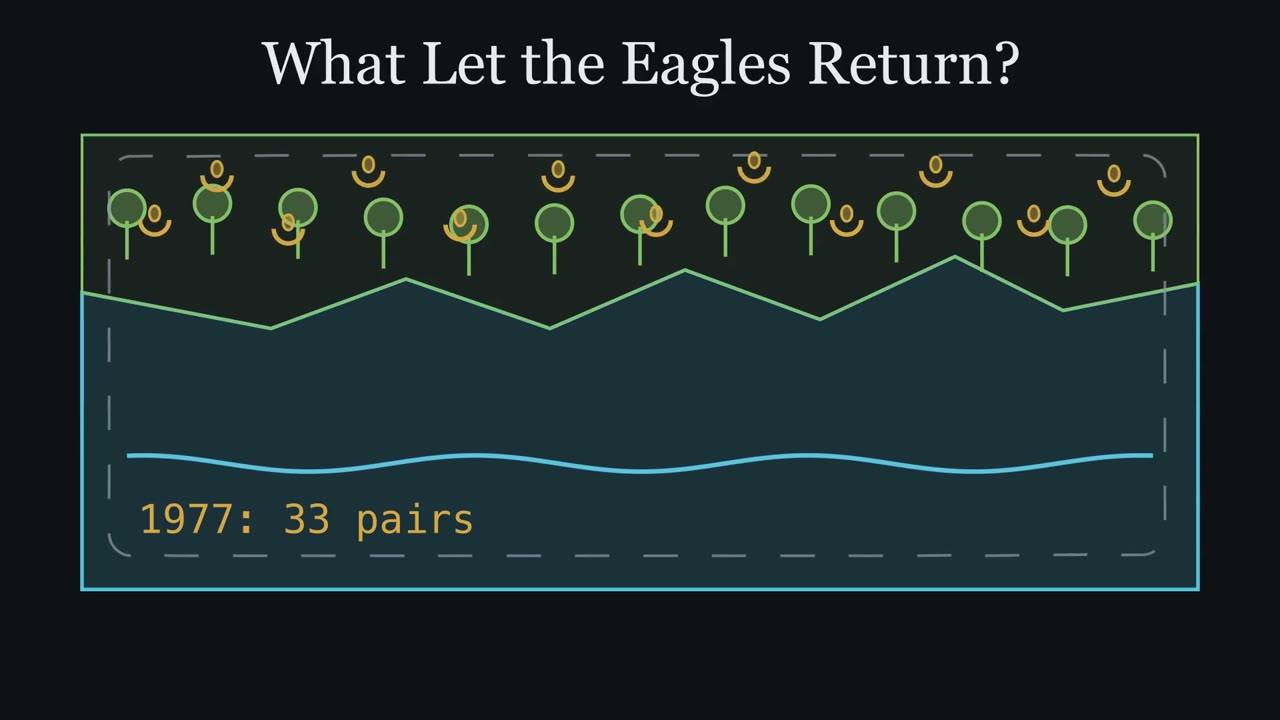
How did Virginia go from 33 pairs of nesting bald eagles in 1977 to more than 1,000 in 2016?
Continue in the lesson: Helping Ecosystems Recover →
3:30 · Free, with captions and a transcript. The lesson has the full text, the questions and the sources.
More films from this lesson
How this film was made. Narration: an AI narrator voice (Kokoro, af_heart) reading narration written from this lesson's text. Animation: AI-generated in code (Manim) by Claude, a schematic with no drawn molecular structures. Captions come from the narration script. See something wrong? Report it.