What Controls Respiration's Speed?
Read the transcript of “What Controls Respiration's Speed?”
Film transcript: What Controls Respiration's Speed?
The first film followed stored food energy through respiration. What makes that process speed up or slow down? Keep the same pea-cell pathway on screen. We will change one condition at a time. The rate of respiration means how fast cells carry out the process. We can track oxygen entering or carbon dioxide leaving over time.
Faster motion through the pathway raises both the rate gauge and the output counter. Start with temperature. In a suitable range, warmer cells usually respire faster. The pathway blocks move more quickly, so oxygen use and carbon dioxide output rise. This does not mean every increase helps. Suppose the cells keep getting hotter. Must the rate keep rising forever? Follow the pathway in your mind, then make your prediction.
No. Too much heat damages cells, and respiration slows or stops. The curve bends downward in the damaged range. Boiling is an extreme case. It kills the pea cells instead of making them respire faster. Next, change oxygen. Close the oxygen valve, and fewer blue dots reach the pathway. Respiration that uses oxygen slows.
Seal the valve, and the pathway runs on the oxygen left. As that oxygen runs out, respiration with oxygen slows, then stops. Now change sugar. With too little glucose, the pathway lacks fuel and slows. Add some, and the rate can rise. Keep adding, and another condition becomes limiting. In yeast, a lot of sugar can increase fermentation while respiration with oxygen falls. That yeast branch changes how we measure. Fermentation also gives off carbon dioxide.
Baker's yeast ferments even when air is present. So most gas in a yeast balloon can come from fermentation. Oxygen use is cleaner for measuring its respiration with oxygen. Each control acts on the same pathway, but the pattern has limits.
Temperature helps only within a suitable range. Oxygen matters to respiration that uses oxygen. More sugar helps only until something else holds the rate back. Respiration releases stored food energy; temperature, oxygen, and sugar change its rate. The picture gives the pattern. Real measurements must show whether the pattern holds and where its limits are. The film has not shown the real pea ranges, yeast values, units, or source limits. Those belong in the evidence. Read them next, compare complete data sets, and test the rule rather than trusting the gauge.
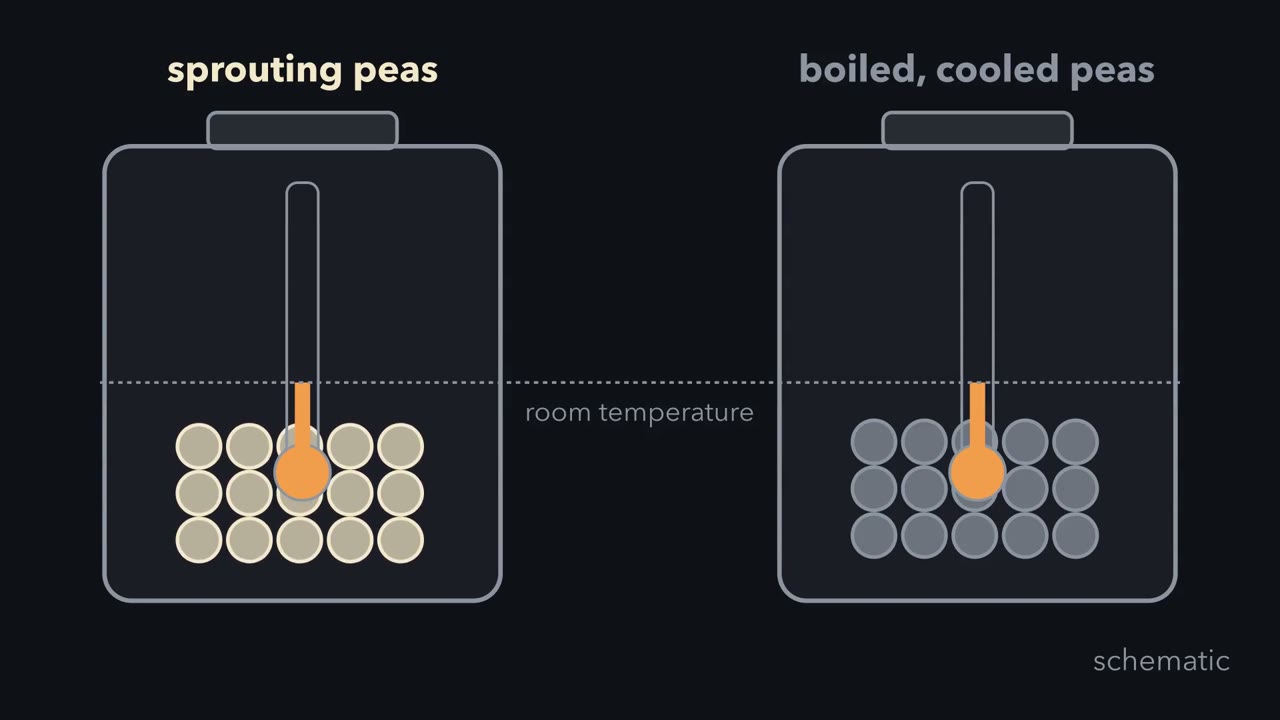
Why do sprouting peas in a thermos get warmer than the room?
Continue in the lesson: Releasing Energy from Food →
3:19 · Free, with captions and a transcript. The lesson has the full text, the questions and the sources.
More films from this lesson
How this film was made. Narration: an AI narrator voice (Kokoro, af_heart) reading narration written from this lesson's text. Animation: AI-generated in code (Manim) by Claude, a schematic with no drawn molecular structures. Captions come from the narration script. See something wrong? Report it.