Why the Wolves Never Finish the Moose
Read the transcript of “Why the Wolves Never Finish the Moose”
Film transcript: Why the Wolves Never Finish the Moose
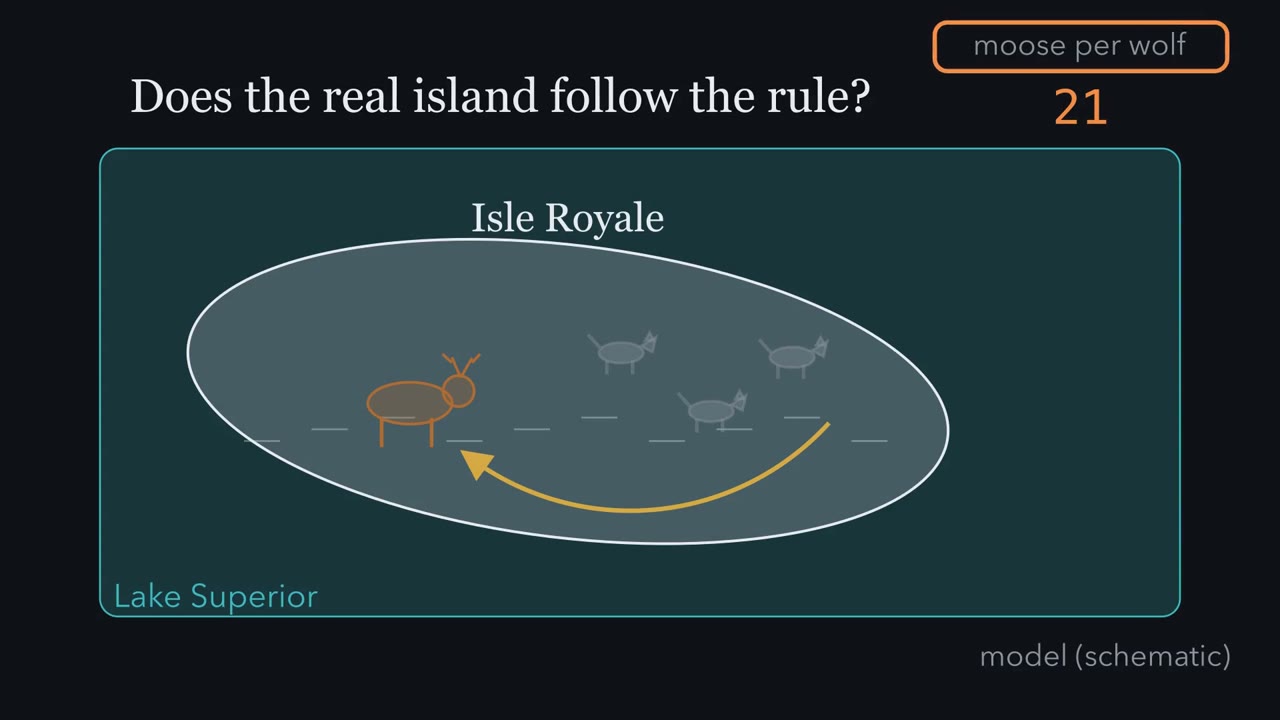
If wolves eat moose, why don't the wolves eat every last moose? On one real island in Lake Superior, they never have. Let's find out why, starting with a model island. First, two words. A population is all the members of one species living in one place. All the moose on our island make one population. All the wolves make another. A predator is an animal that catches and eats other animals. The animal it eats is its prey. Here, the wolves are the predators, and the moose are their prey. Moose eat young trees and other plants. Wolves eat moose. We draw arrows to show who eats whom. Each arrow points from the food to the eater. Now we need one number.
Count the moose for each wolf. The counter in the corner keeps track. It is a rough clue to how easily wolves find food. Our model island starts with many moose and only a few wolves. The counter is high. In this model, that means hunting is easy, and the wolves eat well. With plenty of food, more wolf pups survive and grow up. Year by year, there are more wolves. And more wolves catch more moose. So the moose population falls. Watch the counter drop. Now each wolf has only a few moose to hunt. Here is a question for you. There are now only ten moose for each wolf. What happens to the wolves next? Pause and predict.
In this model, that number is too low. Wolves catch too little food, and fewer pups survive. The wolf population falls. But look at the moose. Many moose are still alive. With fewer wolves hunting, more moose calves survive. The moose population grows again. The counter climbs back up, and the loop can start over. This rule fits a predator that eats mostly one kind of prey. On an island, neither animal can easily leave. A predator with other food may not go hungry, and it could keep eating a prey down to nothing. A real island is messier. Weather, ticks and disease also change the counts. There, this number alone cannot show that wolves are hungry.
You will see real counts in the second film. So here is the answer to our question. When there are few moose for each wolf, wolves tend to catch moose less often. If they get too little food, fewer wolves survive. Wolves usually run short of food before the moose run out.
On an island where wolves hunt moose, why haven't the wolves eaten every last moose?
Continue in the lesson: Predators and Prey →
3:13 · Free, with captions and a transcript. The lesson has the full text, the questions and the sources.
More films from this lesson
How this film was made. Narration: written from this lesson's text and read by an AI narrator voice (Kokoro, af_heart). Animation: AI-generated in code (Manim) by Claude, a schematic with no drawn molecular structures. Captions come from the narration script. See something wrong? Report it.