Two Bodies, One Wheel
Read the transcript of “Two Bodies, One Wheel”
Film transcript: Two Bodies, One Wheel
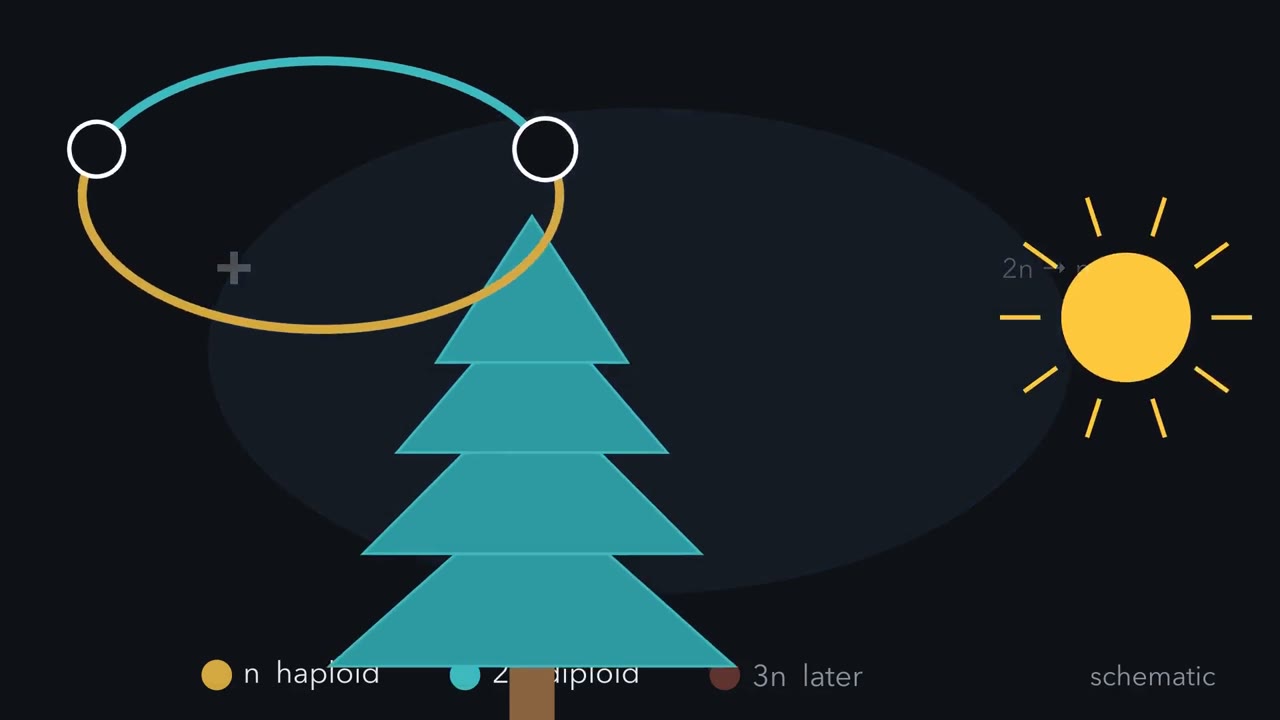
This green moss cushion is haploid, like a human egg. So where is the diploid moss? A haploid cell carries one set of chromosomes. We write that as n, and colour it gold. A diploid cell carries two sets, written 2n, and coloured teal. In a normal life cycle, only two kinds of event change that count.
Meiosis halves it. Every fusion of nuclei adds the sets together. Mitosis, which copies a cell, never changes the count. Now draw a land plant's life as a wheel. A diploid body, the sporophyte, or spore plant, makes spores by meiosis.
Each spore is a single cell. A spore divides by mitosis into a second body, the gametophyte, or gamete plant. It is already haploid, so it makes eggs and sperm by mitosis. Then sperm and egg fuse. The zygote, the single fertilized cell, has two sets again. It divides by mitosis into a new sporophyte. So the wheel has two arcs. From meiosis to fertilization, the path is gold. From fertilization to the next meiosis, it is teal. Other fusions can make other labels, as the next film shows. Now the moss. The gold arc swells into the leafy green shoot, so that shoot is the gametophyte. A sperm swims through a film of rain or dew to an egg on it. The teal arc shrinks to a thin stalk and a capsule.
That is the diploid moss. Meiosis in the capsule makes the spores. Now a fern. Here the arcs swap sizes. The big frond is the sporophyte, teal. Spore cases under it make spores by meiosis. Each spore grows into a small plant on the ground. Gold or teal: the spore, and that little plant?
Both gold. They come after the meiosis gate, and no fusion has happened yet. The little plant is a prothallus, a flat, often heart-shaped gametophyte. It lives on its own. Now compare your own wheel. In humans, meiosis makes eggs and sperm directly. The gold arc shrinks to the gametes alone. There is no haploid body. In the green algae closest to land plants, the teal arc shrinks instead. The zygote is often the only diploid cell. It undergoes meiosis when it germinates. So size tells you nothing. The big body can be gold or teal. Find meiosis and fusion first, and every label follows. One problem remains. In both the moss and the fern, sperm swim to the egg through water.
What can a plant do where there is none?
The green cushion of moss on a wall is haploid, like a human egg. So where is the diploid moss?
Continue in the lesson: Plants on Land →
3:23 · Free, with captions and a transcript. The lesson has the full text, the questions and the sources.
More films from this lesson
How this film was made. Narration: written from this lesson's text and read by an AI narrator voice (Kokoro, af_heart). Animation: AI-generated in code (Manim) by Claude, a schematic with no drawn molecular structures. Captions come from the narration script. See something wrong? Report it.