Looking at Real Cells
Read the transcript of “Looking at Real Cells”
Film transcript: Looking at Real Cells
Everything in the first film was a drawing: a kit, a box and a water tank. How do we know a real plant cell has a box? And how big is one? A real celery cell is too small to see with your eyes alone. To check the model's parts, you need a light microscope and a way to measure. First, make a wet mount. A thin piece of onion skin sits in a drop of iodine stain, under a thin glass cover slip. Light passes up through the thin layer. Through the eyepiece, you see a round circle of light. Inside it, onion skin cells sit side by side, like long boxes. The stain makes each nucleus look darker. Notice what is missing. These onion cells are not green. They have walls, but no developed chloroplasts.
Now a waterweed leaf, mounted in a drop of water. Its cells are boxy too, and most are packed with green chloroplasts. Last, a few cells from the inside of a cheek, colored with a blue stain. They have no box. They are thin and flat, like tiles on a floor. So the box is real. The plant cells show straight walls. The cheek cells show only a thin outline, with no wall. Now, how big? Scientists measure cells in micrometres. The screen shows how small one micrometre is.
Scientists use a tiny ruler inside the eyepiece. In class, you can use the circle of light itself. Count similar cells lying end to end across it. Then divide the circle's width by that count. That gives a rough average width for one cell. Try a made-up class example with cheek cells. The circle's width and the cell count are on the screen. About how wide is one cell?
Divide, and the answer is on the screen. One published study measured cheek cells at nearly the same width. A rough count lands close. One more surprise. Scientists found small clusters of colorless cells inside green waterweed leaves. These cells had no chloroplasts. A dye still lit up a large central vacuole inside them. So even in one green leaf, not every plant cell is green. Look and measure. The box is real, and so are the green chloroplasts and the water tank. But only some plant cells are green, and cells come in many shapes and sizes.
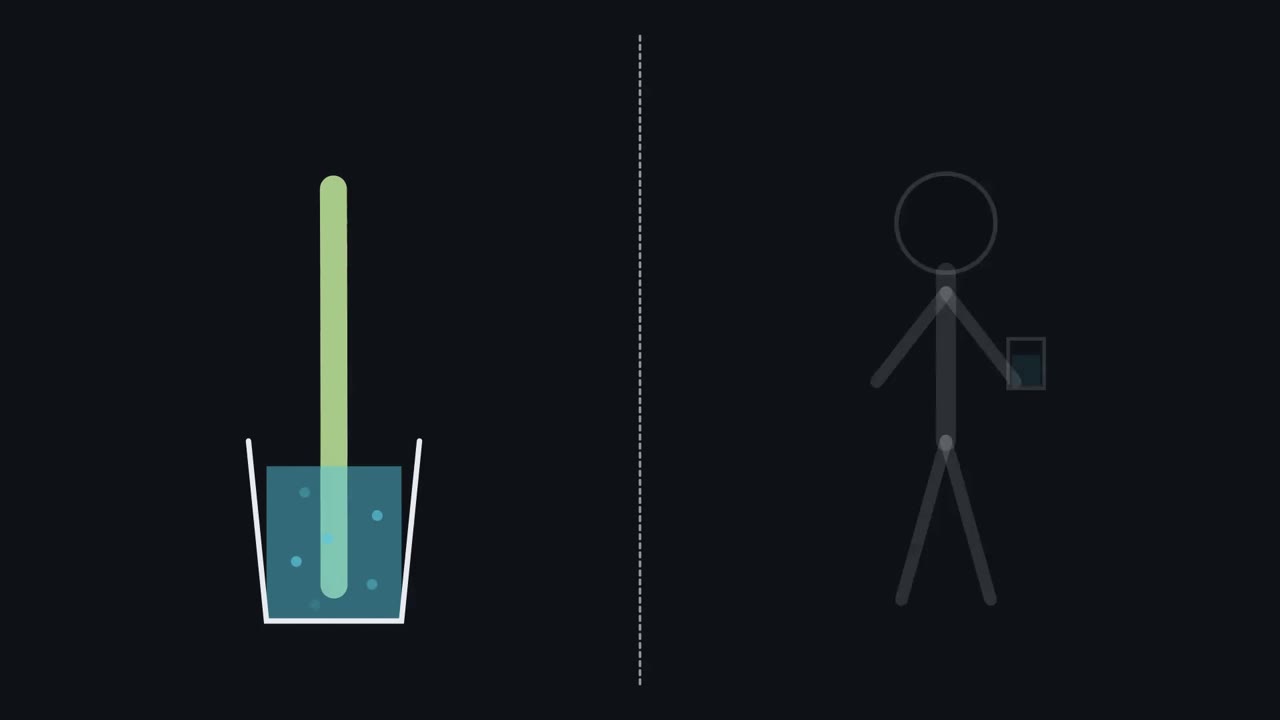
Why does a limp stalk of celery get crisp again in water, when drinking water does not make you any stiffer?
Continue in the lesson: Plant Cells and Animal Cells →
3:07 · Free, with captions and a transcript. The lesson has the full text, the questions and the sources.
More films from this lesson
How this film was made. Narration: an AI narrator voice (Kokoro, af_heart) reading narration written from this lesson's text. Animation: AI-generated in code (Manim) by Claude, a schematic with no drawn molecular structures. Captions come from the narration script. See something wrong? Report it.