Four Names Behind the First Insulin
Read the transcript of “Four Names Behind the First Insulin”
Film transcript: Four Names Behind the First Insulin
The pancreas makes digestive enzymes and, in islets, a hormone. By 1920, extracts lowered blood sugar, but none was safe for patients. In November 1920, Frederick Banting took an idea to John Macleod, a Toronto professor. Tie off the pancreatic duct in dogs. The enzyme-making tissue wastes away. Extract what is left. Macleod gave space, dogs, and two student assistants. One was Charles Best. In summer 1921, Banting and Best made extracts that lowered blood sugar in diabetic dogs. On 11 January 1922, their extract went into Leonard Thompson, then in his early teens. His blood sugar fell a little, and an abscess formed. The extract was too impure.
James Collip raised the alcohol concentration in steps. Impurities dropped out of solution, while the active substance stayed in. He tested each batch on rabbits. It went into the same boy on 23 January. His blood sugar fell by about three quarters. The 1923 Nobel Prize named Banting and Macleod. Banting shared his prize money with Best, Macleod with Collip. The two-name story misses half the people. The receptor was not known to be a tyrosine kinase until 1982. The drug came first, and the mechanism came later.
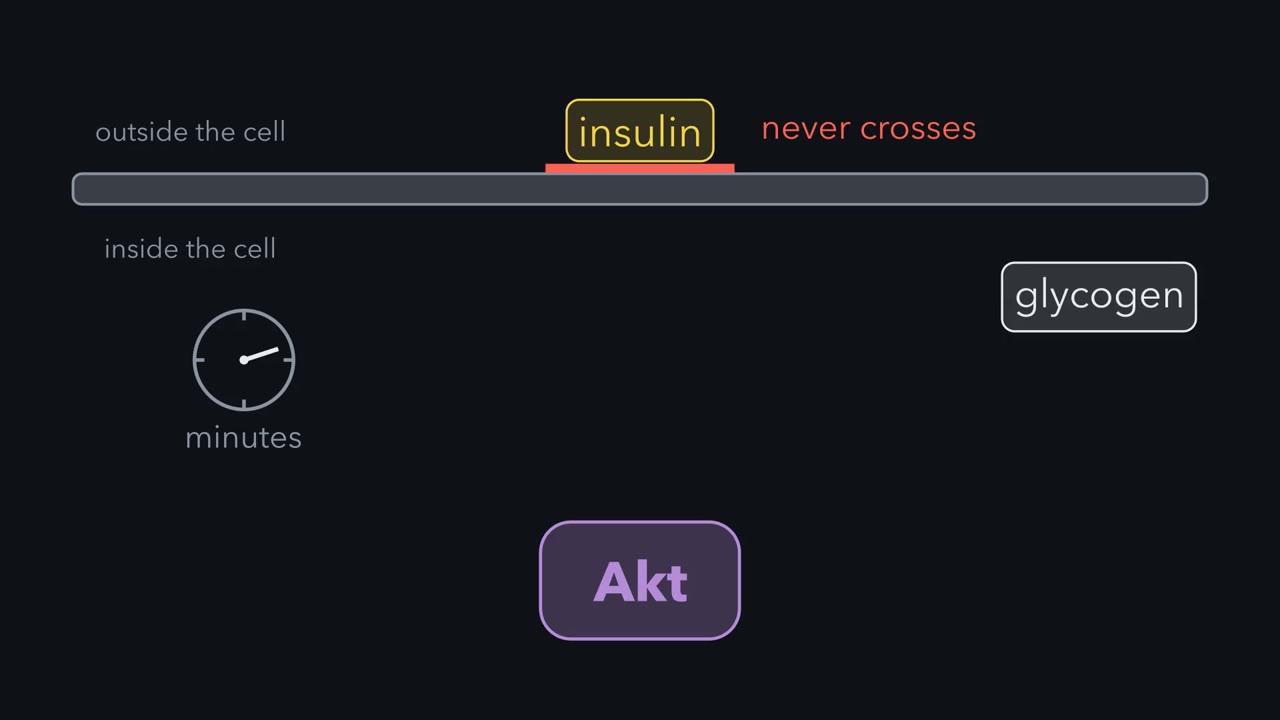
Insulin never crosses the cell membrane. So how does it move glucose transporters to the surface within minutes?
Continue in the lesson: PI 3-Kinase, Akt and Insulin →
1:50 · Free, with captions and a transcript. The lesson has the full text, the questions and the sources.
More films from this lesson
How this film was made. Narration: an AI narrator voice (ElevenLabs, Sarah) reading narration written from this lesson's text. Animation: AI-generated in code (Manim) by Claude, a schematic with no drawn molecular structures. Captions come from the narration script. See something wrong? Report it.