Films · Genetics and Molecular Biology
The Pedigree as a Model Test
Read the transcript of “The Pedigree as a Model Test”
Film transcript: The Pedigree as a Model Test
Can one family observation eliminate an inheritance model? Watch this pedigree become a test instead of a pattern to memorize. The answer depends on what each model says should be possible. This is why a pedigree works like a model test.
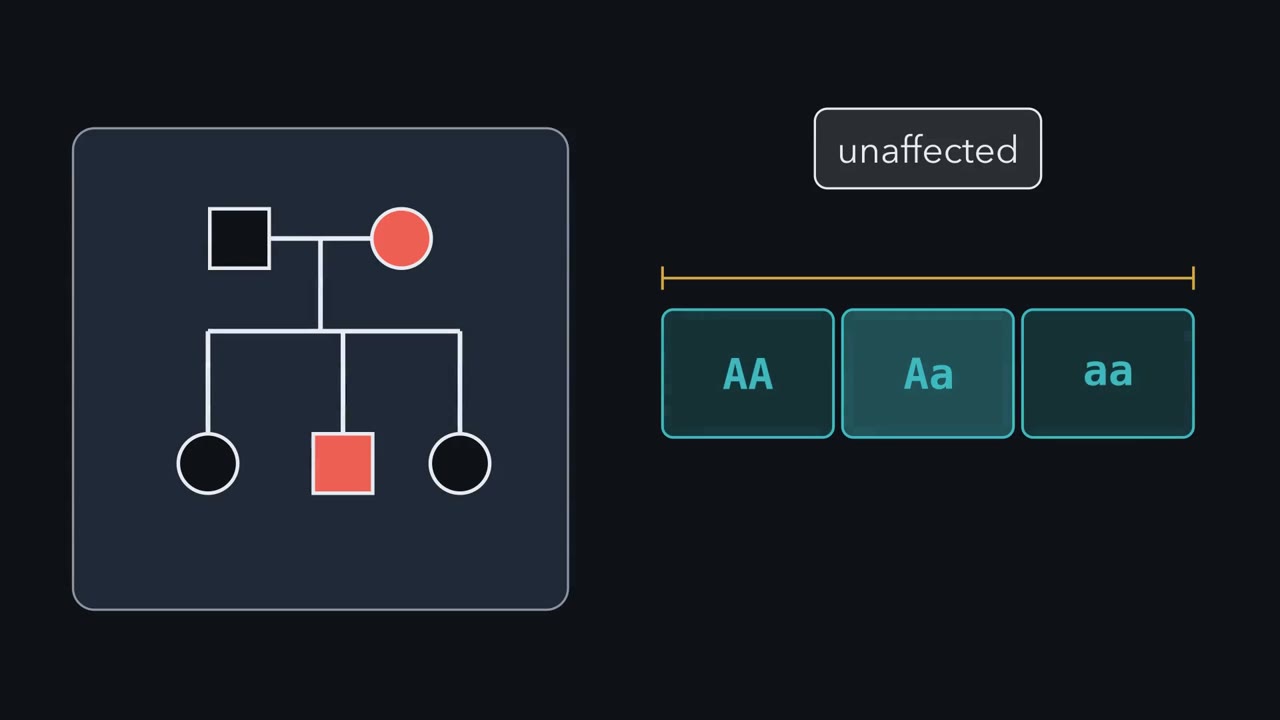
A pedigree records people, relationships, and a named phenotype. Shapes identify family members, connecting lines show relationships, and fill marks affected people. Always read its key. The same symbol can mean something different when the chart defines it differently. Now place a model over the chart. Each inheritance model predicts where an allele can travel and which relatives can receive it. The chart becomes evidence because every line now makes a claim. An autosomal route can move through either parent and either sex. A dominant model lets an affected heterozygous parent pass the allele to children of either sex. An affected child of two unaffected parents contradicts that simple dominant model.
A recessive allele can hide in unaffected carriers. It may appear among siblings when each parent contributes a recessive allele. Here, unaffected parents can carry the allele without showing the trait. Sex-linked models restrict the route. A father gives his X chromosome to daughters and his Y chromosome to sons. That route makes sex and parental origin informative, not merely decorative. An affected father also has an affected son. Could an X-linked allele have travelled directly from that father to that son? Follow the chromosome route before you answer.
No. The son's X chromosome came from his mother. Demonstrated father-to-son transmission therefore contradicts both X-linked models under these assumptions. An affected pair alone shows it only if the mother carries no copy. Mitochondrial inheritance draws a different route. Mothers can transmit mitochondrial DNA to children, while fathers normally transmit none. This maternal route differs from mitochondrial diseases caused by nuclear genes. Fitting predictions support a model; one contradiction can rule it out.
Compatibility adds support, but an observation the model forbids carries sharper information. The model earns confidence by surviving such tests. That is the guiding rule for this simple-model test. That test has a scope. It assumes full penetrance, no new mutation, correct relationships, and the simple model being tested. Change an assumption, and a seeming contradiction may need another explanation. A fitting chart supports a model without proving it. Other models or hidden biology may predict the same small family. Small families often lack the relative who would distinguish those models.
Your brother has cystic fibrosis and you do not. Is your chance of being a carrier 1/2 or 2/3?
Continue in the lesson: Reading Pedigrees: Human Inheritance →
3:36 · Free, with captions and a transcript. The lesson has the full text, the questions and the sources.
More films from this lesson
How this film was made. Narration: written from this lesson's text and read by an AI narrator voice (Kokoro, af_heart). Animation: AI-generated in code (Manim) by Claude, a schematic with no drawn molecular structures. Captions come from the narration script. See something wrong? Report it.