Bohr's Dog Blood: Shifting the Curve
Read the transcript of “Bohr's Dog Blood: Shifting the Curve”
Film transcript: Bohr's Dog Blood: Shifting the Curve
Working tissue pours out carbon dioxide. Does that change how tightly blood holds oxygen, or does carbon dioxide just ride along? The first film showed blood delivering its drop in saturation, from lung to tissue. Now ask what makes that drop bigger where tissue is working. In Copenhagen in 1903, Christian Bohr worked with Karl Hasselbalch and August Krogh. They took fresh dog blood. They exposed samples to gas at a set oxygen pressure, and measured how much oxygen the blood bound. Repeating this at many pressures traces the curve. Then they raised the carbon dioxide in the gas, and measured again at the same oxygen pressures. If carbon dioxide simply rode along, nothing should change.
Only carbon dioxide changed, so any difference came from it, or from the acid it forms. If something does change, where will it show most? At a low oxygen pressure, or near full saturation? More carbon dioxide lowered oxygen binding. The effect was large at low oxygen pressures and small near full saturation. The curve had moved to the right. Today this is called the Bohr effect: a fall in oxygen affinity when pH falls or carbon dioxide rises. The shift raises P50, the oxygen pressure at which hemoglobin is half full. A higher P50 means a looser grip. Now bring back the bands. In the lungs, the shifted curve is still nearly full. Loading barely changes.
But at tissue pressure the shifted curve sits lower. So the release bracket grows, by about two-fifths at rest in this model. And that happens where it matters. Working tissue is high in carbon dioxide and low in oxygen, so blood gives up more exactly there. Published in 1904, the paper offered a reason why blood gives up oxygen more readily in active tissue. Two other changes also shift the curve right. Warmer tissue lowers affinity, and working muscle is warmer than resting muscle. So does more BPG, a small molecule made in red cells. They are separate effects, each with its own cause. The name Bohr effect is kept for pH and carbon dioxide alone.
So a modest right shift costs little in the lungs, where blood loads. It pays out in working tissue, where blood unloads and the need is greatest.
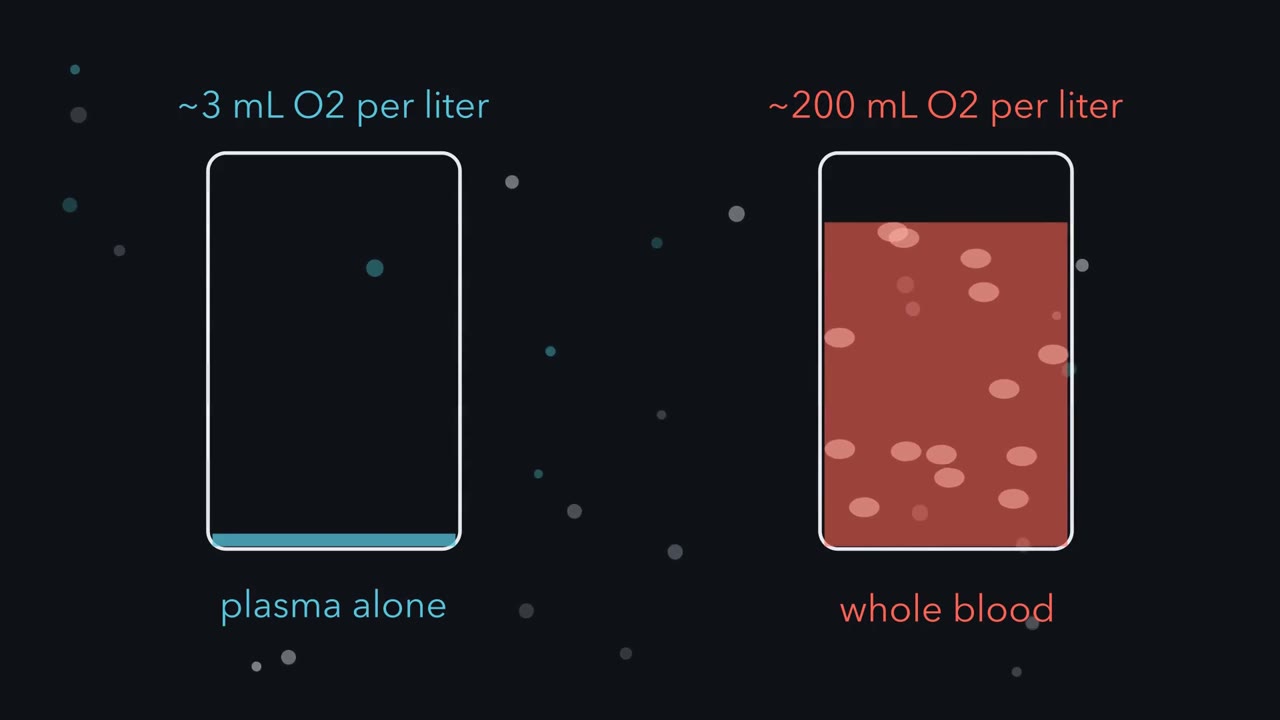
A litre of your arterial blood carries about 200 mL of oxygen. If that blood were plasma alone, it would carry about 3 mL. What makes up the difference, and how does carbon dioxide get back to the lungs?
Continue in the lesson: Carrying Oxygen and Carbon Dioxide →
3:05 · Free, with captions and a transcript. The lesson has the full text, the questions and the sources.
More films from this lesson
How this film was made. Narration: an AI narrator voice (Kokoro, af_heart) reading narration written from this lesson's text. Animation: AI-generated in code (Manim) by Claude, a schematic with no drawn molecular structures. Captions come from the narration script. See something wrong? Report it.