Different Cells, Shared DNA
Read the transcript of “Different Cells, Shared DNA”
Film transcript: Different Cells, Shared DNA
The first film showed how many-celled organisms share life's jobs. How can their cells become different enough to do those jobs? A specialized cell has a structure suited to a particular job. Form is not decoration. It changes what the cell can reach, carry, or move. A neuron grows a long, thin axon. It can carry a signal from the spine to the foot. Its reach fits long-distance signalling. A skeletal muscle cell is a long cylinder packed with fibres that shorten together. A root hair cell grows a thin tube into soil, adding contact where water enters. Structure can affect survival. In Arabidopsis seedlings, lines with longer root hairs stayed anchored better after simulated rain. Their main roots were about the same size.
So root hair length is the likely reason. Now compare two red blood cell cartoons. One is a stiff sphere. The other is a flexible disc dented in the middle. Which passes a narrow vessel? The flexible dented disc bends and squeezes through. A mature red blood cell also has no nucleus. Its small flexible form suits transport through narrow vessels. Different shapes raise a deeper question. Do nerve and muscle cells carry different instructions?
Mostly no. Nearly every body cell with a nucleus carries essentially the same DNA. What differs is gene expression, the use of a gene's instructions to make a product. Each kind of cell uses a different set of genes. Cells fit life's jobs through structure and gene use, alone or together. A muscle cell uses genes for proteins that slide and shorten it. Other genes stay unused. A developing red blood cell uses genes for hemoglobin, the protein that carries oxygen. Later it pushes out its nucleus. Its earlier gene use helped build its specialized contents. This is a main model, not a claim without exceptions. Some immune cells rearrange DNA.
Egg and sperm cells carry one chromosome set, while most body cells carry two. Experiments support the model. A few frog gut-cell nuclei, moved into eggs, still built tadpoles with nerve, muscle, and blood cells. In those nuclei, specializing had not thrown the unused genes away. So cell differences need not mean different instruction books. Different cells use different parts of a shared book, building structures that suit their work.
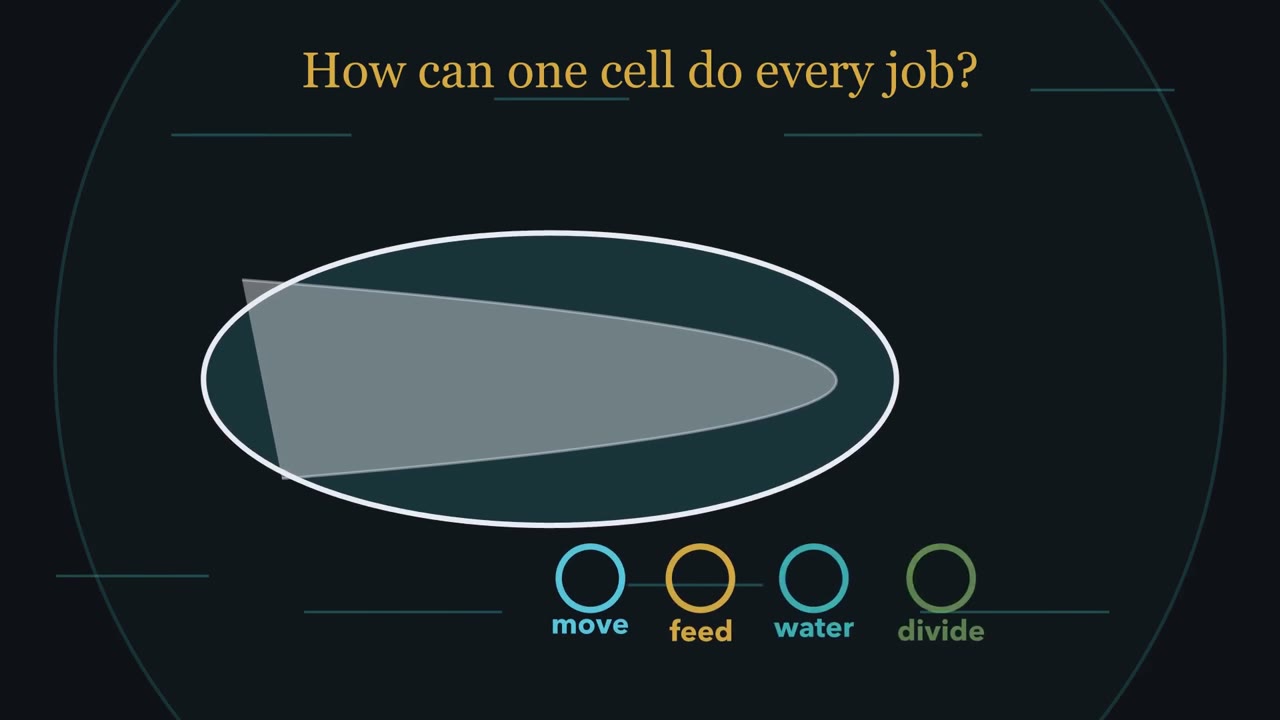
How can one Paramecium do every job of life inside a single cell?
Continue in the lesson: One Cell or Many →
3:14 · Free, with captions and a transcript. The lesson has the full text, the questions and the sources.
More films from this lesson
How this film was made. Narration: an AI narrator voice (Kokoro, af_heart) reading narration written from this lesson's text. Animation: AI-generated in code (Manim) by Claude, a schematic with no drawn molecular structures. Captions come from the narration script. See something wrong? Report it.