Bigger or Brighter?
Read the transcript of “Bigger or Brighter?”
Film transcript: Bigger or Brighter?
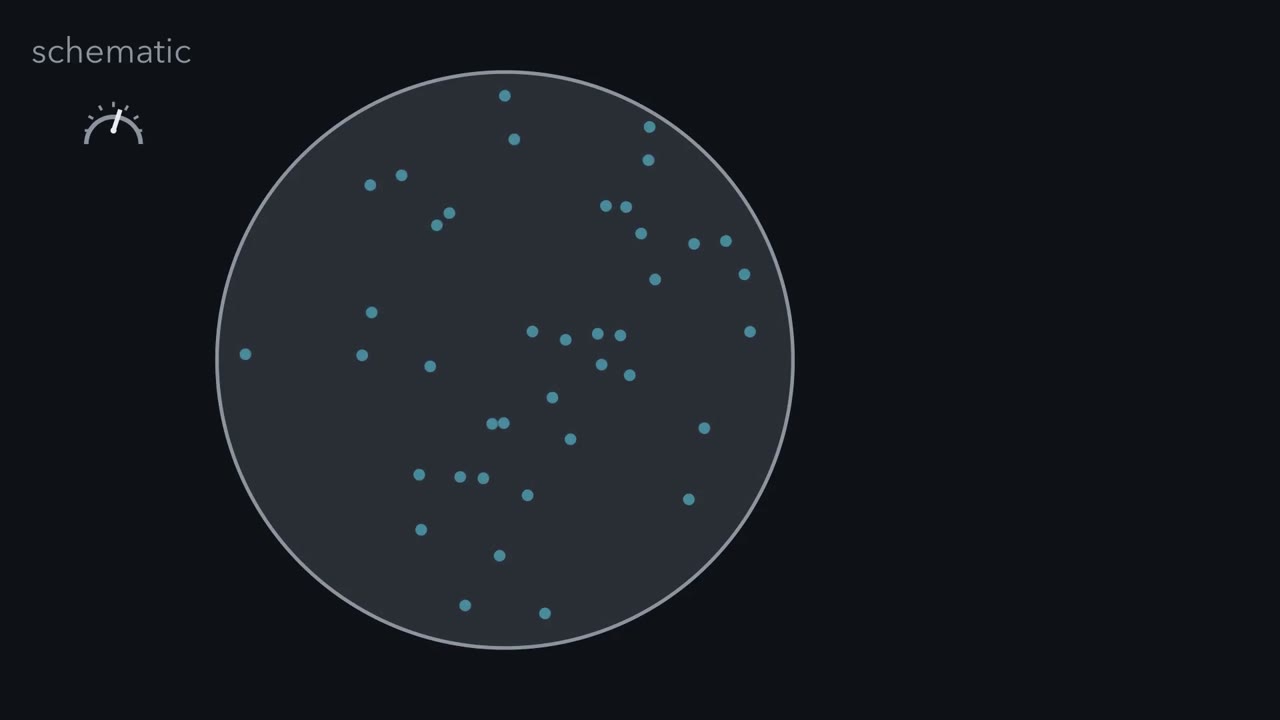
Two nuclei, each dotted with bright spots of a glowing protein. Is a spot a droplet of that protein? Or is it a cluster of binding sites, such as many copies of one DNA sequence? Under a microscope, the two can look alike.
A nucleus has no membrane-bound compartments inside it, yet it holds many bodies like these. The largest, the nucleolus, builds ribosomal subunits. Many of their molecules carry several weak sticky patches, so each can hold many partners at once. That is multivalency. The usual checks cannot tell droplets from sites. Both kinds of spot look round. Droplets fuse, and site clusters can drift together until they look merged. Bleach one with a laser, and it glows again, because molecules that bind and let go refill it too. A bright spot shows only that the protein is concentrated there. So change the amount instead. Give both nuclei one dial: the total protein, averaged over the whole nucleus.
Add a gauge that reads the concentration outside the spots. Now double the protein in both. What will each outside gauge do? The droplet needle holds still. Think of salt water past saturation: added salt stops dissolving and forms a second phase. At equilibrium under fixed conditions, one protein on its own holds the outside at the saturation concentration. The extra builds more of a second, denser phase: the droplets. They take up more room, but glow no brighter.
Bigger, not brighter. On the site side, the needle climbs. Think of the sites as parking spaces, a fixed number, with plenty still free. Some protein is parked and the rest is outside, so the outside rises with the total. The spots fill in and glow brighter, but grow no bigger. Brighter, not bigger.
Keep turning. On the site side, the parking lot fills up. The spots brighten more slowly, and nearly every extra molecule stays outside, so that needle climbs faster. Within this range, the droplets keep taking up more room, and their needle stays put. So here is the test, in its simplest form. Add more protein, and watch where the extra goes. At equilibrium under fixed conditions, one protein forming a phase puts it into more droplet volume, outside held still. A fixed set of sites puts it onto those sites: brighter spots, until they are full. This clean version is for one protein that separates on its own. Real bodies hold many kinds of molecule, some may form on chromatin, and tiny spots blur size into brightness.
So where the extra goes is a clue, not a proof. The text below shows what each complication changes.
How does a nucleus keep things apart with no walls around its compartments?
Continue in the lesson: Nuclear Architecture and Membraneless Compartments →
3:35 · Free, with captions and a transcript. The lesson has the full text, the questions and the sources.
More films from this lesson
How this film was made. Narration: written from this lesson's text and read by an AI narrator voice (Kokoro, af_heart). Animation: AI-generated in code (Manim) by Claude, a schematic with no drawn molecular structures. Captions come from the narration script. See something wrong? Report it.