Wings Faster Than Nerves
Read the transcript of “Wings Faster Than Nerves”
Film transcript: Wings Faster Than Nerves
Does every wingbeat need its own nerve impulse? A fly beats its wings so fast that the answer seemed in doubt. One recording put it to the test. The first film built one machine. Calcium switches it on, and myosin heads pull actin. Now the question is how a fly's flight muscle throws that switch. In vertebrate skeletal muscle, each contraction follows its own nerve impulse. So does the flight muscle of a locust or a dragonfly. This is called synchronous muscle. In nineteen forty-nine, John Pringle tested this rule in blue-bottle flies. He tethered each fly so that it beat its wings in place. Then he put a fine electrode into its flight muscle.
If every beat needs its own impulse, the trace should show one large spike under every wingbeat. What do you think he saw? The large spikes, which he linked to nerve impulses, came far less often than the wings beat. And they were not timed to particular beats. The one-to-one rule failed. So what sets the beat?
Picture the fly's thorax as a springy box. Two sets of power muscles pull on it in different directions. When one set shortens, the box bends, and the other set is stretched. These muscles are already switched on. In them, a stretch raises force, after a short delay. So the stretched set builds force and shortens. That stretches the first set in turn. The muscles and the springy thorax keep the rhythm going between them. This is asynchronous muscle. It powers the wings of flies, bees and wasps, beetles and some other insects. In nineteen fifty-nine, Machin and Pringle reported stretch activation in beetle flight muscle. Does that make the nerve useless?
No. Its few impulses keep the muscle's calcium raised, so it stays switched on. Without them, the wings stop. The pulling machine is the same as in the first film. What changed is the switch. The nerve holds it on, and stretch times each beat. Pringle's recordings left questions open. And how stretch raises force, at the level of the molecules, is still being worked out. So here is the rule for these insects. In asynchronous muscle, stretch times each beat, and the nerve keeps it on.
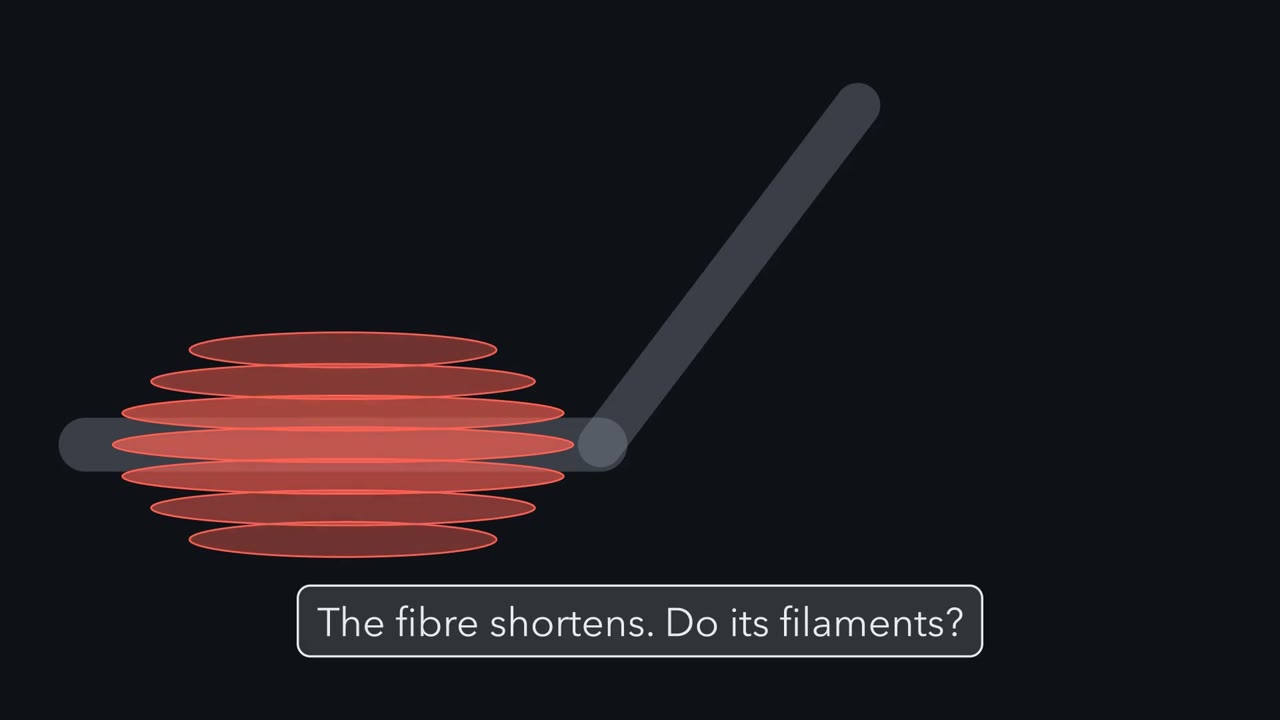
In a skeletal muscle fibre, none of the filaments gets shorter, yet the whole fibre shortens. How can that be?
Continue in the lesson: Muscle, Bone and Movement →
2:59 · Free, with captions and a transcript. The lesson has the full text, the questions and the sources.
More films from this lesson
How this film was made. Narration: an AI narrator voice (Kokoro, af_heart) reading narration written from this lesson's text. Animation: AI-generated in code (Manim) by Claude, a schematic with no drawn molecular structures. Captions come from the narration script. See something wrong? Report it.