Wanting Is Not Liking
Read the transcript of “Wanting Is Not Liking”
Film transcript: Wanting Is Not Liking
dopamine the brain's pleasure signal? It is a common shortcut. Let's test it. Two things need separating. Wanting is the pull of a reward and its cues. Liking is the pleasure of the reward itself. How can you measure liking in a rat, without asking? Watch its face. Sweet tastes bring tongue protrusions. Bitter tastes bring gapes. These reactions can be scored from video. Rats whose forebrain dopamine was depleted with a neurotoxin stopped seeking food. If dopamine carried pleasure, what should their faces do when sugar is placed in the mouth?
Their faces showed normal liking reactions. The seeking was gone, but the liking reactions remained. Now the other direction. Mutant mice make little of the dopamine transporter, so extra dopamine stays outside the cells. They reached sweet food sooner in a runway. They ran no faster. They just paused less on the way. But their liking reactions to sugar were no stronger. So, in these tests, dopamine moved wanting, not liking. Recall the burst that moves to cues. It is compatible with cues gaining pull, but whether it is wanting is debated. Keep the scope. A lifelong mutation is not an acute drug, and an animal's face is not a human report. Other researchers read the same results as changes in willingness to work, or in learning.
Addictive drugs raise dopamine signalling, by different routes. Incentive sensitization theory proposes that in susceptible people, repeated use can make cue-triggered wanting grow. It can grow out of proportion to liking. It offers one explanation for why craving can outlast enjoyment. It is a theory, and other accounts exist. In these tests, dopamine moved wanting, not liking. Its quick bursts mark better than predicted, and its pauses worse than predicted. They are not a direct measure of pleasure.
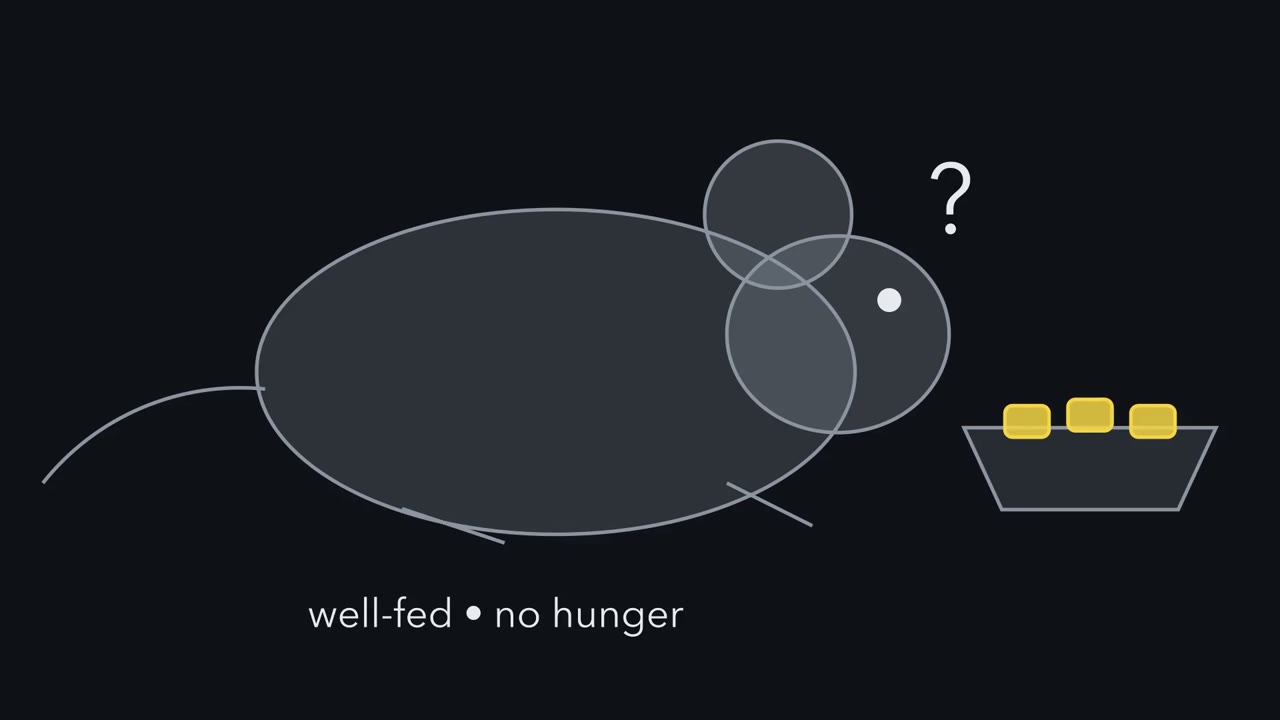
A well-fed mouse starts eating within minutes when one small group of hypothalamic neurons is switched on with light. What are those neurons for?
Continue in the lesson: Feeding, Motivation and Reward →
2:23 · Free, with captions and a transcript. The lesson has the full text, the questions and the sources.
More films from this lesson
How this film was made. Narration: an AI narrator voice (Kokoro, af_heart) reading narration written from this lesson's text. Animation: AI-generated in code (Manim) by Claude, a schematic with no drawn molecular structures. Captions come from the narration script. See something wrong? Report it.