Reading a Broken Machine
Read the transcript of “Reading a Broken Machine”
Film transcript: Reading a Broken Machine
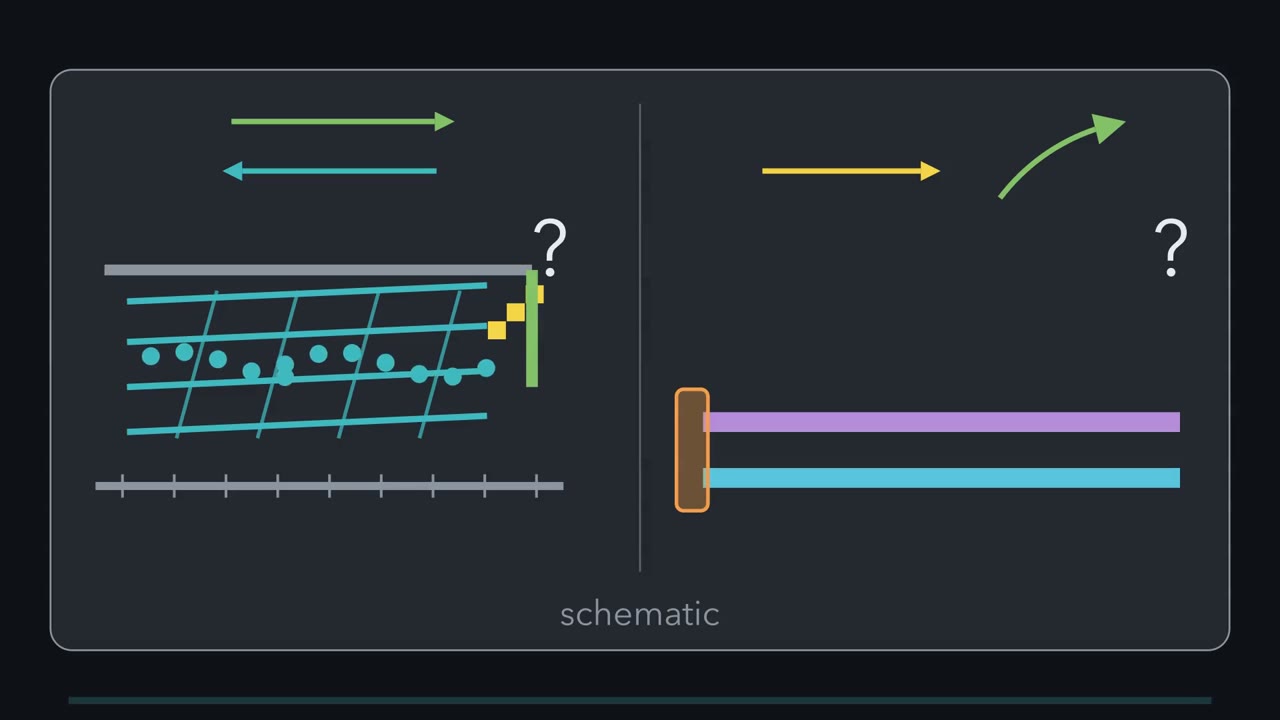
In chapter 1, we cut the links in a drawing, and the doublets slid apart instead of bending. Now turn the question around. When a real cilium stops, which part broke, and where in the body does it show? Summers and Gibbons tested that idea in 1971.
They took axonemes from sea urchin sperm. They briefly treated them with trypsin, a protein-cutting enzyme, then added 0.1 mM ATP. Under dark-field microscopy, the axonemes did not beat. Groups of doublets slid out of the bundle. That dish test became a standard way to ask whether a flagellum's motors work. Now the body. In 1976, Björn Afzelius described four men whose sperm did not swim.
Electron microscopy indicated that the dynein arms, small projections on each outer doublet, were missing from their cilia. Sperm tails and the cilia lining the airways are built on the same basic axoneme. So predict: if the dynein arms are missing, what else should fail?
Three of the four men also had frequent bronchitis and sinusitis. Their airway cilia were not moving mucus, a sweep called mucociliary transport. One missing part disrupted motion in two organs. The match is not perfect: sperm and airway cilia differ in some dynein parts. And one mutation need not act the same everywhere. In mice lacking a protein called Cfap53, cilia on the embryonic node stopped completely. Windpipe and brain-ventricle cilia still beat, but abnormally. The instrument matters too.
Patients with DNAH11 mutations had normal-looking nasal cilia by conventional electron microscopy. Three-dimensional electron tomography found less outer-arm volume near the base. Crawling cells break the same way. Chapter 1's clutch needed integrins to grip. Neutrophils without a working integrin of the beta β2 family grip the vessel wall poorly. They largely fail to leave the blood, so infections are poorly controlled. Read a phenotype backward, tissue by tissue. Ask which machine failed, which part is defective, which tissue you examined, and with what instrument. Motors and constraints from chapter 1 become the places to look.
Four men had sperm that could not swim, and three could not clear mucus from their lungs. How could one missing part explain both?
Continue in the lesson: Cell Shape, Migration and Cilia →
2:55 · Free, with captions and a transcript. The lesson has the full text, the questions and the sources.
More films from this lesson
How this film was made. Narration: an AI narrator voice (Kokoro, af_heart) reading narration written from this lesson's text. Animation: AI-generated in code (Manim) by Claude, a schematic with no drawn molecular structures. Captions come from the narration script. See something wrong? Report it.