Enough Does Not Prove Needed
Read the transcript of “Enough Does Not Prove Needed”
Film transcript: Enough Does Not Prove Needed
Shine light on certain cells in a mouse's brain, and it freezes. Has the memory been found? The cells were tagged while the mouse learned to fear a chamber. A gene called c-fos switches on in recently active neurons. Its promoter can put a light-driven channel, channelrhodopsin-2, into those cells. A drug, doxycycline, blocks the tag. Take it away, and a window opens. Give it back, and the window closes. Open it around training, and mostly cells active during learning get the channel. Days later, in a different box, light on the cells made the mice freeze. Two controls made it specific. Cells tagged in a neutral box caused no fear freezing. Mice with a fluorescent protein but no channel did not freeze to light.
So these cells are enough to drive the fear, in this preparation. That is sufficiency. Does that mean the mouse needs these cells when it remembers by itself? Not yet. Necessity needs the reverse: silence the tagged cells during natural recall, back in the shock box. Kitamura and colleagues tagged prefrontal cells at learning, then silenced them later. On day two, recall was intact. On day twelve, it was disrupted. The standard model predicted that order. But these cells were tagged at learning. So the cortical part of the memory did not first appear after a later transfer. It formed at once, and matured.
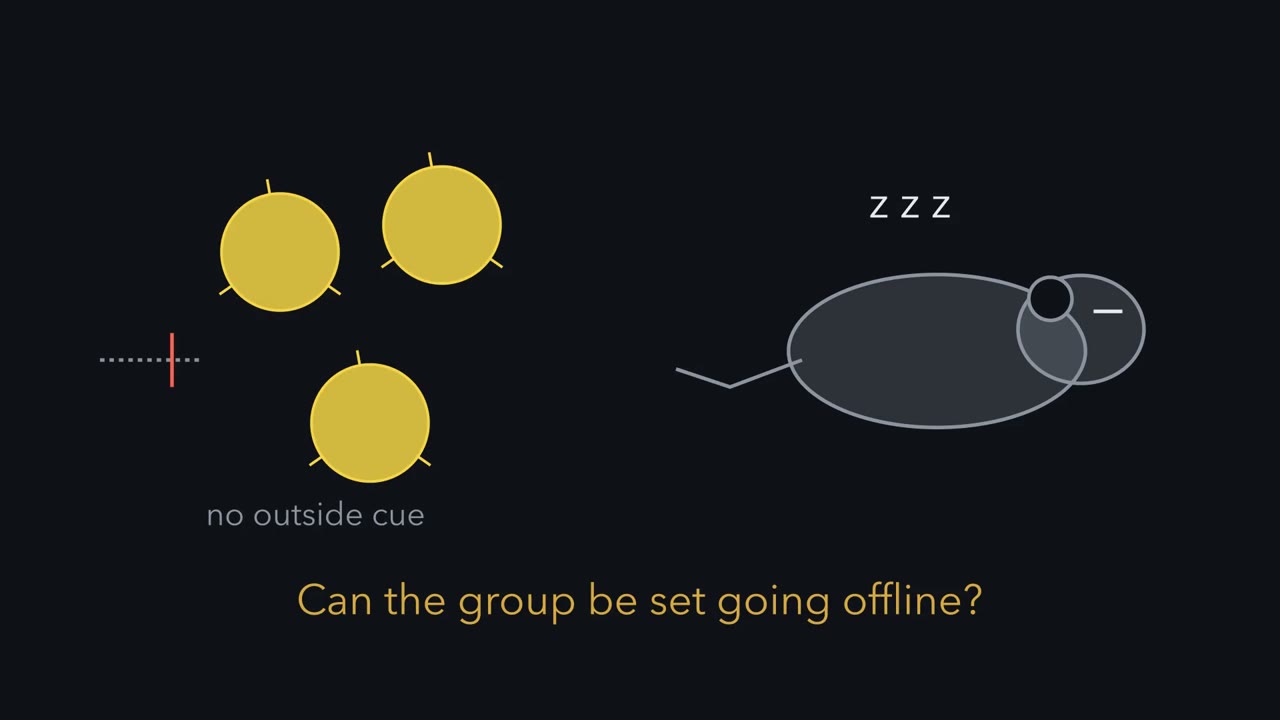
So in these mice, a memory's group is not fixed in one place. Where it is depends on when you ask. That suggests why enough does not prove needed. If the group spans regions, driving one part can complete it. Silencing one part may leave enough of the rest to complete it. All of this is mouse fear, over days to weeks. It is not yet human memory over years. Enough does not prove needed. For each claim, ask which control it needs.
Shine light on cells tagged during learning in a mouse's hippocampus and it freezes as if afraid. Has anyone found where the memory is stored?
Continue in the lesson: Plasticity, Networks and Consolidation →
2:21 · Free, with captions and a transcript. The lesson has the full text, the questions and the sources.
More films from this lesson
How this film was made. Narration: an AI narrator voice (Kokoro, af_heart) reading narration written from this lesson's text. Animation: AI-generated in code (Manim) by Claude, a schematic with no drawn molecular structures. Captions come from the narration script. See something wrong? Report it.