How Meiosis Remixes Alleles
Read the transcript of “How Meiosis Remixes Alleles”
Film transcript: How Meiosis Remixes Alleles
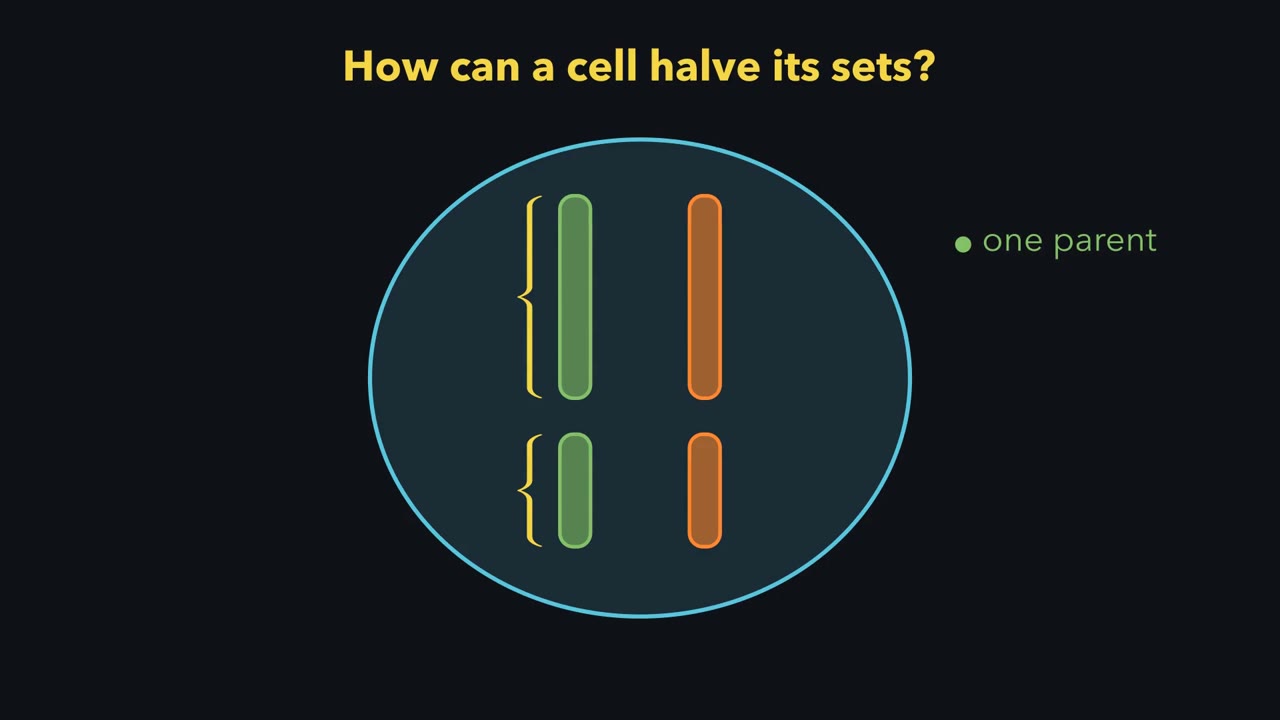
The first film made haploid cells by separating homologous pairs first, then sister chromatids. Why do those cells carry different allele mixes? Return to the same model. Green chromosomes came from one parent, and orange chromosomes came from the other. Each homolog carries the same genes in matching positions, but its alleles may differ. Copying makes sister chromatids. The homologs then lie side by side during the first division, placing matching DNA regions beside each other. Crossing over exchanges matching pieces between non-sister chromatids of paired homologs. Watch two chromatids cross, break at matching positions, and reconnect. Each changed chromatid now carries green and orange sections, combining alleles from that parent's parents.
A second process mixes whole chromosomes. Each homologous pair can face either direction before it separates. One pair's direction does not direct another pair. This is independent assortment: every pair adds another either-or choice. Look at these paired chromosomes. The long green homolog and short orange homolog face the same pole. If only the short pair flips, which chromosome mix will enter that side? Predict before the arrows move.
After the short pair flips, green from both pairs faces the left side. Separation sends that new whole-chromosome mix left. Changing one pair changed the outcome, while every final cell still receives a member of each pair. The count grows by doubling. For each pair, a gamete can receive either homolog. Each added pair doubles the running count across many separate meioses. The screen shows the computed pattern. Crossing over adds more combinations within those whole chromosomes. The doubling rule counts whole chromosomes and ignores crossing over. It also has a limit for genes. Genes close together on one chromosome tend to travel together. Independent assortment applies to genes on different chromosomes.
Meiosis separates homologous pairs first, then sister chromatids, while crossing over and assortment remix alleles. Crossing over remixes chromosome sections. Assortment remixes whole chromosomes. Fertilization then joins independently made egg and sperm cells, usually giving siblings different combinations. The variation is not a promise that every individual survives. It gives a population more allele combinations. When conditions change, some combinations may work better than others.
Diversity raises the chance that some members survive and reproduce; it does not guarantee survival.
If two parents give every child half of their chromosomes, why do their children come out different from each other?
Continue in the lesson: Meiosis and Variation →
3:23 · Free, with captions and a transcript. The lesson has the full text, the questions and the sources.
More films from this lesson
How this film was made. Narration: an AI narrator voice (Kokoro, af_heart) reading narration written from this lesson's text. Animation: AI-generated in code (Manim) by Claude, a schematic with no drawn molecular structures. Captions come from the narration script. See something wrong? Report it.