When People Change the Flow
Read the transcript of “When People Change the Flow”
Film transcript: When People Change the Flow
The first film followed atoms through connected cycles. What happens when people make one flow much larger than before? Return to the same watershed and watch the amounts change. A flow is matter moving between reservoirs during some time. Picture each reservoir with an amount meter.
Arrows show matter entering or leaving. Their widths show relative flow, and every amount here is schematic. If matter enters and leaves at matching rates, the amount can stay steady. That does not mean atoms stop. Tokens keep crossing both boundaries while the meter remains level. Coal, oil, and natural gas hold carbon that was underground for millions of years. Combustion moves that old carbon into today's air quickly.
Plants and the ocean take up some added carbon, but combustion adds it faster than they remove it. Start from the balanced tank. Now the incoming flow grows wider, while the outgoing flow stays the same. What happens to the amount in the reservoir? Hold your answer.
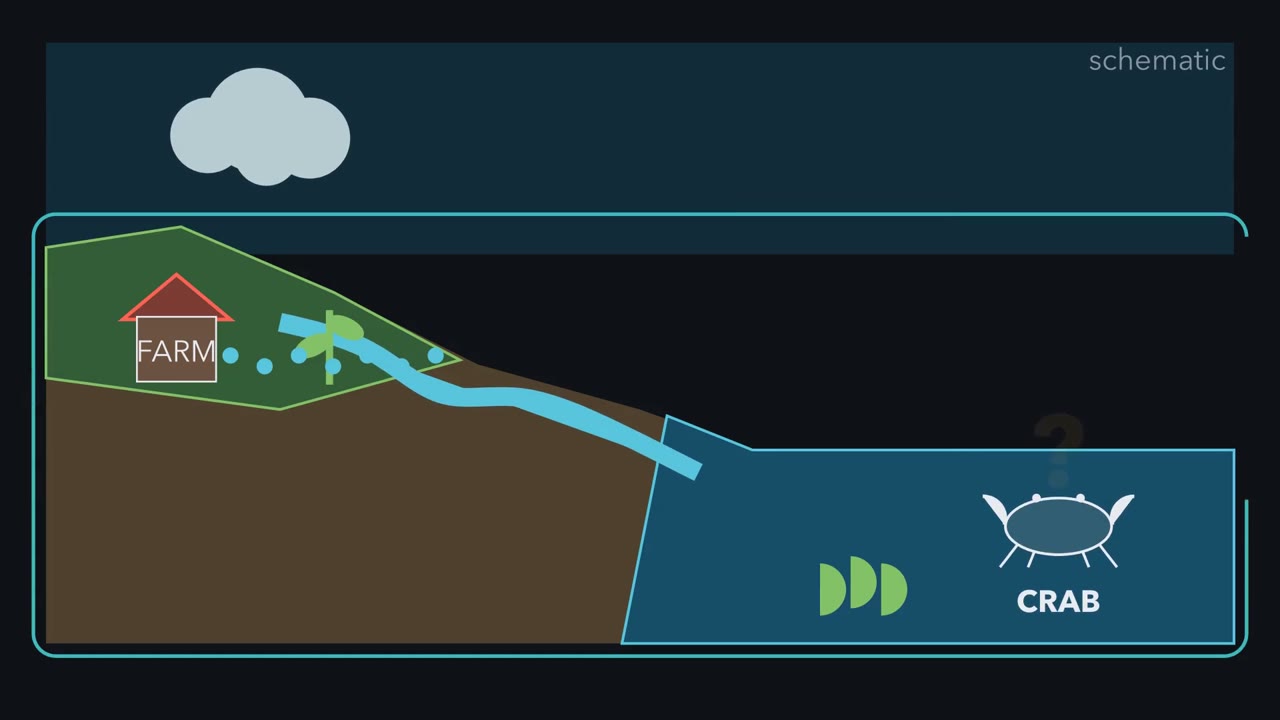
The amount rises, because now more matter enters than leaves. The atoms were not created. They moved from another reservoir, and the receiving reservoir gained them. People also add usable nitrogen to fields as fertilizer. Rain and flowing water can carry some nitrogen toward streams and the Bay. This human-added flow rides inside the water cycle. Not every added nitrogen atom takes the same route. Some stays on land, some enters living things, some reaches water, and some returns to the air as gas. The important question is how the added flow changes each reservoir over time. How can scientists tell whether a cycle changed? A measurement records something observed, such as carbon dioxide in sampled air.
A model combines observations and assumptions to estimate flows that cannot all be measured directly. Each kind of evidence has limits. One station is not the whole atmosphere. A watershed model estimates rather than measures every stream. Its result also depends on which sources the model includes. Use each source for the question it can answer. A measured record shows what changed at its sampling place. A model can compare estimated sources across a watershed, if its boundaries and assumptions stay clear. Carbon and nitrogen follow different processes, yet the same reasoning applies. Identify the reservoir, compare what enters with what leaves, and ask which process changed the flow.
When more matter enters a reservoir than leaves it, the amount rises. The next step is evidence: compare measured records with modeled flows, then keep their different limits in view.
How can rain falling on a farm help build a crab in the Chesapeake Bay?
Continue in the lesson: Matter Cycles →
3:29 · Free, with captions and a transcript. The lesson has the full text, the questions and the sources.
More films from this lesson
How this film was made. Narration: an AI narrator voice (Kokoro, af_heart) reading narration written from this lesson's text. Animation: AI-generated in code (Manim) by Claude, a schematic with no drawn molecular structures. Captions come from the narration script. See something wrong? Report it.