One Crab, Three Connected Cycles
Read the transcript of “One Crab, Three Connected Cycles”
Film transcript: One Crab, Three Connected Cycles
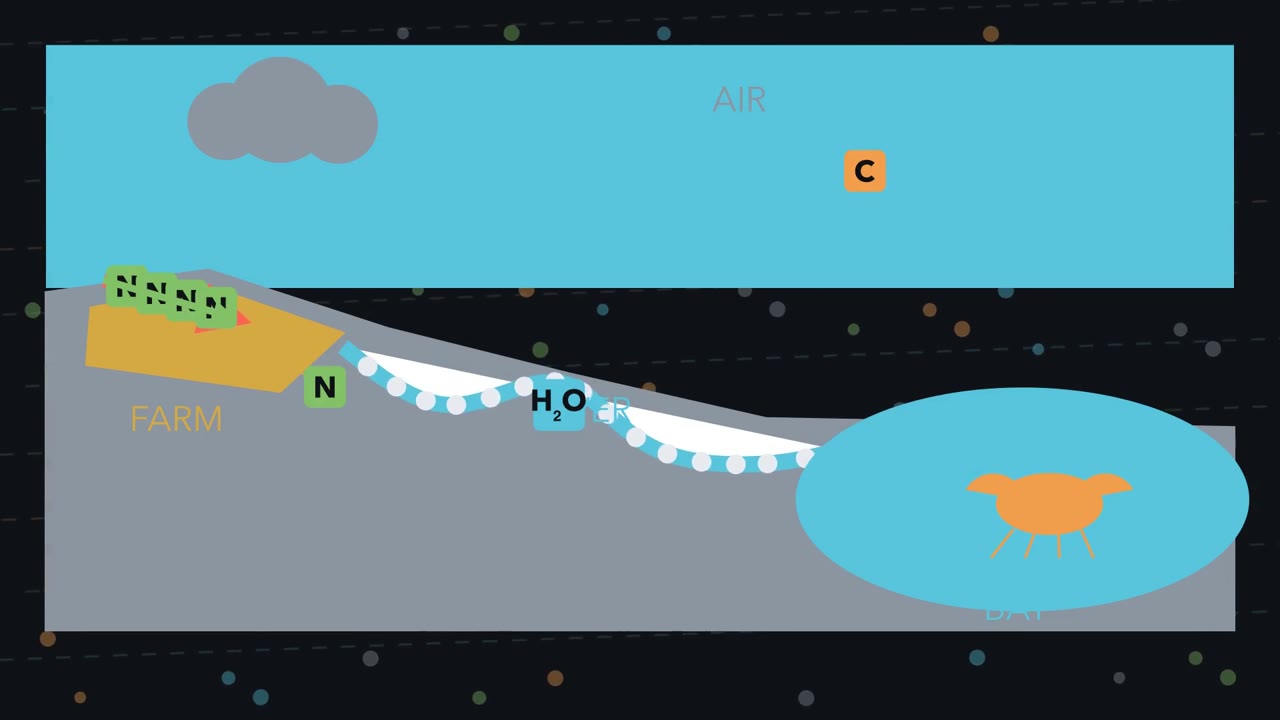
How can rain falling on a farm help build a crab in the Chesapeake Bay? Keep your eyes on one watershed, where land, river, and Bay stay connected. Blue will track water, orange will track carbon, and green will track nitrogen. Each colored token can pause in a reservoir. A reservoir is a place where matter can stay, such as air, water, soil, or a living thing. Start with orange carbon dioxide in air and water. Algae and plants use photosynthesis to build sugars from carbon dioxide and water. Food moves that carbon through living things, until some reaches the crab. The crab's cells use respiration, releasing carbon dioxide to the water.
Plants and microbes respire too. When organisms die, decomposers break down their bodies. Microbial respiration returns much of their carbon to air or water. Water has its own route through evaporation, clouds, precipitation, and flow across land. It also carries other matter. Blue runoff can pick up green nitrogen from a field and move it into a river. Most organisms cannot use nitrogen gas directly. Certain microbes convert it into ammonia, and other microbes help make nitrate. Plants and algae take up ammonium or nitrate. Food can then carry that nitrogen to the crab. Waste and dead bodies keep nitrogen moving. Decomposers return their nitrogen to ammonium.
In wet soil or mud with little oxygen, bacteria can change nitrate back into nitrogen gas. That gas returns to the air. Now follow an orange carbon token inside the crab. When the crab respires, which reservoir receives that carbon next? Hold your answer while the token waits.
The surrounding water receives carbon dioxide from the crab's respiration. That carbon may later enter algae, leave the water, or travel elsewhere. A cycle is a network of possible routes, not one track every atom repeats. Notice how the paths share the same world. Blue water carries green nitrogen.
Algae can hold orange carbon and green nitrogen together. Animals receive both through food, while decomposers send both onward again. At the Bay's surface, orange carbon dioxide can dissolve into seawater. Carbon dioxide also comes back out. Ocean absorption names one direction in a two-way exchange between air and water. In ecosystems, atoms move between reservoirs, and processes connect their cycles. The crab is not an endpoint. It is one temporary reservoir in a moving watershed of air, land, water, microbes, and food.
How can rain falling on a farm help build a crab in the Chesapeake Bay?
Continue in the lesson: Matter Cycles →
3:26 · Free, with captions and a transcript. The lesson has the full text, the questions and the sources.
More films from this lesson
How this film was made. Narration: written from this lesson's text and read by an AI narrator voice (Kokoro, af_heart). Animation: AI-generated in code (Manim) by Claude, a schematic with no drawn molecular structures. Captions come from the narration script. See something wrong? Report it.