Shape Decides the Job
Read the transcript of “Shape Decides the Job”
Film transcript: Shape Decides the Job
Starch and cellulose are both chains of the same sugar, glucose. So why can your own enzymes take starch apart, but not cellulose? The first film showed food taken apart by adding water, one water per link. Here are the same gold sugar blocks. But their links are not all alike. In starch, the glucose links let the chain coil, and some starch branches. It is the plant's store of sugar, and your enzymes can take it apart for energy. A digestive enzyme is a protein folded into a pocket. Starch's links fit that pocket. The enzyme adds water at a link, and the chain breaks into smaller sugars. Other enzymes finish the job, down to glucose.
In cellulose, the glucose blocks are linked the other way. The chains lie straight and stack side by side. Together they form strong fibers that stiffen plant cell walls. Now the same enzyme tries cellulose. Its pocket does not fit these links. Your own enzymes cannot break them. So for you, cellulose is fiber. Same sugar, different links, two shapes, two jobs. One stores energy; the other stiffens plant walls. The blocks, the links between them and the shape they take decide the job. The enzyme follows the same rule. It is a protein, a chain of amino acids folded into a shape. That folded shape makes the pocket, and the pocket fits one kind of molecule.
Lipids follow the rule too. A phospholipid has a head that is attracted to water and two tails that avoid it. Picture many phospholipids dropped into water, all tumbling at once. Each head likes water, and each pair of tails avoids it. Which way will the heads point?
Out, toward the water, on both sides. The tails tuck into the middle. That double layer is the basic structure of a cell membrane. Fats are lipids too, but a fat is not a chain. One glycerol holds three fatty acids by three links. Count from the free pieces, and three waters are missing. The water count still works. The chain picture does not. Counting water only tells you how many links there are. It does not tell you the job. The blocks, the links between them and the shape they take decide what each molecule can do.
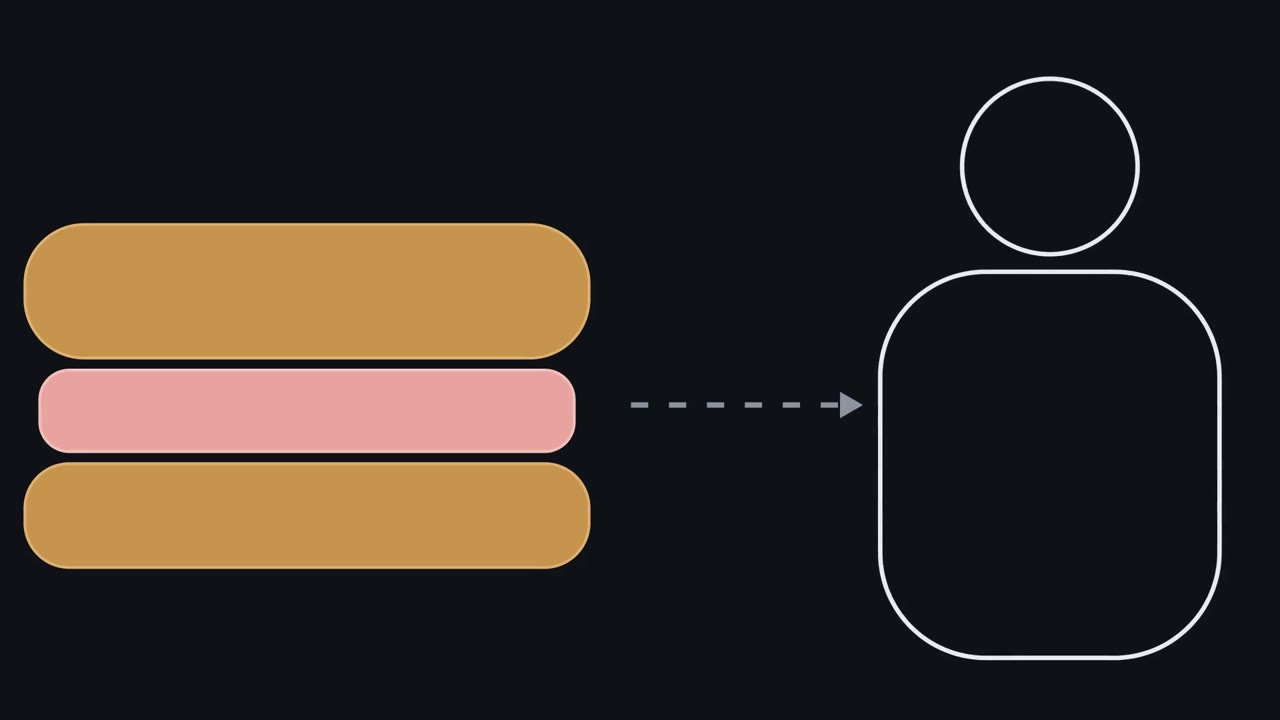
How can a turkey sandwich on whole-wheat bread end up as part of your own body?
Continue in the lesson: What Am I Made Of? →
3:00 · Free, with captions and a transcript. The lesson has the full text, the questions and the sources.
More films from this lesson
How this film was made. Narration: an AI narrator voice (Kokoro, af_heart) reading narration written from this lesson's text. Animation: AI-generated in code (Manim) by Claude, a schematic with no drawn molecular structures. Captions come from the narration script. See something wrong? Report it.