One Budget, Many Uses
Read the transcript of “One Budget, Many Uses”
Film transcript: One Budget, Many Uses
A salmon swims upriver, spawns once, and dies. A songbird nests every spring for years. Both are shaped by natural selection. So how can both strategies be right? Start with one bird in one season. Treat what it takes in and can use as one fixed budget. That budget must pay for four uses.
Upkeep, meaning maintenance and repair. Storage. And reproduction. Lump the first three together as self, in teal. Reproduction stays gold. For this one bird, gold plus teal always equals the intake. So more gold means less teal. That negative link is a trade-off.
Two classic trade-offs live on this line. First, current against future reproduction: what a parent spends on this year's young is not spent on itself. Second, number against size of offspring. A fixed amount put into a clutch can make many small eggs, or a few large ones. Picture two birds with the same intake. One pours most of it into this year's brood. The other keeps more for itself. Each sits at one point on the line, its split.
Selection acts on that split. It favours whichever split leaves the most descendants. Which split wins depends on who dies at what age. Picture two worlds. In the first, adults rarely survive the winter, but their young survive well. In the second, adults usually survive, while many young die, or their survival swings from year to year. Here is a question for you. In the first world, adults rarely live to breed again. Does that lower or raise the extra young one big bout needs to pay?
It lowers it. Holding back buys a future that rarely comes. So putting more into this year's bout can pay, as in the salmon. How far still depends on how extra effort changes breeding and survival. In the second world, teal buys more breeding seasons. Holding back to breed again can pay, as in the songbird. That is why no organism can grow fast, breed early, make many large offspring and live long all at once. Salmon and songbird follow one rule in different worlds. One intake, one split.
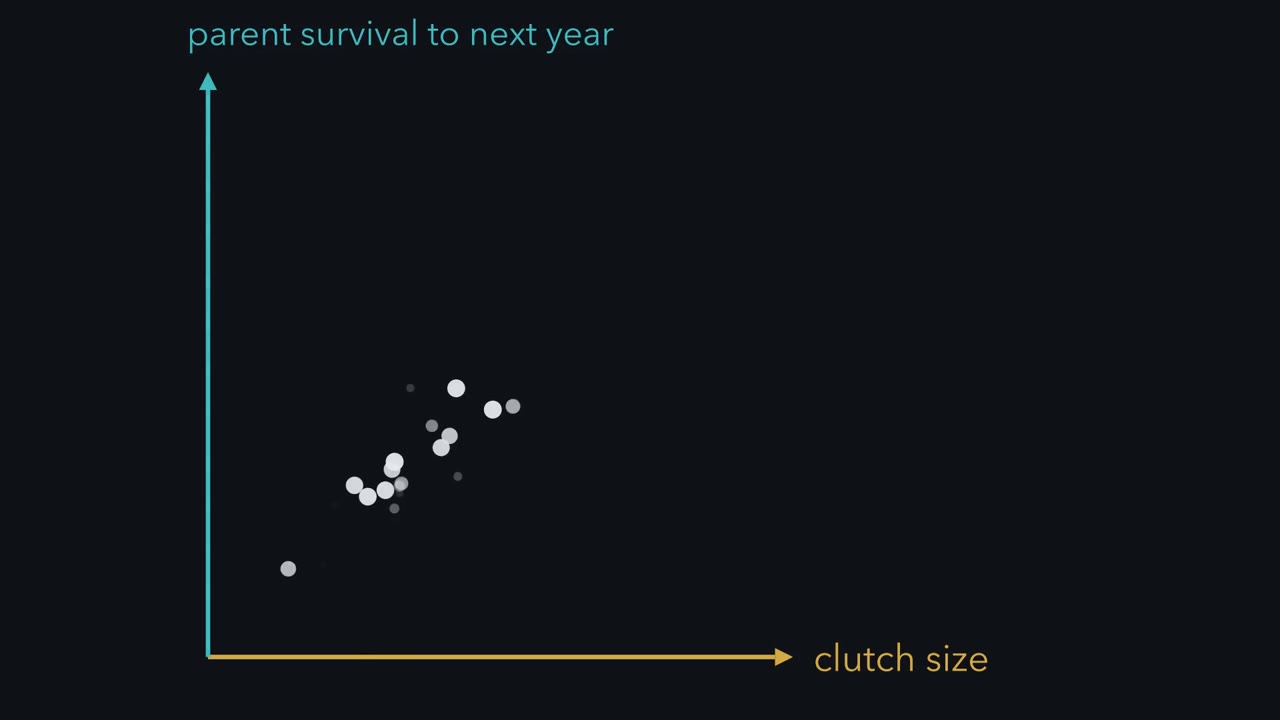
Selection picks the split that leaves the most descendants where that animal lives. There is one catch. So far every bird had the same intake. Real animals do not all take in the same amount. Hold that thought, because it changes what real data show.
If breeding can cost a bird its future, why do birds that lay more eggs often survive better from one year to the next?
Continue in the lesson: Life Histories and Evolutionary Trade-offs →
3:18 · Free, with captions and a transcript. The lesson has the full text, the questions and the sources.
More films from this lesson
How this film was made. Narration: written from this lesson's text and read by an AI narrator voice (Kokoro, af_heart). Animation: AI-generated in code (Manim) by Claude, a schematic with no drawn molecular structures. Captions come from the narration script. See something wrong? Report it.