Two Labs, One Missing Kinase
Read the transcript of “Two Labs, One Missing Kinase”
Film transcript: Two Labs, One Missing Kinase
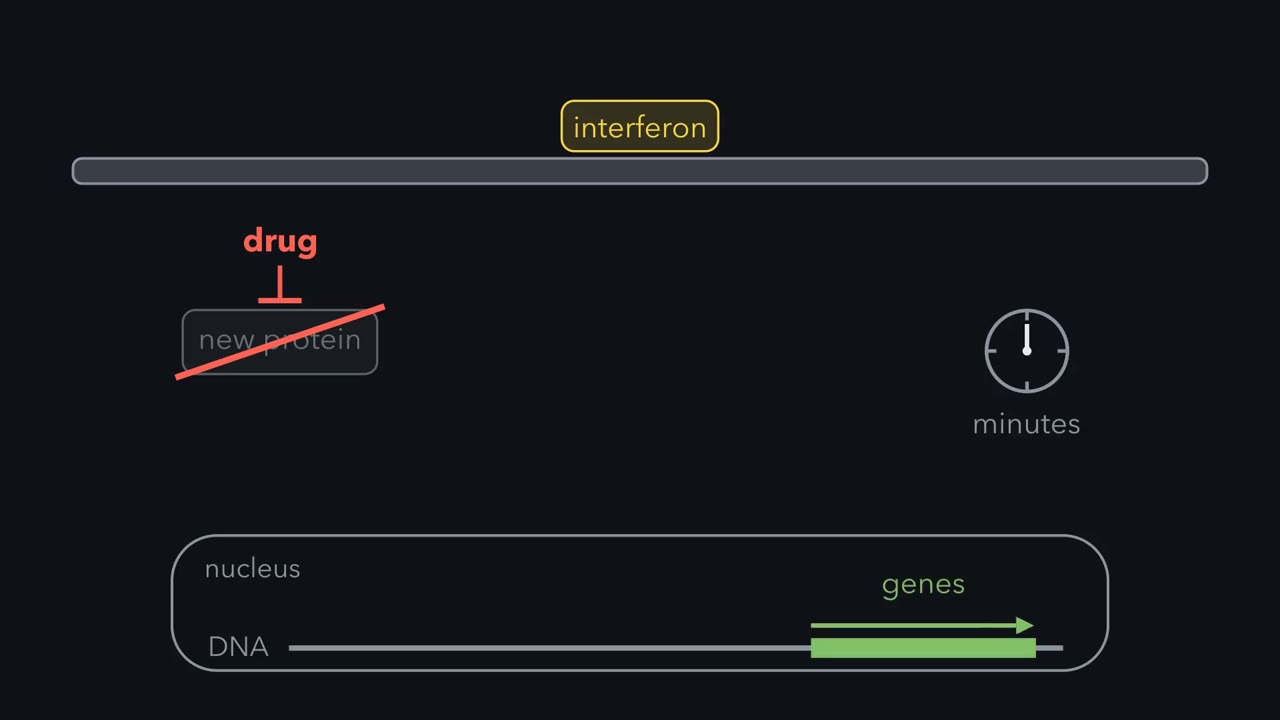
A drug stops the cells making any new protein, and interferon still switches genes on. So the factor must already be in the cell. Two laboratories went looking, from opposite ends. James Darnell's laboratory started at the gene. It found a protein complex, ISGF3, that binds a short DNA sequence shared by interferon-responsive genes. In August 1992, Christian Schindler, Ke Shuai and colleagues reported that interferon puts phosphate on its proteins' tyrosines.
Staurosporine, a drug that blocks many kinases, stopped the activation. Some kinase had to act first. Which one, it could not say. George Stark and Ian Kerr's laboratory started with genetics. Sandra Pellegrini built human cells with a marker gene controlled by interferon-responsive DNA. Only cells deaf to interferon survived. She screened about 100 million mutagenized cells. Each mutant had lost a part of the pathway. She put DNA from normal cells into a mutant, and looked for the rare cell that recovered. In July 1992, her group in Paris reported the gene that rescued one mutant: TYK2. Two weeks apart, the results fit together. A JAK is required, and the DNA-binding proteins carry phosphotyrosine.
Darnell's laboratory named those proteins STATs.
How does a signal reach a gene when the only relay between the receptor and the DNA is one kind of protein?
Continue in the lesson: Cytokine Receptors and JAK–STAT →
1:50 · Free, with captions and a transcript. The lesson has the full text, the questions and the sources.
More films from this lesson
How this film was made. Narration: an AI narrator voice (ElevenLabs, Sarah) reading narration written from this lesson's text. Animation: AI-generated in code (Manim) by Claude, a schematic with no drawn molecular structures. Captions come from the narration script. See something wrong? Report it.