A Clock Made of Cuts
Read the transcript of “A Clock Made of Cuts”
Film transcript: A Clock Made of Cuts
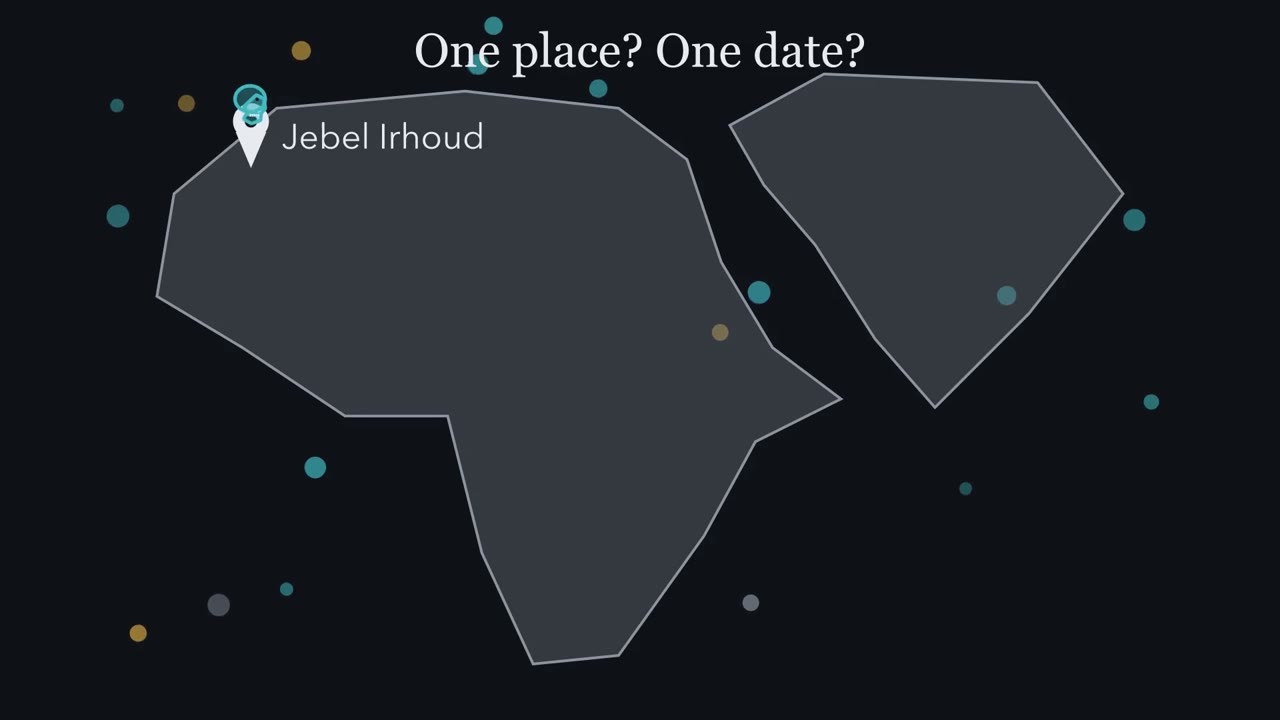
Fossils show where people lived, not who had children together. That needs DNA. If you carry Neanderthal DNA, when did it get there? Start with a clue. A draft Neanderthal genome was compared with genomes of living people. It shared more variants, sites where genomes differ, with sampled Eurasians than with sampled sub-Saharan Africans. The team read this as suggesting interbreeding after some people left Africa. But a clue is not proof, and it gives no date. An old African population, split into partly separate groups, could produce some of it. So look along a chromosome instead.
Picture one teal chromosome in a modern human. It carries one long orange block, inherited from a Neanderthal ancestor. At first the block is long and unbroken. Each time eggs and sperm are made, paired chromosomes swap pieces. This is recombination. A swap inside the orange block can split it, in the copy passed to a child. Generation after generation, the swaps pile up. Some descendants keep the orange block whole. Some keep a shorter piece, and some lose it. Across many descendants, the orange pieces that survive get shorter on average. That makes length a clock. Long orange segments mean the mixing happened recently.
Short flecks mean it happened long ago. Today, after far more generations, the Neanderthal pieces in living non-Africans are short. The cutting has run a long time. Now meet Ust'-Ishim, a man who lived in western Siberia long before us. Will his orange segments be longer or shorter than yours?
Longer. Fewer generations of cutting had passed since the mixing. From their lengths, Fu and colleagues worked out how long before his life the gene flow came. At Bacho Kiro Cave in Bulgaria, three early Homo sapiens were sampled. Each had a Neanderthal ancestor only a few generations back. That was a separate, recent contact in their own family trees. Their orange runs are the longest of all. Line the three up. Bacho Kiro, long runs. Ust'-Ishim, medium pieces. A living person, short flecks. The surplus was a clue. The lengths test it, and say when. One caution travels with this clock. It gives an average, for one main period of mixing. And it says when, not how much ancestry came across.
If our species began in Africa, why do living people whose ancestors lived outside Africa carry a little Neanderthal DNA, and how can a genome tell when it got there?
Continue in the lesson: Human Evolutionary History: An African Origin and Archaic Ancestry →
3:16 · Free, with captions and a transcript. The lesson has the full text, the questions and the sources.
More films from this lesson
How this film was made. Narration: an AI narrator voice (Kokoro, af_heart) reading narration written from this lesson's text. Animation: AI-generated in code (Manim) by Claude, a schematic with no drawn molecular structures. Captions come from the narration script. See something wrong? Report it.