Two Proteins, One Phosphate
Read the transcript of “Two Proteins, One Phosphate”
Film transcript: Two Proteins, One Phosphate
A bacterium senses most of its surroundings with two-component systems. Component one is a sensor kinase, usually set in the membrane. When it detects its signal, it takes the end phosphate from ATP. It puts that phosphate on one of its own histidines. Component two is the responder. It moves that phosphate onto one of its own aspartates. The change in shape that follows switches it on. Most responders are transcription factors, so the whole pathway is a sensor and a gene switch with one phosphate passed between them. Set this beside an animal pathway. A phosphate on aspartate is labile. How long it lasts differs from one responder to another, from seconds for CheY, a swimming responder, to minutes or more for others.
A phosphate on serine, threonine or tyrosine stays until a phosphatase removes it. So the cell controls off separately from on. Because that mark stays, another protein can bind it. An SH2 domain reads a phosphotyrosine. In the bacterial relay, the phosphate changes the responder that carries it, and no separate domain reads it. Most sensor kinases pass their phosphate to one partner and largely ignore the rest. An animal receptor recruits several pathways at once, and each runs through tiers of kinases.
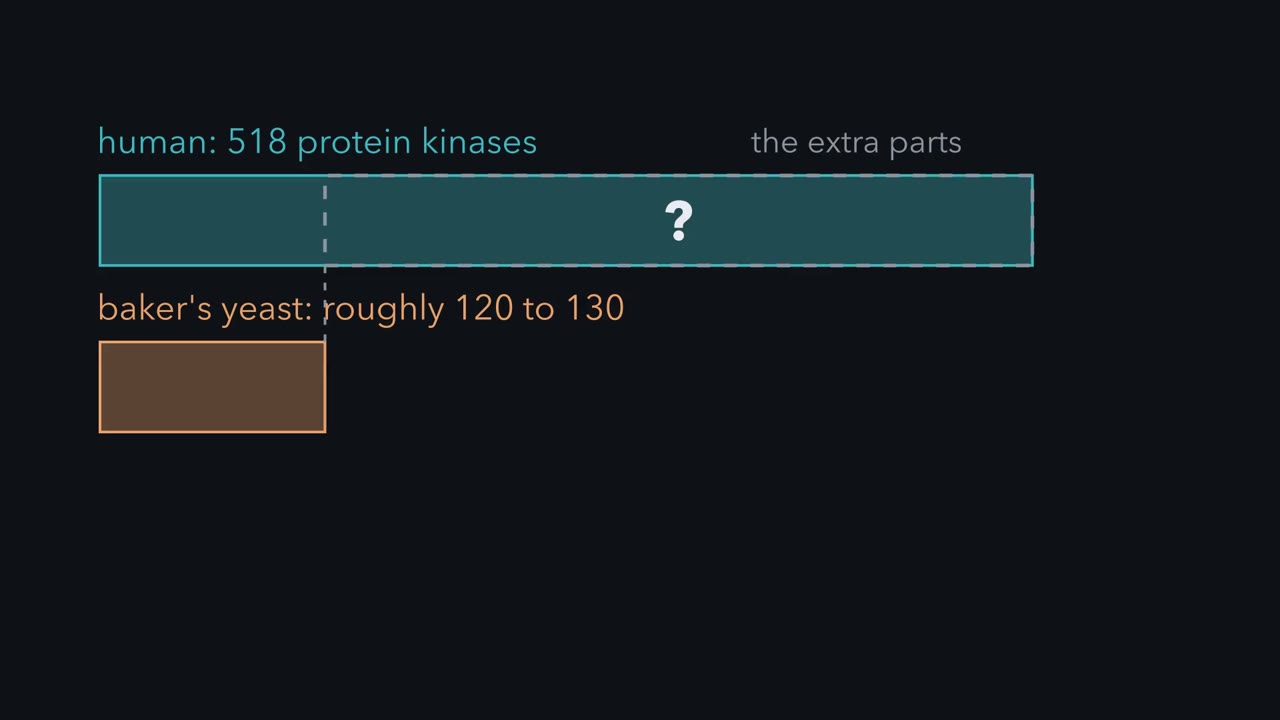
A human has 58 receptor tyrosine kinases and baker's yeast has none. Where did they come from?
Continue in the lesson: How Signaling Evolved →
1:47 · Free, with captions and a transcript. The lesson has the full text, the questions and the sources.
More films from this lesson
How this film was made. Narration: an AI narrator voice (Gemini, Charon) reading narration written from this lesson's text. Animation: AI-generated in code (Manim) by Claude, a schematic with no drawn molecular structures. Captions come from the narration script. See something wrong? Report it.