Four Ways to Hold Steady
Read the transcript of “Four Ways to Hold Steady”
Film transcript: Four Ways to Hold Steady
The first film followed a body as it pushed back against warming. Do hearts, leaves, roots, and cells all use that same loop? Keep the same colors while the parts change. A gold badge marks the condition each case helps protect.
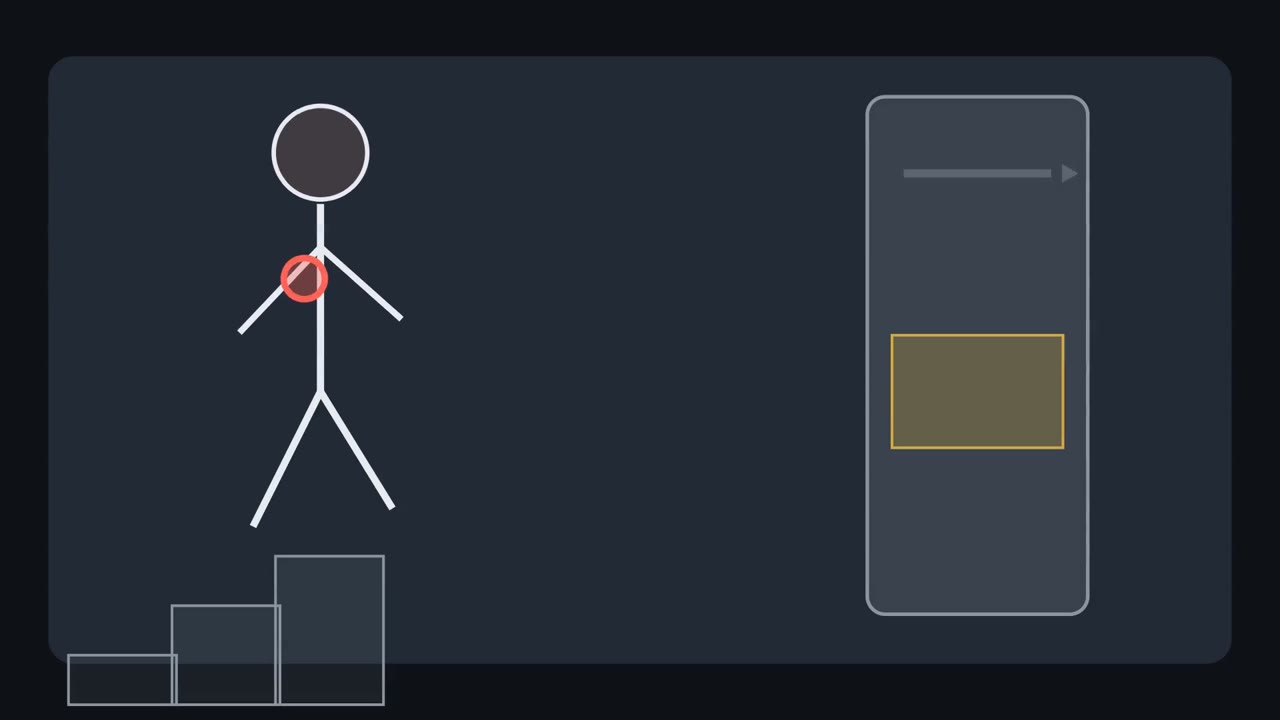
Start with the heart during exercise. Commands from the brain speed it as movement begins. Sensors in working muscles and blood vessels add information. The faster heart moves more blood past those muscles. Exercise control combines advance commands from the brain with feedback from sensors. Now move the gold range badge to a leaf.
Dry air makes water vapor leave faster through stomata, the leaf's small pores. Guard cells can narrow each pore and slow that loss. But the pore also admits carbon dioxide. Predict what happens to carbon dioxide entry when the guard cells narrow the pore. Does only water movement change, or do both movements slow? Watch the two arrows while you decide.
Both movements slow. Fewer water-vapor particles escape, helping the leaf keep water. Fewer carbon-dioxide particles enter, which is the tradeoff. One response can protect one condition while limiting another process. A root takes a slower path. When water is uneven in soil, the root can curve as it grows toward wetter ground. This is hydrotropism. It supports water supply, but biologists usually call it a response, not a complete feedback loop. A single cell uses its boundary. The selectively permeable membrane lets some substances cross and holds others back.
Passive transport follows a concentration gradient without cellular energy. Active transport spends cellular energy to move against that gradient. Together, these routes keep the inside different. Each case helps keep something steady, but by a different route. The heart changes flow, guard cells change a pore, and membranes control what crosses. Roots support water supply by changing growth direction. The goal is shared, but the diagrams are not identical. Body temperature fits the full sensor, control center, and effector map.
Exercise adds advance commands. Hydrotropism is not usually called a complete loop. A membrane needs no brain-like controller. The text now adds what the pictures skipped: the heart's two nerves and what complicates leaf pores. Then real heart-rate data show how one return unfolds over time.
Why does your heart speed up when you run up the stairs, and then slow down again over the next few minutes?
Continue in the lesson: Homeostasis in Action →
3:12 · Free, with captions and a transcript. The lesson has the full text, the questions and the sources.
More films from this lesson
How this film was made. Narration: an AI narrator voice (Kokoro, af_heart) reading narration written from this lesson's text. Animation: AI-generated in code (Manim) by Claude, a schematic with no drawn molecular structures. Captions come from the narration script. See something wrong? Report it.