Turning Heads, Steady Eyes
Read the transcript of “Turning Heads, Steady Eyes”
Film transcript: Turning Heads, Steady Eyes
Turn your head, and your eyes stay fixed on the world. How does the ear do that? Same switch, new front end. A semicircular canal is a fluid-filled ring. In its swelling, hair bundles sit in a gelatinous flap called the cupula. When the head turns, the fluid lags behind, bends the cupula, and pushes the bundles. During everyday head movements, the canal's nerve fibres signal roughly how fast the head is turning. They fire even at rest. Canals on opposite sides pair up. A turn to the left excites the left canal and inhibits the right. The canals drive the vestibulo-ocular reflex, which keeps the eyes still in the world. In a left turn, the left vestibular nucleus excites the right abducens nucleus.
It drives the right lateral rectus, and the right eye turns right. Abducens interneurons cross to the left oculomotor nucleus, which turns the left eye right. Both eyes turn right as the head turns left. Now the left inner ear is suddenly destroyed. The head is still. What does the brain think is happening?
The right side's resting firing is now unmatched. The brain reads a turn to the right. The eyes drift slowly left, with quick jerks back to the right. The room seems to spin. That is one mechanism of vertigo. The otolith organs sense gravity and straight-line acceleration. Their bundles are capped by a crystal-loaded membrane. Tilt the head back, and that heavy membrane slides backward. Accelerate forward, as an aircraft does on its takeoff run, and it slides backward too. Without a view outside, you can feel tipped back. So an otolith organ alone cannot tell tilt from acceleration. A tilt also rotates the head, and the canals feel rotation. One switch. A wave, a ring of fluid, a heavy membrane.
And circuits that read which cells are active, and how the two sides compare.
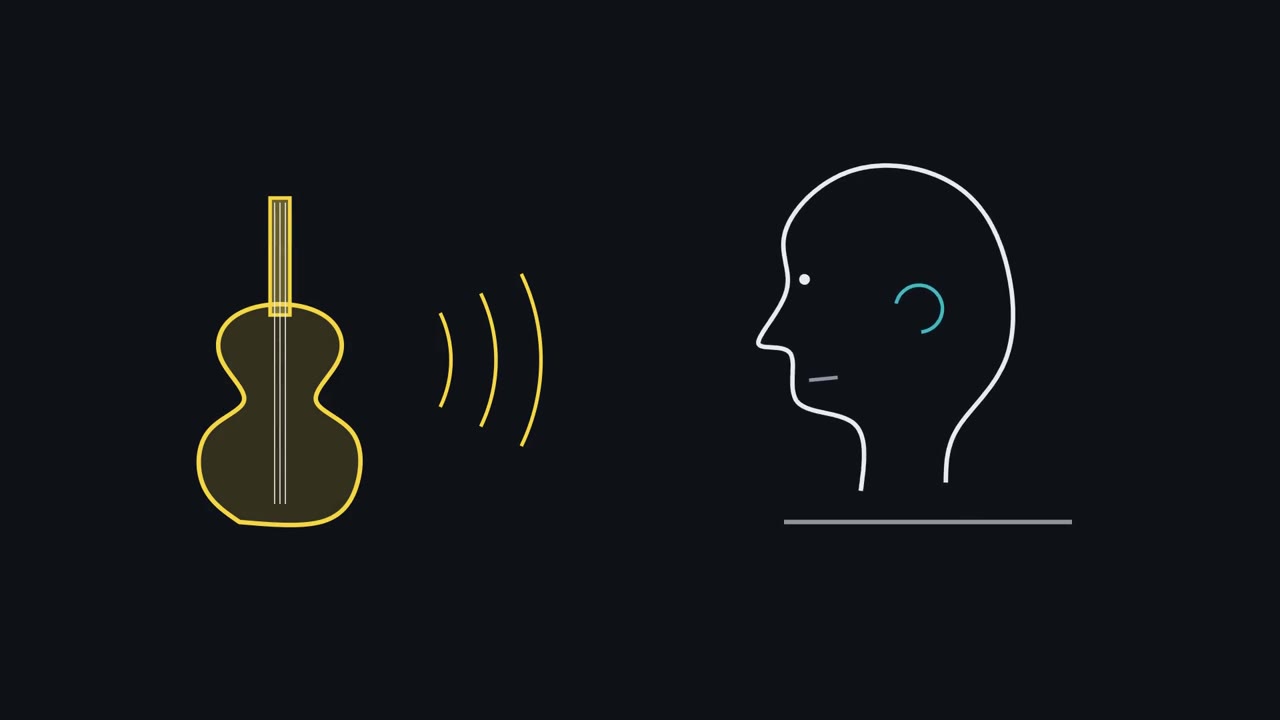
The same kind of cell tells you that a violin is playing an A and that your head is turning left. How does one cell type do both jobs?
Continue in the lesson: Hearing and Balance →
2:24 · Free, with captions and a transcript. The lesson has the full text, the questions and the sources.
More films from this lesson
How this film was made. Narration: an AI narrator voice (Kokoro, af_heart) reading narration written from this lesson's text. Animation: AI-generated in code (Manim) by Claude, a schematic with no drawn molecular structures. Captions come from the narration script. See something wrong? Report it.