Reading the Warblers' Tree Map
Read the transcript of “Reading the Warblers' Tree Map”
Film transcript: Reading the Warblers' Tree Map
The film's tree and your simulation both gave each kind its own zone by rule. Did real warblers use spruce trees in different patterns? To find out, keep the same tree and replace imagined paths with recorded observations.
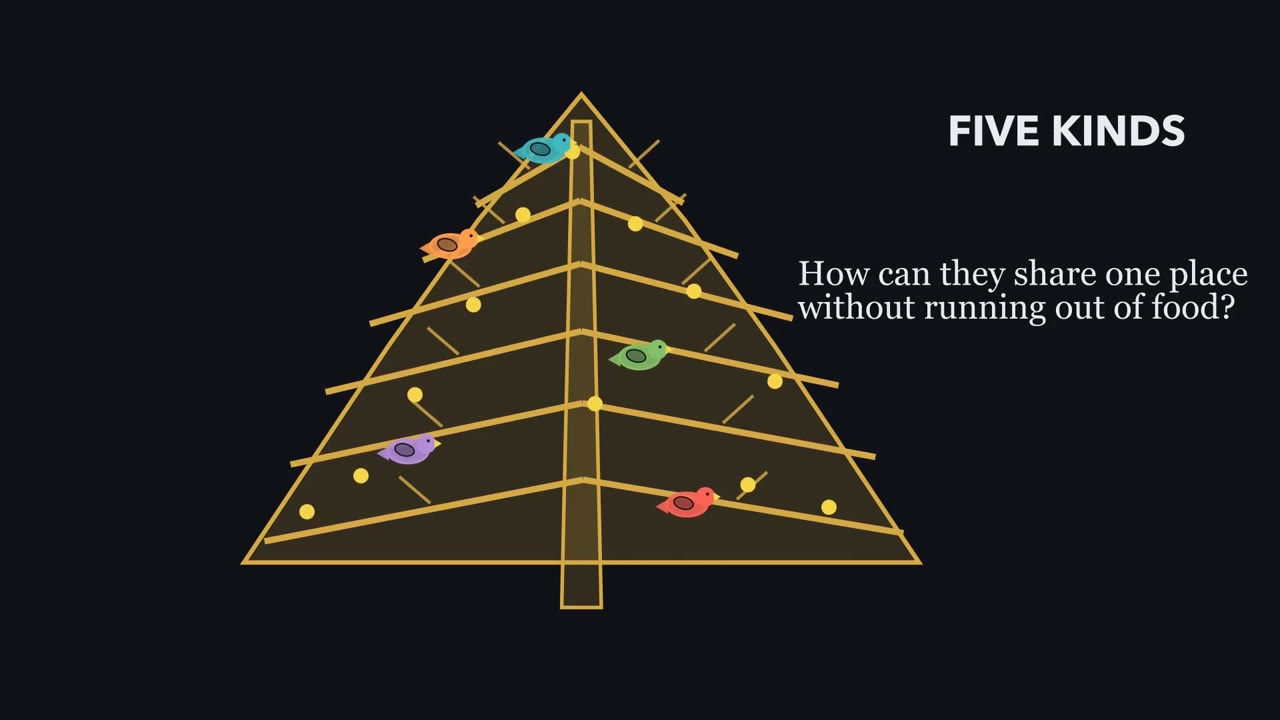
Robert MacArthur divided spruce trees into named zones. Height bands ran down from the treetop. Each branch also had a base, a middle, and outer tips. Using the same map for every bird made their patterns comparable. When MacArthur could see a bird, he timed how long it stayed in each zone. The forest was dense, and birds were often hidden. Many hours of watching produced few useful seconds. Each colored timer fills only while its bird remains visible. For each kind, the recorded seconds became percentages of its total recorded time. Darker zones mean more time there. The maps show different centers of activity, but their colored areas still overlap.
No bird owns a private slice of the tree. Some kinds centered activity high in the tree. Others centered lower, or spread their time more widely. Predict how to read a shared zone. Both kinds clearly have recorded time there. Does that show complete separation, or does it show overlap? Hold your answer while both cells glow.
It shows overlap. Both kinds spent recorded time in that zone. Their percentages can still differ, so overlap does not mean identical use. Read down a column to compare kinds, then read across a row to find each kind's pattern. A large value marks a strong center of activity. Smaller values still matter because they show shared use. Now separate observation from explanation.
The table records time, not insects eaten. Some records were singing birds, not feeding birds. Visibility matters because dense branches can hide birds. Percentages summarize what the observer could record, not everything birds did. The study did not directly measure competition. Different tree use may reduce competition, but the table alone cannot prove that cause. A careful claim keeps those parts apart. The warblers shared a habitat and used it in different, overlapping patterns. That pattern carefully supports a possible explanation for sharing. It remains evidence for the idea, not proof of every step.
How can five kinds of small birds that all eat insects share the same spruce trees?
Continue in the lesson: Habitat and Niche →
3:05 · Free, with captions and a transcript. The lesson has the full text, the questions and the sources.
More films from this lesson
How this film was made. Narration: an AI narrator voice (Kokoro, af_heart) reading narration written from this lesson's text. Animation: AI-generated in code (Manim) by Claude, a schematic with no drawn molecular structures. Captions come from the narration script. See something wrong? Report it.