Keeping the Gas Fresh
Read the transcript of “Keeping the Gas Fresh”
Film transcript: Keeping the Gas Fresh
Two people move the same total air each minute. So why is one of them building up carbon dioxide while the other is not? The first film ended at a dead-ended sac, the alveolus. Blood can at best match the gas inside it. Blood flow keeps bringing new blood. But the gas must be renewed too, through the airways. So what keeps moving fresh air in? A mammal pulls air in. The diaphragm, a dome of muscle under the lungs, contracts and flattens. The chest enlarges, pressure in the lungs falls, and air flows in. This is aspiration. But a tube leads to the sac. The airways, from nose and mouth down to the smallest bronchioles with no alveoli, exchange nothing. They are dead space.
So the first air into the sac each breath is stale air left in the tube. And fresh air still in the tube when you stop breathing in is breathed out unused. Take slow, deep breaths. Each breath clears the dead space and sends a large fresh portion into the sac. The total air moved each minute is minute ventilation. The fresh part reaching the alveoli is alveolar ventilation. Now keep the total air per minute the same, but take smaller, faster breaths. Does carbon dioxide in the sac rise, fall or stay the same?
It rises. Each small breath barely clears the dead space. Less fresh air reaches the sac, while the body makes carbon dioxide as fast as before. Here the first film's rule runs in reverse. Blood giving up carbon dioxide leaves with no lower partial pressure than the gas it last touched. So the blood's carbon dioxide climbs with the sac's. The brainstem watches that result. Carbon dioxide crosses into the brain's fluid and lowers its pH.
Sensors near the brainstem surface detect the fall, and the drive to breathe rises. Haldane and Priestley sampled the last of a forced breath out. In resting subjects, a small rise in alveolar carbon dioxide greatly increased breathing. Lowering oxygen did little until it fell far. So breathing keeps the gas the blood touches fresh. At rest, a mammal's controller mostly reads carbon dioxide. That level is the result of its own breathing, set against the body's carbon dioxide output. Too little fresh air, and carbon dioxide climbs. The sensors then push breathing back up.
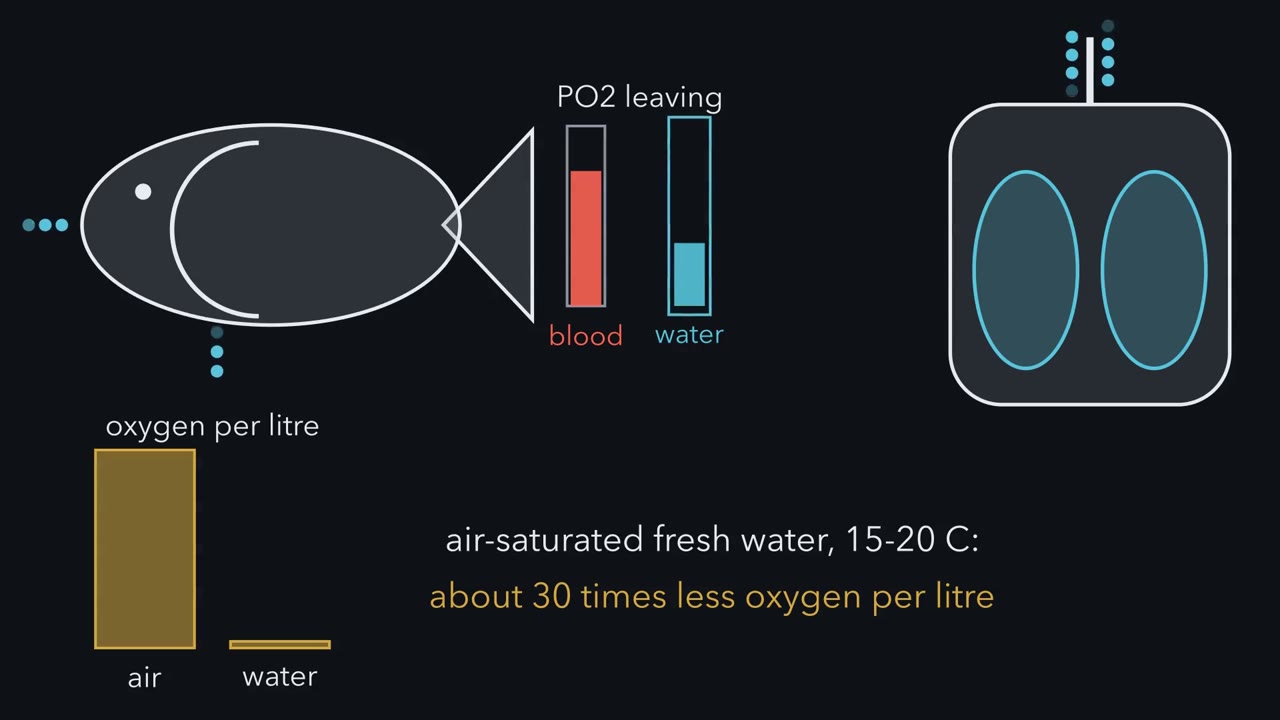
Water holds far less oxygen than air, yet a trout's gill can send its blood out at a higher oxygen partial pressure than the water leaving it. Your lung cannot do that with air. Why not?
Continue in the lesson: Gas Exchange and Breathing →
3:08 · Free, with captions and a transcript. The lesson has the full text, the questions and the sources.
More films from this lesson
How this film was made. Narration: an AI narrator voice (Kokoro, af_heart) reading narration written from this lesson's text. Animation: AI-generated in code (Manim) by Claude, a schematic with no drawn molecular structures. Captions come from the narration script. See something wrong? Report it.