Cohen finds that the EGF receptor adds phosphate to tyrosine
Read the transcript of “Cohen finds that the EGF receptor adds phosphate to tyrosine”
Film transcript: Cohen finds that the EGF receptor adds phosphate to tyrosine
Stanley Cohen wanted to know whether a growth factor could drive a chemical reaction in a preparation with no living cells. He wrote that, as a biochemist, he expected a hormone or growth factor to control some chemical reaction. He thought this reaction could be shown in a cell-free system. His model was Sutherland's work: adding glucagon to cell membranes produced cyclic AMP. At Vanderbilt University at the end of the 1970s, Cohen's laboratory used membranes from A-431 cells, a human tumour cell line with many EGF receptors. There were no living cells in the preparation. Graham Carpenter did much of the biochemistry. When they added EGF (epidermal growth factor) to the membranes, phosphate began to move onto protein.
Cohen wrote that he was exhilarated. Here was a cell-free system in which EGF had an effect. Hirota Ushiro then identified the amino acid that received the phosphate. It was tyrosine. At that time, tyrosine was not known as a site for a regulatory phosphate. In a normal cell, phosphotyrosine is less than 1% of all the phosphate on proteins, and almost no one had looked for it. The EGF receptor turned out to be the kinase itself.
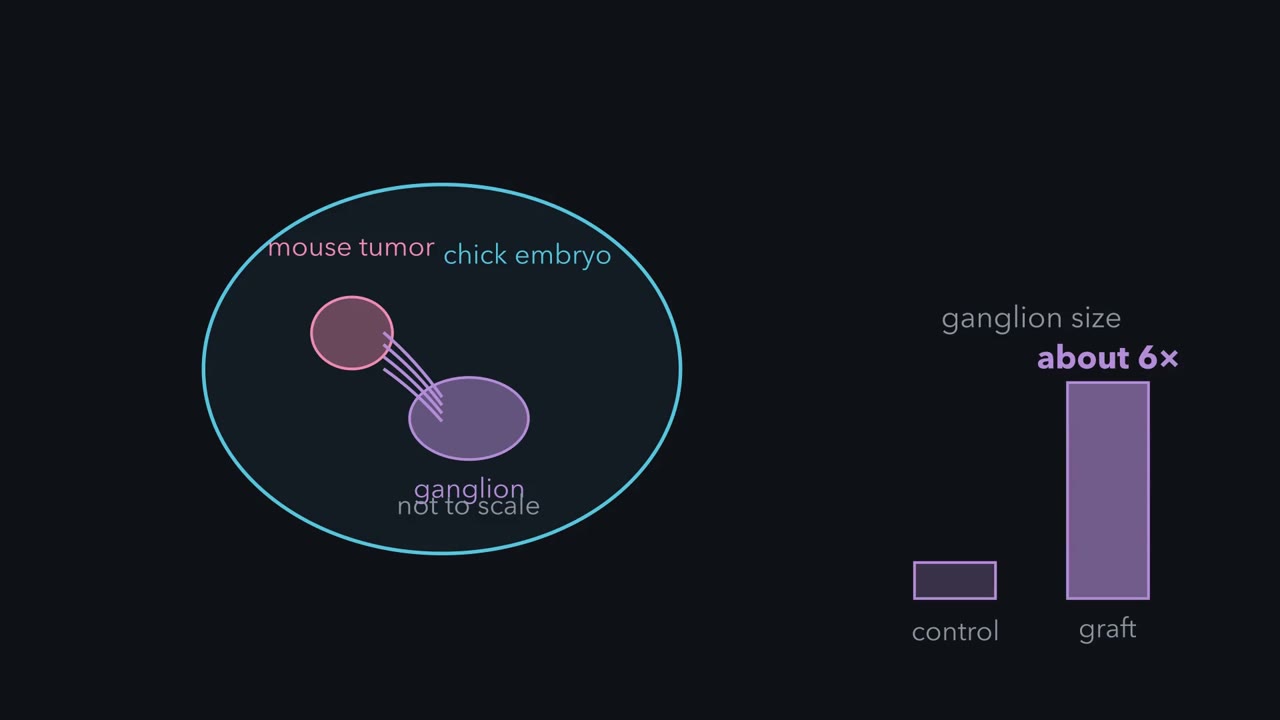
A mouse tumor that never touched a chick embryo's nerves made its ganglia swell. What was it releasing, and why do neurons depend on a signal from their targets?
Continue in the lesson: Finding a Signal: NGF, EGF and the Bioassay →
1:13 · Free, with captions and a transcript. The lesson has the full text, the questions and the sources.
More films from this lesson
How this film was made. Narration: an AI narrator voice (ElevenLabs, Brian) reading a passage Chris Deppmann wrote for his graduate signaling course. Animation: AI-generated in code (Manim) by Claude, a schematic with no drawn molecular structures. Captions come from the narration script. See something wrong? Report it.