Press play to start at .
Build or Burn
From the film
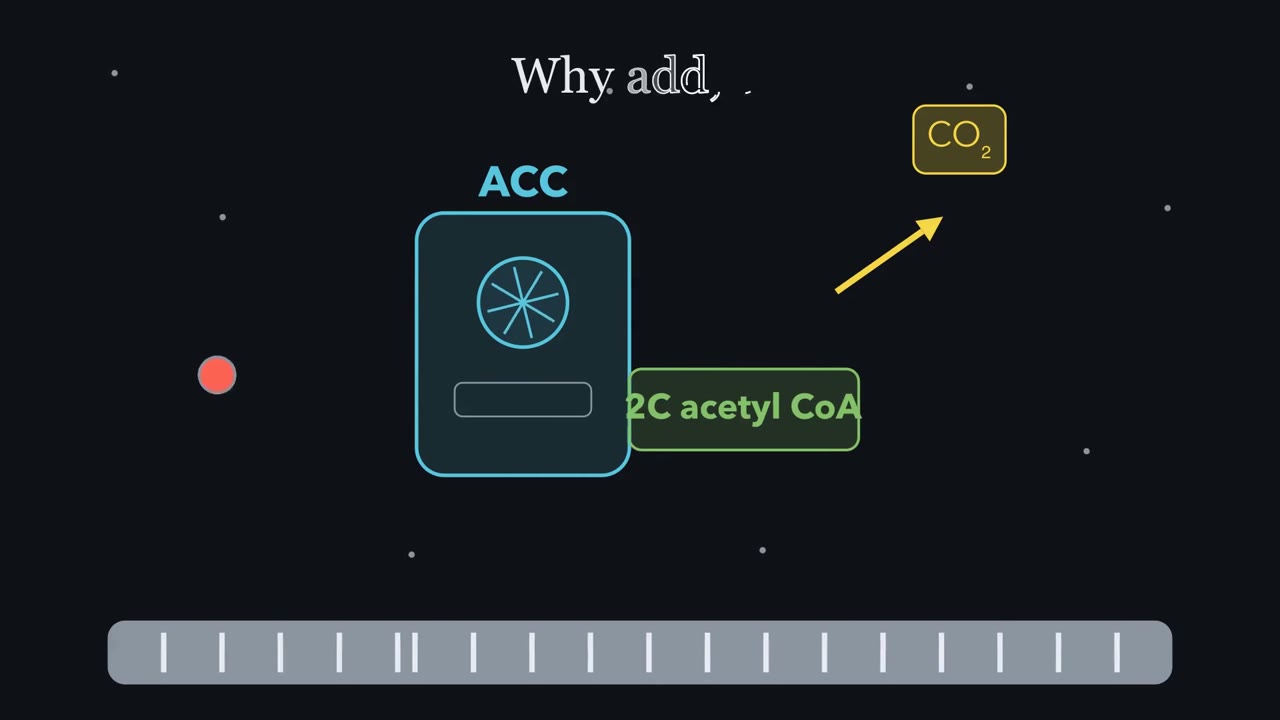
- ACC is the point where the cell decides whether to build fat.
- Citrate and insulin switch ACC on; palmitoyl CoA, the end product, and AMPK switch it off.
- Malonyl CoA also blocks CPT-I, the gate fat must pass to enter the mitochondrion and be burned.
- Much of the malonyl CoA that blocks CPT-I comes from ACC2 on the mitochondrion; ACC1 mainly feeds synthesis.
- So a cell that is building fat tends not to burn it at the same time.
Read the transcript of “Build or Burn”
Film transcript: Build or Burn
Tap a sentence to play from there.
- 0:00 A fed cell builds palmitate two carbons at a time.
- 0:04 Each turn costs one ATP and two NADPH.
- 0:09 But the same cell also holds mitochondria that burn fat.
- 0:14 So what stops new fat from being burned as fast as it is made?
- 0:20 If both ran at once, the cell would build a chain, then tear it down, paying for both. Its separate places, carriers and electron pools make it possible to control each direction on its own.
- 0:35 Building has one main control point.
- 0:38 That point is ACC, the enzyme that makes malonyl CoA.
- 0:43 Citrate, which piles up when fuel is plentiful, switches it on.
- 0:48 So does insulin. Palmitoyl CoA, the finished product, switches it off, a clean feedback brake.
- 0:56 AMPK, the cell's low-fuel sensor, also switches ACC off, by attaching a phosphate.
- 1:03 Another enzyme, PP2A, removes the phosphate and turns it back on.
- 1:09 Now the elegant part.
- 1:12 Malonyl CoA has a second job.
- 1:15 It blocks CPT-I, the gate fat must pass to enter the mitochondrion and be burned.
- 1:22 So the molecule that commits a cell to building also shuts the door on burning.
- 1:27 ACC comes in two forms.
- 1:31 ACC1 works in the cytoplasm and feeds the synthase.
- 1:35 ACC2 sits on the mitochondrion itself.
- 1:40 Why put a fat-building enzyme on the organelle that burns fat?
- 1:49 Because that is where the blocker is made.
- 1:53 Much of the malonyl CoA that blocks CPT-I comes from ACC2.
- 1:58 ACC1's malonyl CoA is mainly a building block.
- 2:04 ACC2's is mainly a signal.
- 2:07 Follow a well-fed cell.
- 2:10 Insulin and plentiful citrate push ACC on, and malonyl CoA rises.
- 2:16 The synthase gets its extenders, and the CPT-I gate closes.
- 2:21 A cell that is building fat tends not to burn it.
- 2:25 So the answer to our question is one small molecule with two jobs.
- 2:30 In the cytoplasm it is a brick for the chain.
- 2:34 At the mitochondrion it is a lock on the door.
- 2:37 So a cell tends not to build and burn at once.
Making fat: the same idea, other levels
A level is a place to start, not a rank. If this loses you, the rung below teaches the same idea, told more simply.
College, upper level · the level you chose
Fatty Acid Synthesis: Building the Chain Two Carbons at a Time · this lesson
Seven turns of four steps build palmitate from 8 acetyl CoA and 14 NADPH.
Biochemistry · about 25 min · film 3:21 · 3 practice questions
Next door
- Burning fat: The Two-Carbon Ledger · 3:17 Making fat and burning it run in opposite directions, so a cell switches between them.
- Blood sugar control: How the body switches fuels · 2:32 After a meal, insulin tells the liver to turn spare sugar into fat.
- Cholesterol: The cholesterol gauge · 3:15 Both fats and cholesterol are built from the same two-carbon starting piece, acetyl-CoA.
- Hunger and appetite: Feeding, Motivation and Reward Fat stores send leptin to the brain, which then adjusts how hungry you feel.
More films from this lesson
Continue in the lesson: Fatty Acid Synthesis: Building the Chain Two Carbons at a Time →
Free, with captions and a transcript. The lesson has the full text, the questions and the sources.
How this film was made. Narration: an AI narrator voice (Kokoro, af_heart) reading narration written from this lesson's text. Animation: AI-generated in code (Manim) by Claude, a schematic with no drawn molecular structures. Captions come from the narration script. See something wrong? Report it.