Press play to start at .
Fuel the Liver Ships
From the film
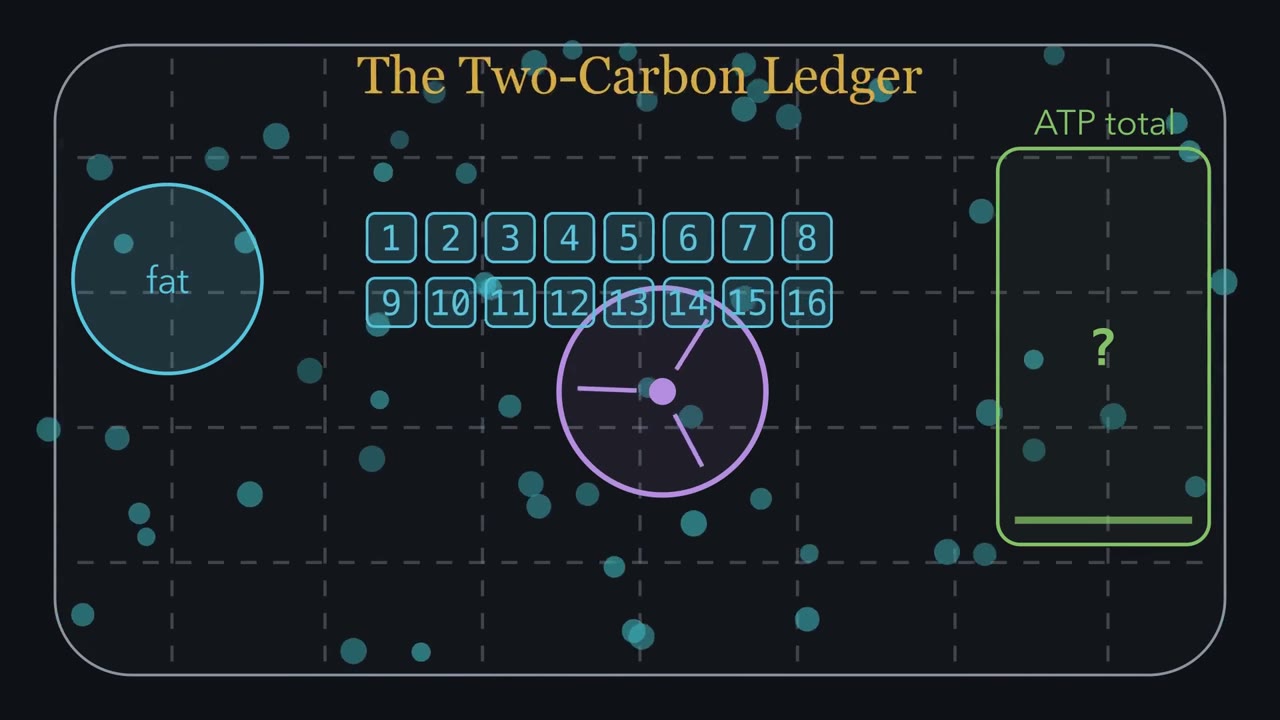
- Mammals cannot make net glucose from even-chain fat by the usual route: each citric acid cycle turn takes in two carbons and loses two as CO2.
- Only the glycerol backbone and the tail of odd chains make net sugar from fat.
- In a fast, the liver makes acetyl-CoA faster than its citric acid cycle can burn it, and repackages the surplus as ketone bodies.
- The liver cannot use its own ketones because it lacks thiophorase, and red blood cells cannot because they have no mitochondria.
- Heart, muscle, kidney and, after adaptation, the brain run on ketones; by day 40 of a fast, protein breakdown falls from roughly 75 to 20 grams a day.
Read the transcript of “Fuel the Liver Ships”
Film transcript: Fuel the Liver Ships
Tap a sentence to play from there.
- 0:00 Fat comes apart two carbons at a time, as acetyl-CoA.
- 0:05 Now stretch that over a long fast.
- 0:09 In 1965, Angus Barbieri stopped eating for 382 days.
- 0:15 How did his brain keep running?
- 0:20 Under medical supervision, he lived on water, tea and coffee, with vitamins.
- 0:26 He went from 456 pounds to 180.
- 0:31 Early in a fast, the brain depends on glucose.
- 0:35 So where could glucose come from?
- 0:37 Not from even-chain fat, by the usual route.
- 0:42 Each turn of the citric acid cycle takes in two carbons as acetyl-CoA.
- 0:48 It loses two as carbon dioxide.
- 0:52 No oxaloacetate is left over to build glucose.
- 0:55 Only the glycerol backbone and the tail of odd chains make net sugar from fat.
- 1:02 Most of fat's carbon needs another route.
- 1:05 When glucose is scarce, low insulin floods the liver with fatty acids.
- 1:11 It opens the carnitine gate.
- 1:14 Beta β-oxidation then makes acetyl-CoA faster than the liver's citric acid cycle can burn it.
- 1:21 The liver repackages the surplus.
- 1:25 Two acetyl-CoA become one acetoacetate, a ketone body.
- 1:31 It can be reduced to D-3-hydroxybutyrate, the dominant form in blood.
- 1:36 Here is the idea. Even-chain fat cannot become net glucose.
- 1:43 So in a fast, the liver ships fat's two-carbon units as ketone bodies, fuel for other tissues.
- 1:50 Shipping costs the liver.
- 1:53 If it exports palmitate as four acetoacetate, it keeps about 26 of the 106 ATP.
- 2:00 The tissues that burn the ketones collect most of the rest.
- 2:05 Those capsules still hold most of the energy, and the liver made every one.
- 2:10 Will the liver burn its own ketones?
- 2:18 No. The liver lacks thiophorase, the enzyme that reloads acetoacetate onto coenzyme A. Red blood cells cannot use ketones either, having no mitochondria.
- 2:33 Heart, muscle, kidney and, after adaptation, the brain run on them.
- 2:37 George Cahill's starvation studies measured the payoff.
- 2:42 By day 40, protein breakdown fell from roughly 75 to 20 grams a day.
- 2:49 The brain had shifted onto ketones, sparing muscle.
- 2:53 That is how a year of fat could feed a brain.
- 2:56 By Cahill's data, Barbieri's brain would have run largely on ketones from his own fat. Gluconeogenesis would have supplied the glucose it still needed.
- 3:07 The even-chain carbons made no net sugar.
- 3:11 The liver turned them into a fuel it cannot burn, and sent it to tissues that can.
Burning fat: the same idea, other levels
A level is a place to start, not a rank. If this loses you, the rung below teaches the same idea, told more simply.
College, upper level · the level you chose
Fatty Acid Degradation: The β-Oxidation Spiral · this lesson
Palmitate gives 8 acetyl-CoA, 7 FADH2, 7 NADH, about 106 net ATP.
Biochemistry · about 27 min · film 3:17 · 7 practice questions
Next door
- Making fat: The carbon fatty acid synthesis throws away · 3:21 A cell does not build fat and burn it at once, because one product blocks the other's entry step.
- Lipids and fatty acids: Shape is destiny · 2:27 The fats burned here are the same fatty acid tails that build membranes and store energy.
- Fasting: How the body switches fuels · 2:32 Hours without food shift the body from sugar toward burning stored fat.
More films from this lesson
Continue in the lesson: Fatty Acid Degradation: The β-Oxidation Spiral →
Free, with captions and a transcript. The lesson has the full text, the questions and the sources.
How this film was made. Narration: an AI narrator voice (Kokoro, af_heart) reading narration written from this lesson's text. Animation: AI-generated in code (Manim) by Claude, a schematic with no drawn molecular structures. Captions come from the narration script. See something wrong? Report it.