Four Tests of Whale Ancestry
Read the transcript of “Four Tests of Whale Ancestry”
Film transcript: Four Tests of Whale Ancestry
The first film placed fossil whales in time. If that history is right, what should we find inside living whales and their DNA? Keep one branching tree in view. A common ancestor is an ancestral population from which later species descended. Branches split; they do not form a ladder.
Living species sit at the tips. DNA passes from parents to offspring. Small copied changes can travel down a branch. Nearby branches have had less time to collect different changes. Matching DNA stretches are therefore usually more similar. Suppose an insertion spread through the ancestral population of whales and hippos before they split, and was never lost. Where should matching markers appear today? Choose whale and hippo, whale and fish, or all three.
The matching markers should reach whales and hippos. Researchers found shared insertions at the same spots in the genome. That pattern groups whales with hippos among even-toed hoofed mammals. That grouping does not mean hippos became whales. Both living groups occupy separate tips. They share an earlier population, then each branch continued changing. Relatives are not automatically ancestors. Anatomy tests the tree another way. Homologous structures come from one structure in a common ancestor. A whale flipper, a human arm and a bat wing hold the same set of bones, arranged differently. Living whales also carry small hip bones that support no legs.
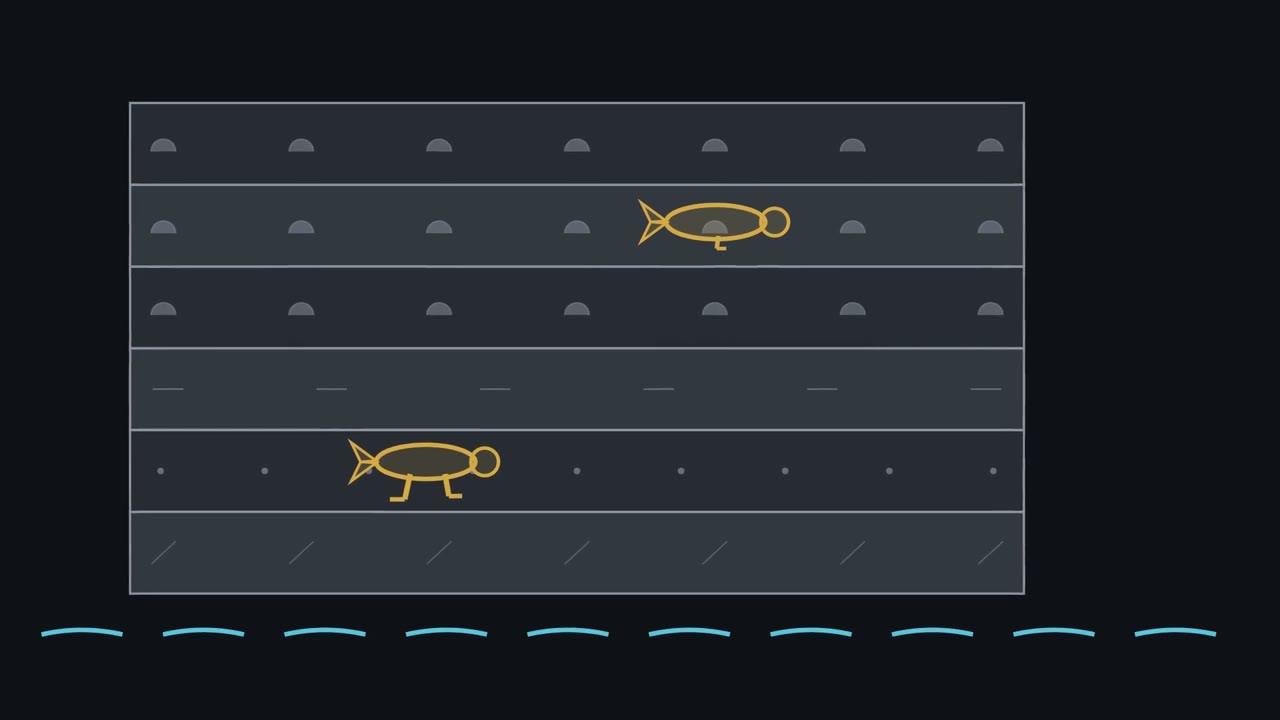
They are vestigial: reduced parts that have lost all or most of the job they did in ancestors. Vestigial does not mean useless. In males, these bones anchor muscles used in mating. Development supplies a fourth test. A spotted dolphin embryo begins hind-limb buds. The signals that keep a limb growing switch off early or never appear. The buds stop and break down. The embryo is not replaying its ancestors. Now bring the lanes together. Gold fossils show change through time. Blue DNA places whales on a mammal branch. Green anatomy and teal development preserve inherited patterns. Different methods fit one history. Agreement is not certainty, and each test has limits.
Fossil sequences do not identify direct parents. Similarity matters only for comparable DNA. A useful structure can still record ancestry. A scientific theory is a tested explanation that connects many observations. Evolution predicts related patterns before each evidence lane is opened. Confidence grows when those patterns appear across methods, not because any label says proof. Each method could have pointed to another history. Instead, their patterns agree within their limits.
Independent evidence that agrees strengthens an explanation of common descent.
If whales live their whole lives in water, why do some fossil whales have legs, and why do living whales still carry small hip bones?
Continue in the lesson: Evidence for Evolution →
3:42 · Free, with captions and a transcript. The lesson has the full text, the questions and the sources.
More films from this lesson
How this film was made. Narration: an AI narrator voice (Kokoro, af_heart) reading narration written from this lesson's text. Animation: AI-generated in code (Manim) by Claude, a schematic with no drawn molecular structures. Captions come from the narration script. See something wrong? Report it.